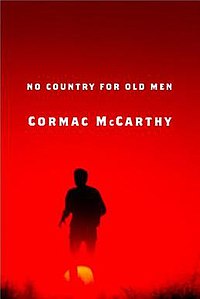
I
enjoy stories with villians. A good villain is a fully developed
character and not just a background entity, not just an obscure presence
prompting the “good” characters onward. While Chigurh is obviously the
bad character, it is less clear if Llewelyn Moss is the good character.
The voice of peacekeeper, Sheriff Ed Tom Bell, is conflicted as well.
Llewelyn
finds the remains of a drug deal gone wrong. He grabs the cash and
makes a dash. Chigurh pursues relentlessly with the passion of a zealot
who believes in what he’s doing. Others give chase including the law and
the lawless. In the end, it is not money that drives the characters. It is principle and will.
McCarthy
has a way of exploring good and evil that is only possible by exploring
violence -- minds that are violent by nature and violent acts that lie
dormant in any average person and erupt given the right circumstances.
Chigurh is unusual because he is morally
demented as opposed to morally corrupt. He does not necessarily take
pleasure in violence but he is committed to violence nonetheless. He is
not altogether illogical either which is the scary part. His mind is
functioning properly. He is not “insane” in the sense that he lacks the
ability to reason. He has reasoned and found himself at odds with
traditional views of morality and the sacredness of life.
The
novel is sparse in language and, while I found it easier to read than
All the Pretty Horses or The Road, No Country for Old Men is less
linguistically beautiful. It is also significantly less violent than The
Road (which won the Pulitzer) and moves much faster than All the Pretty Horses. It’s a good middle-of-the-road McCarthy read so if you’re new
to his novels I would say start with No Country for Old Men and see if
you can handle forays into dark psyches and violent behaviors.
Publisher: Vintage, 2005. Pages 309
Rating: 3 Stars Source: used bookstore
Monday, October 22, 2012
Friday, September 21, 2012
Review: Nation by Terry Pratchett
The beginning of Nation gripped me. I loved the alternate-reality Victorian setting that’s introduced. The narrative quickly shifts to an alternate-reality Pacific island. Mau is on a quest to prove his manhood when the tsunami strikes and obliterates his village and the prim and proper Daphne is stranded on his island. I enjoyed Daphne’s sea voyage and the entire crash scene.
Together, Mau and Daphne rebuild the Nation as they overcome their fears of one another, take in refugees and learn to work with each other. The novel became increasingly introspective as Mau reconsiders all the old ways and worship of the old gods. As the new leader, he must decide how to direct his people and as truths are uncovered he learns that letting go of the past is not the same as disrespecting it.
My interest waned significantly in the middle. I just wasn’t interested in the story anymore and the underlying ideological message of questioning “the way things have always been done” and “the things we’ve always believed” was so transparent that I just got bored. However, the serious minded teen may enjoy this thought-provoking YA novel. This book counts towards the POC Reading Challenge!
Publisher: HarperCollins, 2009 Pages: 384
Rating: 3 Stars Source: Public Library
Together, Mau and Daphne rebuild the Nation as they overcome their fears of one another, take in refugees and learn to work with each other. The novel became increasingly introspective as Mau reconsiders all the old ways and worship of the old gods. As the new leader, he must decide how to direct his people and as truths are uncovered he learns that letting go of the past is not the same as disrespecting it.
My interest waned significantly in the middle. I just wasn’t interested in the story anymore and the underlying ideological message of questioning “the way things have always been done” and “the things we’ve always believed” was so transparent that I just got bored. However, the serious minded teen may enjoy this thought-provoking YA novel. This book counts towards the POC Reading Challenge!
Publisher: HarperCollins, 2009 Pages: 384
Rating: 3 Stars Source: Public Library
Friday, July 13, 2012
Owly: The Way Home and the Bittersweet Return by Andy Runton
Owly is a popular graphic novel at my library. I had to place a hold on it and I took that as a good sign, that kids must really like this book. I was not disappointed.
An unlikely friendship forms between an owl and a worm. Together, they search for Wormy's home and parents. In the second adventure, they befriend a pair of hummingbirds. Both stories focus on friendship as they help each other out of tough situations. Owly is particularly sensitive to his friends' needs. It's impossible not to love him.
Owly is nearly wordless but I was impressed with how Runton conveyed conversations and emotions. I "heard" their conversations in my head even though there weren't any words on the page. Instead of text, the speech bubbles hold pictures and other symbols. The artwork is skillful in conveying meaning. The simplest strokes, like the arch of an eyebrow, tell readers if Owly is thinking, scared, happy, etc. So, while there isn't much traditional text, I found I was scrutinizing the pictures and reading everything -- expressions, gestures, background and the "speech" bubbles. I'm not used to paying so much attention to the pictures but I really enjoyed doing so with Owly.
Owly is a great book to read with a young child to ask him/her "What's going on in this picture?" or "What are they saying now?" to help encourage a child's narration skills and to draw on their vocabulary to describe what's happening on the page.
The artwork is as cute as the story. Runton's cartoon-like style and the brief use of text will appeal to reluctant readers and graphic novel readers. An innocent tale of friendship, I thoroughly enjoyed Owly.
Publisher: Top Shelf Productions, 2004. Pages: 160
Rating: 4 Stars Source: Public Library
An unlikely friendship forms between an owl and a worm. Together, they search for Wormy's home and parents. In the second adventure, they befriend a pair of hummingbirds. Both stories focus on friendship as they help each other out of tough situations. Owly is particularly sensitive to his friends' needs. It's impossible not to love him.
Owly is nearly wordless but I was impressed with how Runton conveyed conversations and emotions. I "heard" their conversations in my head even though there weren't any words on the page. Instead of text, the speech bubbles hold pictures and other symbols. The artwork is skillful in conveying meaning. The simplest strokes, like the arch of an eyebrow, tell readers if Owly is thinking, scared, happy, etc. So, while there isn't much traditional text, I found I was scrutinizing the pictures and reading everything -- expressions, gestures, background and the "speech" bubbles. I'm not used to paying so much attention to the pictures but I really enjoyed doing so with Owly.
Owly is a great book to read with a young child to ask him/her "What's going on in this picture?" or "What are they saying now?" to help encourage a child's narration skills and to draw on their vocabulary to describe what's happening on the page.
The artwork is as cute as the story. Runton's cartoon-like style and the brief use of text will appeal to reluctant readers and graphic novel readers. An innocent tale of friendship, I thoroughly enjoyed Owly.
Publisher: Top Shelf Productions, 2004. Pages: 160
Rating: 4 Stars Source: Public Library
Friday, June 22, 2012
Review: Breakfast at Tiffany's by Truman Capote
I love the movie Breakfast at Tiffany's and I enjoyed the movie Capote with Philip Seymour Hoffman. So, I figured I needed to read Capote's novella that inspired Breakfast at Tiffany's. And I loved it. If you need a plot summary click here.
Fantastic prose. First person narration doesn't really describe it. It's chock full of conversation which is not what I tend to associate with "literature." But this is the good stuff. The conversations are interesting because they reveal the way Holly's world works -- the way she works, the way 1950s New York society works and how people perceive other people. Also, they're funny conversations -- unusual and witty.
How people perceive other people... I think this is why I enjoyed "Fred's" narration so much. He's not really telling us a story about himself like most first person narrators do. He doesn't droll on about his own feelings (interesting though they are). He's telling us Holly's story -- she's the main character and "Fred" is just the one to tell us about her. The fact that we never know "Fred's" real name drives home this point for me. "Fred's" perspective is limited to his direct and indirect encounters with Holly and information passed through the grape vine. As a result, Holly is something more than a character in a book. She's that person we all knew once or maybe catch glimpses of in ourselves. "Fred's" narration makes me wonder: Am I who I think I am or, am I who others think am I? Which is the truer perspective? The narration works well in establishing both "Fred" and Holly's characters and their relationship and is a technique I haven't really encountered before (or noticed if I have).
On the surface, Breakfast at Tiffany's is about a quirky girl who obeys her own ambiguous set of rules. But I found this book is really about getting to know someone -- encountering a person who is special, unusual and magnetizing but also evanescent, elusive and fragile. That's Holly Golightly. The reader goes through this social experience with "Fred," getting to know Holly with him.
I'll leave you with one of my favorite passages with O.J. and "Fred" talking, O.J. speaking first...
"So," he said, "what do you think: is she or ain't she?"
"Ain't she what?"
"A phony."
"I wouldn't have thought so."
"You're wrong. She is a phony. But on the other hand you're right. She isn't a phony because she's a real phony. She believes all this crap she believes" (28-29).
Publisher: Modern Library, 1994 (originally, 1958) Pages: 3-105 (of 161)
Full Title: Breakfast at Tiffany's: A Short Novel and Three Stories
Rating: 5 Stars Source: Public Library
Fantastic prose. First person narration doesn't really describe it. It's chock full of conversation which is not what I tend to associate with "literature." But this is the good stuff. The conversations are interesting because they reveal the way Holly's world works -- the way she works, the way 1950s New York society works and how people perceive other people. Also, they're funny conversations -- unusual and witty.
How people perceive other people... I think this is why I enjoyed "Fred's" narration so much. He's not really telling us a story about himself like most first person narrators do. He doesn't droll on about his own feelings (interesting though they are). He's telling us Holly's story -- she's the main character and "Fred" is just the one to tell us about her. The fact that we never know "Fred's" real name drives home this point for me. "Fred's" perspective is limited to his direct and indirect encounters with Holly and information passed through the grape vine. As a result, Holly is something more than a character in a book. She's that person we all knew once or maybe catch glimpses of in ourselves. "Fred's" narration makes me wonder: Am I who I think I am or, am I who others think am I? Which is the truer perspective? The narration works well in establishing both "Fred" and Holly's characters and their relationship and is a technique I haven't really encountered before (or noticed if I have).
On the surface, Breakfast at Tiffany's is about a quirky girl who obeys her own ambiguous set of rules. But I found this book is really about getting to know someone -- encountering a person who is special, unusual and magnetizing but also evanescent, elusive and fragile. That's Holly Golightly. The reader goes through this social experience with "Fred," getting to know Holly with him.
I'll leave you with one of my favorite passages with O.J. and "Fred" talking, O.J. speaking first...
"So," he said, "what do you think: is she or ain't she?"
"Ain't she what?"
"A phony."
"I wouldn't have thought so."
"You're wrong. She is a phony. But on the other hand you're right. She isn't a phony because she's a real phony. She believes all this crap she believes" (28-29).
Publisher: Modern Library, 1994 (originally, 1958) Pages: 3-105 (of 161)
Full Title: Breakfast at Tiffany's: A Short Novel and Three Stories
Rating: 5 Stars Source: Public Library
Friday, June 15, 2012
Review: Deadlocked by Charlaine Harris
I discovered the Sookie Stackhouse series (Southern Vampire Mysteries) last fall and whizzed through 11 of the novels. They were pure fun to read and not my usual fare. I recall I was in "the curve" of the semester, where the newness had worn off, and I needed a mental snack break. The Sookie Stackhouse series was just the pick-me-up I needed.
Heretofore, the mystery in each story has held my attention. But in Deadlocked the mystery lagged a bit. The who-done-it was obvious and the suspense of watching the culprit outed wasn't as suspenseful as I'd liked. Sookie's relationship status didn't help much either. She's waiting for him to commit. He's waiting for her to commit. Lots of distrust. The novel is aptly named -- Deadlocked. Everyone is waiting for someone else to make the first move.
Several story lines fizzle out in this novel which makes for a downer read. Many of my favorite characters do put in appearances so that was nice. And Harris' writing style is fluid and makes for an easy, fun reading experience. There were answers in this novel but few conclusions...I guess that's why it's a series!
If you like Southern Vampire stories I recommend the series. Neither romance nor mystery are my usual reading choices but I have enjoyed Harris' characters and sense of humor and have picked up a few books from her other mystery series (non-vampire related) to read.
Publisher: Ace, 2012 Pages: 336
Rating: 3 Stars Source: public library
Heretofore, the mystery in each story has held my attention. But in Deadlocked the mystery lagged a bit. The who-done-it was obvious and the suspense of watching the culprit outed wasn't as suspenseful as I'd liked. Sookie's relationship status didn't help much either. She's waiting for him to commit. He's waiting for her to commit. Lots of distrust. The novel is aptly named -- Deadlocked. Everyone is waiting for someone else to make the first move.
Several story lines fizzle out in this novel which makes for a downer read. Many of my favorite characters do put in appearances so that was nice. And Harris' writing style is fluid and makes for an easy, fun reading experience. There were answers in this novel but few conclusions...I guess that's why it's a series!
If you like Southern Vampire stories I recommend the series. Neither romance nor mystery are my usual reading choices but I have enjoyed Harris' characters and sense of humor and have picked up a few books from her other mystery series (non-vampire related) to read.
Publisher: Ace, 2012 Pages: 336
Rating: 3 Stars Source: public library
Tuesday, June 12, 2012
Review: A Confusion of Princes by Garth Nix
Taken from his parents as a toddler, Khemri was groomed to be a Prince of the Empire -- a biologically, technologically and psychologically upgraded human, one of thousands who rule the Empire, governed only by the Imperial Mind. Having come of age, Khemri is elated to take a post as Prince. But the Empire is a more dangerous place than he was lead to believe and power and glory more elusive and less thrilling than he expected.
The book begins with a great hook: “I have died three times, and three times been reborn...” (1). Nix quickly introduces the technologically advanced world via Khemri’s voice. He tells his story of transformation from an obnoxious and egotistical teen (an gross exaggeration of teenagers generally?) to a more thoughtful, mature adult. As with Nix’s Abhorsen series, I enjoyed how the protagonist deals with real coming-of-age issues, albeit in a sci-fi setting here. Khemri’s transformation is that of many teens’. While Khemri may fight his battles in a spaceship, his transformation from identity/thrill-seeking teen to a more mature adult is relatable.
I was excited to read A Confusion of Princes as I am a fan of Nix’s Abhorsen/Old Kingdom series. I’m re-listening to Lirael now. I enjoyed the hierarchy within the Empire with its unique system of mental communication. Yet, the novel could have used another hundred pages. The plot moved too swiftly and didn’t leave time to explore this interesting world and its characters. As a survival story, A Confusion of Princes did not disappoint. But more character development was needed.
On an aside, Khemri’s character is repeatedly defined as being brown-skinned with dark eyes. Yet, the character on the cover, though hard to see clearly, looks to be white. I like the cover on its own but would have liked it more if the guy on the cover clearly represented the character in the book.
Nix fans won’t want to miss A Confusion of Princes with its unique, technologically advanced world. Khemri’s story will please teens who enjoy Star Wars, space operas and survival stories. Overall, I think I’m more of a fantasy fan than science fiction fan but I still enjoyed this story. This book counts towards the POC Challenge. Favorite Quote: "'There is always a choice,' said Morojal. 'Even if the alternatives don't appear to be equal'" (134). Publisher: HarperCollins, 2012 Pages: 337 Rating: 3 Stars Source: Public Library
The book begins with a great hook: “I have died three times, and three times been reborn...” (1). Nix quickly introduces the technologically advanced world via Khemri’s voice. He tells his story of transformation from an obnoxious and egotistical teen (an gross exaggeration of teenagers generally?) to a more thoughtful, mature adult. As with Nix’s Abhorsen series, I enjoyed how the protagonist deals with real coming-of-age issues, albeit in a sci-fi setting here. Khemri’s transformation is that of many teens’. While Khemri may fight his battles in a spaceship, his transformation from identity/thrill-seeking teen to a more mature adult is relatable.
I was excited to read A Confusion of Princes as I am a fan of Nix’s Abhorsen/Old Kingdom series. I’m re-listening to Lirael now. I enjoyed the hierarchy within the Empire with its unique system of mental communication. Yet, the novel could have used another hundred pages. The plot moved too swiftly and didn’t leave time to explore this interesting world and its characters. As a survival story, A Confusion of Princes did not disappoint. But more character development was needed.
On an aside, Khemri’s character is repeatedly defined as being brown-skinned with dark eyes. Yet, the character on the cover, though hard to see clearly, looks to be white. I like the cover on its own but would have liked it more if the guy on the cover clearly represented the character in the book.
Nix fans won’t want to miss A Confusion of Princes with its unique, technologically advanced world. Khemri’s story will please teens who enjoy Star Wars, space operas and survival stories. Overall, I think I’m more of a fantasy fan than science fiction fan but I still enjoyed this story. This book counts towards the POC Challenge. Favorite Quote: "'There is always a choice,' said Morojal. 'Even if the alternatives don't appear to be equal'" (134). Publisher: HarperCollins, 2012 Pages: 337 Rating: 3 Stars Source: Public Library
Friday, June 8, 2012
Review: Dead End in Norvelt by Jack Gantos
For a book about a kid being grounded all summer, Dead End in Norvelt by Jack Gantos, is surprisingly touching and funny. Jack Gantos’ character in the book (yes, he writes about himself), while mischievous, maintained an honest voice throughout the novel, enduring him to me, making me laugh.
Jack helps his elderly neighbor, Miss Volker, write obituaries as she is physically incapable of doing so. An unlikely relationship forms between them. Having an older person in a child’s life is such a gift. Though Jack is skeptical of Miss Volker at first, he comes to realize his great fortune at having her for a mentor. Miss Volker shows Jack what he’s truly capable of and what it means to be a friend.
Somewhat tedious are the history lessons that accompany the obits Jack and Miss Volker write. It wasn’t that the histories weren’t interesting but I wanted to get back to the story and having so many obits written so closely together...it got slow. The history lessons felt like just that -- history lessons. As a kid, I probably wouldn’t have finished the book because of these history bits.
As an adult, I forged through the histories and was rewarded with a satisfying if somewhat far-fetched ending. I enjoyed the caught-in-the-middle relationship Jack has with his parents. He can’t please one without getting in serious trouble with the other. One sympathizes. The town's citizens were colorful and Jack's interactions with them humorous. I laughed out loud several times and recommend this book be read aloud (as it was to me to my great enjoyment).
Publisher: Farrar, Straus and Giroux, 2011 Pages: 352
Rating: 4 Stars Source: Public Library
Jack helps his elderly neighbor, Miss Volker, write obituaries as she is physically incapable of doing so. An unlikely relationship forms between them. Having an older person in a child’s life is such a gift. Though Jack is skeptical of Miss Volker at first, he comes to realize his great fortune at having her for a mentor. Miss Volker shows Jack what he’s truly capable of and what it means to be a friend.
Somewhat tedious are the history lessons that accompany the obits Jack and Miss Volker write. It wasn’t that the histories weren’t interesting but I wanted to get back to the story and having so many obits written so closely together...it got slow. The history lessons felt like just that -- history lessons. As a kid, I probably wouldn’t have finished the book because of these history bits.
As an adult, I forged through the histories and was rewarded with a satisfying if somewhat far-fetched ending. I enjoyed the caught-in-the-middle relationship Jack has with his parents. He can’t please one without getting in serious trouble with the other. One sympathizes. The town's citizens were colorful and Jack's interactions with them humorous. I laughed out loud several times and recommend this book be read aloud (as it was to me to my great enjoyment).
Publisher: Farrar, Straus and Giroux, 2011 Pages: 352
Rating: 4 Stars Source: Public Library
Tuesday, June 5, 2012
Review: North and South by Elizabeth Gaskell
I recently re-watched BBC’s North and South miniseries (2004) and liked it so well I downloaded the book to my kindle and began reading. This is one of the few times I felt the film adaptation was better than the book.
North and South tells the story of the Margaret Hale whose father, because of his conscience, leaves the ministry and relocates his family to the northern manufacturing town of Milton. Margaret languishes in Milton’s smog, missing friends while caring for an ailing parent. The only society to be found is with Milton’s elite tradesmen of whom Margaret thinks little. Meanwhile, Milton’s workmen go on strike (relatively novel in the mid 1800s as factory work was fairly new), causing trouble and unrest for the entire town.
Where Gaskell lost me is with the general characterization of Margaret. She’s too perfect. For instance, she tells one lie (to ensure someone’s safety) and, because she was caught in her lie by the man she cares about, she hates herself. With 20/20 hindsight, Margaret feels her lie was unnecessary and totally wrong and can’t get over the fact that her love interest thinks ill of her because he knows she lied. The self-loathing went on for far too many pages (and months in the story). Margaret: Girl, an innocent life was at stake so you told a lie. So what if that guy knows you lied. If he doesn’t care to understand the whole story, and you can’t bare to tell him, then move on.
Margaret Hale: misunderstood angel. Blah.
Where the novel was interesting was in the class conflict. Interactions between Margaret’s (demoted) family, the elite tradesmen and the workmen fueled the plot. I enjoyed the fiery conversations between Mr. Thornton (factory owner/love interest) and Margaret. I liked her spunk in speaking her opinion about the treatment of workmen as well as Mr. Thornton’s personal story. I’m not sure if they ever agree completely but they do influence each other enough to consider the other’s point of view.
Despite my frequent frustration with Margaret, I enjoyed Gaskell’s writing and her ability to weave a multi-layered story. It has a recognizable pattern (romance) but creates enough tension between characters to keep one reading to see their reactions. Though a friend of Charlotte Bronte’s, Gaskell’s writing lacks the darker shades of her friend’s writing. North and South does not explore the power struggle between Margaret and Mr. Thornton as well as it could have and like we see between Bronte’s Jane Eyre and Mr. Rochester. Yet, North and South was not a light book as it took the manufacturing strike seriously. There was really no humor at all (missing Jane Austen’s wit) and so this novel fizzled out for me.
Give me passion and action or at least some intelligent humor (shoot, any humor) but not this “oh, no. He thinks me a fallen woman!” crap. The miniseries is excellent. The book is for die-hard Victorian novel lovers who, like myself, will find some level of enjoyment in the cultural aspect of the story as much or more than the supposed romance. It was a struggle to finish but I’m glad I did.
Have you seen the movie or read the book? Both? What do think?
Publisher: Kindle Edition, 2009 (First published: 1855) Pages: 499
Rating: 3 Stars Source: free on Amazon
North and South tells the story of the Margaret Hale whose father, because of his conscience, leaves the ministry and relocates his family to the northern manufacturing town of Milton. Margaret languishes in Milton’s smog, missing friends while caring for an ailing parent. The only society to be found is with Milton’s elite tradesmen of whom Margaret thinks little. Meanwhile, Milton’s workmen go on strike (relatively novel in the mid 1800s as factory work was fairly new), causing trouble and unrest for the entire town.
Where Gaskell lost me is with the general characterization of Margaret. She’s too perfect. For instance, she tells one lie (to ensure someone’s safety) and, because she was caught in her lie by the man she cares about, she hates herself. With 20/20 hindsight, Margaret feels her lie was unnecessary and totally wrong and can’t get over the fact that her love interest thinks ill of her because he knows she lied. The self-loathing went on for far too many pages (and months in the story). Margaret: Girl, an innocent life was at stake so you told a lie. So what if that guy knows you lied. If he doesn’t care to understand the whole story, and you can’t bare to tell him, then move on.
Margaret Hale: misunderstood angel. Blah.
Where the novel was interesting was in the class conflict. Interactions between Margaret’s (demoted) family, the elite tradesmen and the workmen fueled the plot. I enjoyed the fiery conversations between Mr. Thornton (factory owner/love interest) and Margaret. I liked her spunk in speaking her opinion about the treatment of workmen as well as Mr. Thornton’s personal story. I’m not sure if they ever agree completely but they do influence each other enough to consider the other’s point of view.
Despite my frequent frustration with Margaret, I enjoyed Gaskell’s writing and her ability to weave a multi-layered story. It has a recognizable pattern (romance) but creates enough tension between characters to keep one reading to see their reactions. Though a friend of Charlotte Bronte’s, Gaskell’s writing lacks the darker shades of her friend’s writing. North and South does not explore the power struggle between Margaret and Mr. Thornton as well as it could have and like we see between Bronte’s Jane Eyre and Mr. Rochester. Yet, North and South was not a light book as it took the manufacturing strike seriously. There was really no humor at all (missing Jane Austen’s wit) and so this novel fizzled out for me.
Give me passion and action or at least some intelligent humor (shoot, any humor) but not this “oh, no. He thinks me a fallen woman!” crap. The miniseries is excellent. The book is for die-hard Victorian novel lovers who, like myself, will find some level of enjoyment in the cultural aspect of the story as much or more than the supposed romance. It was a struggle to finish but I’m glad I did.
Have you seen the movie or read the book? Both? What do think?
Publisher: Kindle Edition, 2009 (First published: 1855) Pages: 499
Rating: 3 Stars Source: free on Amazon
Thursday, May 31, 2012
Outlander Read-A-Long Participation Post
I've wanted to participate in another read-a-long for some time (my last being Northanger Abbey). And I've wanted to read Outlander by Diana Gabaldon for some time. Now's my chance to do both! I started Outlander long ago and read about 50 pages (where she time travels) before returning the book to the library. Since then, I've picked up the first two books in the series from the library's discard shelf. So, I'm ready to read!
Sign up at The Reading House Wives if you'd like to participate. The read-a-long runs June 11th to July 23rd and I'll be posting, as instructed, every Monday about the book.
Subscribe to:
Posts (Atom)


