Showing posts with label social issues. Show all posts

Saturday, December 28, 2013

Review: My Sister Lives on the Mantelpiece by Annabel Pitcher

This was possibly the best book I’ve read in years. I rarely give a “5 Star” status but didn't even have to think about it. There were many reasons for me NOT to like this book. It’s contemporary fiction (I’m drawn to fantasy). It’s about “depressing” subjects, it’s akin to a “problem novel,” which I tend to find forced with see-through agendas taking on too many issues. But I loved this book. It wasn’t forced, it was genuine. Not depressing, but uplifting.

When children ask questions, and adults won't or can’t answer, they are left to make their own assumptions about life. Ten-year-old Jamie has a lot of questions and the first person narration captures his observations.

His older sister, Rose (a twin), died five years before the novel begins in a London terrorist attack. Jamie can hardly remember Rose, but his family has fallen apart because of the loss. His father harbors fear and hate for Muslims and holds onto his grief, forcing it onto others. His mother has checked out and left the family. His older sister, Jas, does her best to make sure Jamie knows he is cared for.

What shined was Jamie’s relationship with his classmate and best friend, Sunya, who wears a hijab to school. Though this relationship is a risk for Jamie (how furious would his father be if he knew?), it is Sunya who strengthens Jamie’s spirit when he is at his lowest. She sticks up for him, plays into his fascination with superheros and even calls Jamie out when he acts like a fair-weather friend.

Jamie’s belief that things can get better and that friendship is important carry this book. He loves his family despite their glaring problems and takes action, doing the best a 10-year-old can, to make things better. I laughed and I cried in no small part to Annabel Pitcher’s writing but also because of David Tennant’s amazing narration. Just fantastic.

The mantelpiece, the hearth, is supposed to be the center of home which conjures feelings of warmth and belonging, love and security. But in Jamie’s home, his dead sister lives on the mantelpiece and her ghostly presence looms large, scattering all positive emotions. But with help from Sunya and Jas, Jamie finds a way to make his presence known and remind a family what it means to be family. 

Though targeted at middle-grade readers, I'd recommend this book to anybody. Anybody! <3

Publisher: Findaway World, 2012     Length: 6 hours
Rating: 5 Stars     Source: Public Library

Sunday, March 31, 2013

Review: Superman Versus the Ku Klux Klan by Rick Bowers

Rick Bowers weaves two seemingly disconnected histories, the creation and immense popularity of Superman with the long and disturbing history of the Ku Klux Klan, to produce a surprising story of how the entertainment industry promoted social justice. The two narratives are brought together when the the Adventures of Superman radio show uses its national popularity to combat the pervasive influence of the KKK in its 1946 “Clan of the Fiery Cross” episodes. 

Bowers provides a brief but insightful history of the KKK, its beginning after the Civil War, and cycle of influence in the U.S. Alternating chapters discuss the modest beginnings of Superman and his rise from comic book to radio show to T.V. and the silver screen. Though not a deep exploration of either subject I learned a lot about both. And so did the teens who read this book in my discussion group.

My book group teens were surprised by the long history and real power the KKK exercised. They also enjoyed the chapters about Superman and how a couple of teenagers were responsible for his creation. In book discussion, we listened to the first episode of the “Clan of the Fiery Cross” (below) and laughed at the Kellogg’s cereal commercials as well as the out-of-date insults used by the teens. They found it hard to believe that millions of kids tuned into this show just because it sounds so cheesy to us today.

Many reviews I’ve read recommend this book for late elementary and middle school readers. Both my teens and I strongly disagreed. This is a great book for high school students and I recommend it for a history class. Bowers shows the significance of using primary sources when doing research as he debunks myths about the broadcast’s use of KKK code words (which Wikipedia still says is true!). The text is dry. I wanted to learn about the subject but it was often simply boring. The original photographs opening each chapter offered little relief. When I asked my teens who would enjoy this book they said: Anyone really interested in Superman or general U.S. history. When asked what age it was for they said: high school students and adults. They were shocked anyone would recommend this to younger students or to reluctant readers. I would add that this is a good choice for a teen who doesn’t care for fiction.

Overall, this is a thumbs up. I learned a lot. My book group teens did, too. We had a great discussion about primary versus secondary sources. We also made a pro con list of who was the better superhero: Superman or Batman. It was an enthusiastic debate.


Publisher: National Geographic Society, 2012     Pages: 160
Rating: 3.5 Stars     Source: Public Library
Full Title: Superman Versus The Ku Klux Klan: The True Story of How the Iconic Superhero Battled the Men of Hate

Tuesday, June 5, 2012

Review: North and South by Elizabeth Gaskell

I recently re-watched BBC’s North and South miniseries (2004) and liked it so well I downloaded the book to my kindle and began reading. This is one of the few times I felt the film adaptation was better than the book.

North and South tells the story of the Margaret Hale whose father, because of his conscience, leaves the ministry and relocates his family to the northern manufacturing town of Milton. Margaret languishes in Milton’s smog, missing friends while caring for an ailing parent. The only society to be found is with Milton’s elite tradesmen of whom Margaret thinks little. Meanwhile, Milton’s workmen go on strike (relatively novel in the mid 1800s as factory work was fairly new), causing trouble and unrest for the entire town.

Where Gaskell lost me is with the general characterization of Margaret. She’s too perfect. For instance, she tells one lie (to ensure someone’s safety) and, because she was caught in her lie by the man she cares about, she hates herself. With 20/20 hindsight, Margaret feels her lie was unnecessary and totally wrong and can’t get over the fact that her love interest thinks ill of her because he knows she lied. The self-loathing went on for far too many pages (and months in the story). Margaret: Girl, an innocent life was at stake so you told a lie. So what if that guy knows you lied. If he doesn’t care to understand the whole story, and you can’t bare to tell him, then move on.

Margaret Hale: misunderstood angel. Blah.

Where the novel was interesting was in the class conflict. Interactions between Margaret’s (demoted) family, the elite tradesmen and the workmen fueled the plot. I enjoyed the fiery conversations between Mr. Thornton (factory owner/love interest) and Margaret. I liked her spunk in speaking her opinion about the treatment of workmen as well as Mr. Thornton’s personal story. I’m not sure if they ever agree completely but they do influence each other enough to consider the other’s point of view.

Despite my frequent frustration with Margaret, I enjoyed Gaskell’s writing and her ability to weave a multi-layered story. It has a recognizable pattern (romance) but creates enough tension between characters to keep one reading to see their reactions. Though a friend of Charlotte Bronte’s, Gaskell’s writing lacks the darker shades of her friend’s writing. North and South does not explore the power struggle between Margaret and Mr. Thornton as well as it could have and like we see between Bronte’s Jane Eyre and Mr. Rochester. Yet, North and South was not a light book as it took the manufacturing strike seriously. There was really no humor at all (missing Jane Austen’s wit) and so this novel fizzled out for me.

Give me passion and action or at least some intelligent humor (shoot, any humor) but not  this “oh, no. He thinks me a fallen woman!” crap. The miniseries is excellent. The book is for die-hard Victorian novel lovers who, like myself, will find some level of enjoyment in the cultural aspect of the story as much or more than the supposed romance. It was a struggle to finish but I’m glad I did.

Have you seen the movie or read the book? Both? What do think?

Publisher: Kindle Edition, 2009 (First published: 1855)     Pages: 499
Rating: 3 Stars     Source: free on Amazon

Thursday, March 29, 2012

Review: Moon Over Manifest by Clare Vanderpool


Stories. Every day we tell each other stories. We read them, listen to them and share them with others. Stories take many forms: people “catching up,” movies and T.V. shows, music, video games, dirty footprints in the house and, of course, books. Rich in its layers, Moon Over Manifest shows how we are our histories and all our stories are connected.

Can you ever really understand a person or even a place until you know its story?

Abilene and her father, Gideon,  lived the life of hobos, hopping on and off trains until he found work. But now Abilene is too old to be drifting. So, Gideon sends Abilene to stay in Manifest, Kansas with people he knew long ago...

Abilene is looking for stories: a hidden box, with letters and trinkets, reveals a story central to who the townspeople of Manifest are; the story of the Ratler, an unknown townsperson acting as a spy, that Abilene and her friends try to reveal; Miss Sadie the diviner has stories to tell if only someone will listen. Abilene knows these stories are important but the story she most wants to hear is the story of her father who once lived in Manifest. What kind of person is her father? Why did he send her away to live with strangers? Is he coming back for her?

Moon Over Manifest reminds me of the movie Fried Green Tomatos (one of my all-time favorites) in a couple ways. Like the movie, the story is set in the Depression Area. Moon Over Manifest also shifts between the past (in the letters and through Miss Sadie’s stories) and the present as (Abilene narrates her experience in Manifest). The flashbacks take us to the town of Manifest during World War One while Abilene’s story takes place in Manifest during the 1930s. This switching technique worked well and I loved the flashbacks.

Stories are central to the human experience. We can’t always remember raw facts and data. But we can remember stories. They evoke emotion, sympathy and empathy. Stories explain the facts and help us make sense of them. Stories help us remember and help us share memories. Remember when dad did.... Remember when your sister... We’ve all heard stories like these, haven’t we? Stories bind us together and so we tell them over and over.

Stories connect people and I think that’s what Moon Over Manifest shows. No matter how different the townspeople are, no matter their country of origin, their wealth or social class, age or gender, everyone's stories are connected.

While marketed as a children’s book, Moon Over Manifest is nuanced and Vanderpool is an excellent writer. The prose is enjoyable as are the many characters. Adults as well as children will appreciate this work. I highly recommend it!

Publisher: Yearling, 2011 (paperback copy)     Pages: 351
Rating: 5 Stars     Source: purchased copy

Saturday, March 10, 2012

Review: Glory Be by Augusta Scattergood

It's the summer of 1964 in Hanging Moss, Mississippi and things are a changin'.

Town Council Man, James Smith, is against desegregation. So, he shuts down the community pool “for repairs.”

Glory’s birthday is the Fourth of July and she’s always had her party at the community pool...until this year. She unknowingly enters the fray as she outspokenly denounces the decision to close the pool.

Laura Lampert’s a Yankee whose mother is starting a freedom clinic in Hanging Moss. Friends are few for a white girl who drinks from the “coloreds only” drinking fountain.

Frankie Smith is caught between his family’s hatred and his friends’ readiness for change. Bullied into doing what’s wrong separates Frankie from his friends all summer.

Miss Bloom, Hanging Moss Librarian, refuses to be bullied and invites the entire town, black and white, to a celebration at the library. 

Emma is more than Glory’s family’s maid. She’s a “freedom fighter” who shelters activists at her home and bravely attends the library’s celebration as one of the few African Americans who do. 

Glory Be has be likened to The Help and I think it’s a good analogy though the two are different in presentation. In The Help, readers see events through many characters’ eyes with each chapter presenting a different character’s point of view. In Glory Be it is Glory’s voice that is the strongest and the book is written from her point of view. The strength in Glory’s point of view is that readers get a distinct feel for what is was like for a white child to participate in the Civil Rights Movement in the South. The other characters are shown how a child would understand them. Adults’ actions are often confusing to Glory and in her innocence she attempts to set them straight. Slowly, Glory begins to understand the implications of what’s going on around her. 

The story goes beyond the Civil Rights Movement and explores a young girl growing up. The relationship between Glory and her teenage sister, Jesslyn, is in flux and I enjoyed watching that relationship change. Their father is a reverend who is somewhat distant as he deals with professional duties. Emma is a stand-in mother to the girls but not there all day. Glory has learned to turn to her sister for support and friendship but now her sister is distancing herself from Glory, desiring more privacy and "grown-up" activities. 

Change is hard -- even good change. Glory Be was an enjoyable story about friendship and family during the Civil Rights Movement. Though I wished Emma’s voice had been louder this is ultimately a story about a white child’s experience and perspective and one well worth reading. This book counts towards the POC Reading Challenge!

Publisher: Scholastic Press, 2012     Pages: 202
Rating: 4 Stars     Source: Free Uncorrected Proof  (paperback)

Tuesday, August 2, 2011

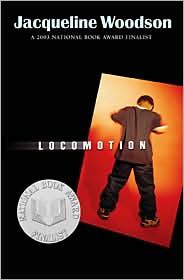
Review: Locomotion by Jacqueline Woodson

After Lonnie's parents died he and his sister live in separate foster homes. Lonnie uses writing assignments in school to cope. The result is a short novel in verse -- a book of poems that tells a story. Lonnie deals with some heavy stuff for an eleven year old. Grief, loss, separation, loneliness and uncertainty are a few of the themes. But Lonnie also talks of hope and his affection for his sister.

The poems are short, ranging from three lines to a little over a page. From free verse to Haiku there is a variety of poetry Lonnie experiments with to express what he sees, feels and remembers. Locomotion would make great teaching material to use as examples of poetry. The book may also appeal to elementary kids who are ready to move beyond strictly rhyming and silly poems (not that there anything wrong with silly rhyming poems!).

From my perspective, Locomotion was a little sad and ended abruptly. There is a follow up novel called Peace Locomotion in which Lonnie writes letters to his sister. For such a short book it took me a long time to read. The text was often introspective. I don't think I was in the mood for it. Yet, I would recommend this text to kids interested in poetry or for someone looking for a book about grieving. This text counts towards to the POC Reading Challenge

Publisher: Speak, 2003     Pages: 100
Rating: 3 Stars     Source: Public Library

Saturday, May 7, 2011

Review: Claudette Colvin: Twice Toward Justice by Phillip M. Hoose

The Montgomery Bus Boycott of 1955 protested racial segregation. You probably remember Rosa Parks who refused to give up her seat on the bus, BUT did know it was a 15-year-old girl who started it all? A year before Rosa took her now famous seat, Claudette Colvin, acting entirely on her own and fed up with racial segregation, refused to move for a white passenger. Claudette was drug off the bus while shouting "It's my constitutional right!" She was jailed that night and eventually testified "as a key plaintiff in Browder v. Gayle, the landmark case that struck down the segregation laws of Montgomery and swept away the legal underpinnings of the Jim Crow South.

The structure of this book is amazing and to take full advantage of it I highly recommend reading the hardback. The photographs are in black and white and several take up full pages. They give readers a glimpse into how racial segregation affected lives in the South. There are several photos of Claudette and her family, too. Separated from the main text are black boxes offering extra information that the reader can choose to skip over, continuing with the story, or stop to read to learn more about issues and people introduced in the text.

Claudette's bravery, her struggle for justice, once on the bus and again in court, as a teenager no less, is inspiring as much as it is informational. Claudette's story is an excellent choice for middle schoolers, or anyone, looking to learn about the Civil Rights Movement and how one person really can make a difference.

Publisher: Farrar, Strause and Giroux, 2009     Pages: 144
Rating: 4.5 Stars     Source: Purchased Copy

Tuesday, February 8, 2011

Review: The Dismissal of Miss Ruth Brown by Louise S. Robbins

History, what we know of the past, is often told by the victors. Having transcribed countless interviews, faithfully scoured dusty files and coils of microfilm, Louise S. Robbins forms a more complete account of Ruth Brown’s career as a librarian. The text is a scholarly endeavor to bring about a more accurate picture of a “perfect town” that wasn’t so perfect after all. It’s a true story about racism and about standing up for what you believe. About censorship and the public library’s role towards it at a critical time in American history.

An abbreviated summary: “In 1950 Ruth W. Brown, librarian at the Bartlesville Public Library, was dismissed from her job after thirty years of exemplary service, ostensibly because she had circulated subversive materials. In truth, however, Brown was fired because she was active in a group affiliated with the Congress of Racial Equality.”

If you are interested in the civil rights movement, information and library science, libraries generally, censorship or American history I definitely recommend this book to you. It is told like an elongated form of investigative journalism and tends to be fact heavy. What I most enjoyed about Ruth Brown’s personality was how, despite her appearance, she was anything but a stereotypical librarian (especially for her day).


Publisher: University of Oklahoma Press, 2001     Pages: 256
Rating: 3 Stars     Source: purchased

Wednesday, May 5, 2010

The Help by Kathryn Stockett

By now, what has not been said about this number one, top selling novel? That’s more of a statement than a question. I doubt I can say anything that hasn’t been said before. My hope is that if you haven’t read The Help you’ll beg it off your friend, get in the hold line at your library or break down and purchase it because why? Because it is worth it. I know some people have a few complaints that run along the lines of: the ending was anti-climatic or the dialect bothered them. Some more serious complaints are that it’s just one more bash on Mississippi. Even if you finish and wonder what all the fuss is about I promise you won’t be disappointed that you read it.

I wasn’t sure what this book was about when I decided to buy it. I knew it was set in the Southern U.S. during the 1960s and there was something about a lot of women afraid to follow after whatever it was they wanted. And that there would be racial issues thrown in there. This is a terrible summary. However, not knowing what I was in for left me deliciously and delightfully surprised. I didn’t expect to become engrossed by a maid’s daily life. I didn’t expect to laugh out loud on several occasions. I didn’t expect to learn and this novel enlightened me about how complicated the civil rights movement was for many different (but not so different) people.

This book was a pleasure to read. As a rule, I don’t mind dialect but I find it slows my pace down. Truly though, I savored every page. The story alternates between three women’s point of view: one young white woman, one middle-aged black maid and one not-quite-old black maid. I adored all the voices but Aibileen’s (the eldest’s) was my favorite. There is so much tension, anxiety and fear in these women’s lives because of their desire to tell the truth. I felt nervous for them and kept hoping they’d find a way to iron out the wrinkles (hehe. Aibileen hates ironing pleats). I feel this book is a must read for those living in the U.S., perhaps especially my 20-something generation who have grown up in a different era and have little understanding of what daily life was like in the South during the 1960s.

So, I have this great thing called a public library. And mine hosted the author, Kathryn Stockett, who stopped by on her way to the Windy City to speak, read and sign our books! Hearing her speak was a blast. If you have the opportunity to see her, do it! She spoke a bit about her anxieties being a white woman writing in the voice of black women. Stockett had a black maid growing up and this book is her way of expressing many of the things she has learned about what life was like for the help. In case you’re curious, she said two of her favorite authors are Lee Smith and Kaye Gibbons (among many others). She has an awesome southern accent! And in response to a question said that no, she is not Skeeter (the young white protagonist), that she was never as brave as Skeeter or able to ask those kinds of difficult questions when she was a child. I think she was rather brave to write this story, though. Ms. Stockett was gracious enough to let me take my picture with her so, there we are. Now, go get yourself a copy of The Help and settle in for a good read.
Publisher: Amy Einhorn Books, 2009     Pages: 451
Rating: 5 Stars                                             Source: Purchased on Amazon

Wednesday, February 10, 2010

The Girl Who Fell from the Sky by Heidi W. Durrow

I was drawn to this novel after reading the description: a girl with a white, Danish mother and an African-American father, struggles with her cultural identity in the U.S. At once, it reminded me of Harlem Renaissance writer Nella Larsen’s Quicksand published in 1928. The story background is nearly identical. So, I was curious to see how Durrow would build on Larsen’s classic. Fast-forward sixty years and the basic plot of Quicksand is as culturally relevant (and personally relevant for Durrow) as it was when Larsen wrote her novel.

The Girl Who Fell from the Sky is set in the 1980s and broken into two parts. The first lingers on the childhood of Rachel, the bi-racial protagonist with beautiful blue eyes and creamy dark skin that sets her apart from everyone she knows. Each chapter is written from the view point of a different character. Fitting together several first person narratives made the story much more personal than a traditional third person narrator. Part two brings all the characters full-circle. We watch Rachel try on her “whiteness” and “blackness” until she comes to terms with her heritage and her family.

If you’re familiar with Quicksand you may remember that Helga Crane’s story is similar to Rachel’s. However, Helga’s story ends with an observation – that the time for women of color to be free hasn’t quite come. And it wasn’t until the 1960s that black women’s suffrage rights were upheld throughout the country. The Girl Who Fell ends on a note of hope – people who love Rachel are always telling her she can be what she wants to be, do what she wants to do. And in this way at least we can trust that Rachel's story is true – that things have changed enough to give us hope. This is a coming-of-age story that shows the struggle of growing up outside of preconceived conventions about race. We see this story from every angle: the white mother, the black father, the neighbor boy, the boss and the aunt – which adds an important dimension to this narrative.

Heidi Durrow’s first novel, The Girl Who Fell from the Sky, is an impressive accomplishment. I was skeptical at first, being familiar with Larsen’s novel, but Durrow did not disappoint. I enjoyed the narrative structure and the prose captured the atmosphere perfectly. If you're wondering what the title and cover picture have to do with the book well, they’re part of the mystery and tension that surround Rachel's life. Follow along as Rachel pieces her life together to make sense of it all.
Publisher: Algonquin Books of Chapel Hill, 2010      Recommended Age: 16+
Source: IC Public Library                                                   Pages: 264
Rating: 4.5 Stars                                                                  More on this author at: http://heidiwdurrow.com/

Monday, February 1, 2010

Flight by Sherman Alexie

Put on your seatbelts, you’re in for a ride. Flight takes the reader through time and space on a journey of reflection. Prepare to be transported, living brief moments in the bodies of other people. Encounter the famous and forgotten of the past. Struggle with the choices you are faced with as the character is. While body-swapping, you’ll experience the memories and emotions of white men and Indian men – feeling their rage, grief, fears and loves. When thrown in the middle of a battle, how do you decide who the good guys are? What would you kill for? Flight offers pause in a world of Hollywood violence. None of this reflection, however, slows down the plot. It moves along swiftly with the humor I’ve come to expect from this author. Once again, Alexie makes me laugh and cry on the same page. I think you will too.
Rating: 4 stars                                        
Publisher: Black Cat, copyright 2007     Pages: 181
Source: Iowa City Public Library            More on this author at: http://www.fallsapart.com/