Showing posts with label nonfiction. Show all posts

Sunday, March 31, 2013

Review: Superman Versus the Ku Klux Klan by Rick Bowers

Rick Bowers weaves two seemingly disconnected histories, the creation and immense popularity of Superman with the long and disturbing history of the Ku Klux Klan, to produce a surprising story of how the entertainment industry promoted social justice. The two narratives are brought together when the the Adventures of Superman radio show uses its national popularity to combat the pervasive influence of the KKK in its 1946 “Clan of the Fiery Cross” episodes. 

Bowers provides a brief but insightful history of the KKK, its beginning after the Civil War, and cycle of influence in the U.S. Alternating chapters discuss the modest beginnings of Superman and his rise from comic book to radio show to T.V. and the silver screen. Though not a deep exploration of either subject I learned a lot about both. And so did the teens who read this book in my discussion group.

My book group teens were surprised by the long history and real power the KKK exercised. They also enjoyed the chapters about Superman and how a couple of teenagers were responsible for his creation. In book discussion, we listened to the first episode of the “Clan of the Fiery Cross” (below) and laughed at the Kellogg’s cereal commercials as well as the out-of-date insults used by the teens. They found it hard to believe that millions of kids tuned into this show just because it sounds so cheesy to us today.

Many reviews I’ve read recommend this book for late elementary and middle school readers. Both my teens and I strongly disagreed. This is a great book for high school students and I recommend it for a history class. Bowers shows the significance of using primary sources when doing research as he debunks myths about the broadcast’s use of KKK code words (which Wikipedia still says is true!). The text is dry. I wanted to learn about the subject but it was often simply boring. The original photographs opening each chapter offered little relief. When I asked my teens who would enjoy this book they said: Anyone really interested in Superman or general U.S. history. When asked what age it was for they said: high school students and adults. They were shocked anyone would recommend this to younger students or to reluctant readers. I would add that this is a good choice for a teen who doesn’t care for fiction.

Overall, this is a thumbs up. I learned a lot. My book group teens did, too. We had a great discussion about primary versus secondary sources. We also made a pro con list of who was the better superhero: Superman or Batman. It was an enthusiastic debate.


Publisher: National Geographic Society, 2012     Pages: 160
Rating: 3.5 Stars     Source: Public Library
Full Title: Superman Versus The Ku Klux Klan: The True Story of How the Iconic Superhero Battled the Men of Hate

Thursday, March 21, 2013

The Midwest: God's Gift to Planet Earth by Mike Draper

The Midwest, the heartland, fly-over country: this is my home.

“Like most foreign countries, outsiders have heard of it, but the details of what goes on inside are pretty hazy” (19). So says Mike Draper, narrator of The Midwest: God’s Gift to Planet Earth!

The Midwest gets overlooked. People really don’t seem to know what we do here and so assume that we don’t do much of anything but grow corn. Well, there’s quite a bit that goes on here, let me tell ya!

With the zippy wit and humor a t-shirt shop owner (yes, he really does run a t-shirt shop in Des Moines), Draper enlightens readers of the glory of the Midwest. It really is a surprising place. Sure, there’s stuff to complain about but every region of the U.S. has its baggage. Draper focuses on the positive, though, he does poke fun at Midwestern stereotypes. From famous people and inventions to geography and the weather, this book gives a brief and biased overview of the 12-state region.

Midwesterners will get a kick out of reading this book. But for those who’ve never spent time in the Midwest, if you are guilty of overlooking the heartland (gasp!), and are looking for a fun read, then I recommend this “Illustrated Guide to the History and Culture of the Galaxy’s Most Important Region.” 

Publisher: RAYGUN, 2012     Pages: 239
Rating: 4 Stars     Source: Public Library

Saturday, February 11, 2012

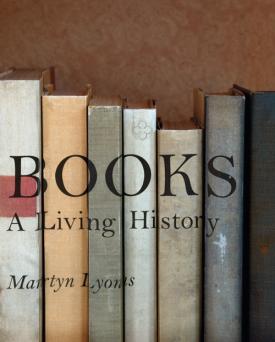
Review: Books: A Living History by Martyn Lyons


Attention Book Lovers! Are you interested in the creation of “the book?” Are you curious about its future at a time when ebooks are gaining popularity? In this fascinating and wonderfully illustrated tome, Martyn Lyons chronicles the development and status of the book.

More than a tribute to the codex (what we recognize as a book with two covers, a spine and paper in between), Lyons looks at how books have come into being -- the reasons people  bothered to write things down, how books were treated and the technological changes that made new formats possible. He covers ancient texts like cuneiform tablets and Chinese bamboo books to the rise of modern publishing houses, genres, the mass marketing of books and finally ebooks.

Lyons creates a flowing account of the book’s history that is easily digested. The photographs of artifacts, rare books, paintings and people that appear on nearly every page make a rich and visually appealing reading experience. If you would like to be a book aficionado as well as book lover then may I suggest Books: A Living History.

Publisher: Getty, 2011     Pages: 224
Rating: 5 Stars     Source: purchased copy

Wednesday, July 27, 2011

Review: In Stitches by Anthony Youn, M.D.

Tony was raised to be a doctor. His parents would except nothing less. Growing up as one of two Asian-American kids in a small town wasn't easy. Neither was medical school. In Stitches is a lighthearted memoir about Tony's progression from awkward child to confident doctor. 

The first of five parts covers Youn's premed years: birth-college. He recounts many failed attempts at gaining a girlfriend. The rejections begin piling up. Like most kids, he struggles with his looks and as his jaw juts out it sabotages his lustful ambitions. The text focuses on his attempts to score and until he finds a steady girlfriend the story is more about chasing skirts than becoming a doctor. About a third of the way through, once Youn finds said girl, the text focused much more on his medical school days which was what kept my attention. For all the emphasis on finding a girlfriend I would have liked a bit more about their relationship. We really don't know anything about her.

Things get dicey and interesting in part 4, "Third Year," where Youn recounts the "highlights" of clinical rotations. He encounters interns from hell, detached cool-as-a-cucumber doctors, horrible trauma and quirky surgeons. Tony is drawn to plastic surgery and ends his last year in school working with plastic surgeons around the country. 

Youn tells the story as one looking back, who's breathed a sigh of relief that those grueling years of med school are behind him. One can only imagine what a current medical student might write -- a whoa-is-me type of journal. But Youn's memoir is light and funny. This text counts towards to the POC Reading Challenge!

Publisher: Gallery Books, 2011     Pages: 271     Written with Alan Eisenstock
Rating: 3.5 Stars     Source: Won from Crazy-for-Books. Thanks, Jen!

Wednesday, June 15, 2011

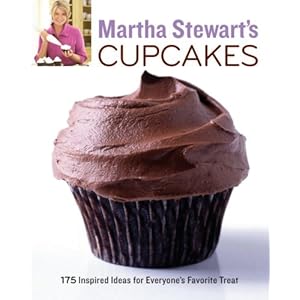
Review: Martha Stewart's Cupcakes

Mmm, cupcakes. They're cute and taste good! Who doesn't like a cupcake? The pictures below are of cupcakes I made using recipes and decoration ideas from Martha Stewart's Cupcakes.

All recipes are from scratch. Except for a few decorative candies, the marzipan and fondant, this book will teach you how to make everything in your own kitchen. No box mixes!

While having fancy equipment is nice it's not necessary to make the cakes and frosting. I own a Sunbeam mixer (with a wonky beater) and find I can still make my frosting stiff or fluffy - whichever I need. If you want to do the fun and fancy frosting decorations you will need a piping bag and tips. I bought a 12 piece Wilson set and find I can make everything so far in the book. The frosting is most of the fun and I recommend getting some tips, even if just a few, so you can swirl and peak and make petals. Having an offset spatula facilitates doing frosting like on the book cover but you can always use a butter knife. Picture: White and Devil's Food cupcakes with Swiss Meringue Buttercream in roses and peaks.


Buy the best quality of ingredients as your budget allows because these cakes are meant to be delicious! If you skimp you could run into problems. For instance, I used chocolate chips once instead of baker's chocolate and the frosting was very disappointing. I learned my lesson! If it says use cake flour, not regular flour, buy the cake flour, etc. These recipes are for gourmet (but doable) cake so don't waste your time and money on the wrong ingredients! That being said, I only use imitation vanilla when it calls for the real deal. The only ingredient I've had trouble finding is marzipan. Picture (above): Devil's Food cupcakes with Swiss Meringue Buttercream for grass and marzipan for ladybugs. Tip: don't do frosting with sweaty hands or the frosting will melt in your piping bag and refuse to form well. Also, these were outside in June so, the "grass" looks dewy. Picture (left): Banana-Pecan w/ Swiss Meringue Buttercream (chocolate version gone wrong) and fondant monkey faces.

The instructions are thorough and easy to follow. I am never left guessing. The writing is clear and there is a helpful section, The Basics, in the back on baking tools, ingredients, cookies, frosting, presentation ideas and templates, ingredient sources, and an index. The recipes are grouped as follows: Swirled and Sprinkled, Filled and Layered, Piped and Topped, Birthdays, Holidays, and Celebrations. Each has at least one full-page color photo of the finished cupcakes and several other photos show how to make frosting and decorations. Picture: One-Bowl Chocolate cupcakes with Swiss Meringue Buttercream as beetles and butterflies. Cake not recommended for humid days. The wings were difficult to cut, with lots of crumbs, as the cake was super moist.

Total times for making these cakes ranges from two to six hours depending on the complexity of the cake and frosting and how many you make. There is truly a cake for every occasion. I began baking not knowing what I was doing and am getting better with each try. There's really no reason to be intimidated by any of the recipes. It is totally possible to make parts at a time - bake the cakes and refrigerate/freeze them one day then make the frosting the next.

I'm not a Martha Stewart junky at all. I've only seen parts of her show. Yet, I've enjoyed baking these cakes and will keep making more from this book. The cakes are always a big hit. You won't go wrong with Martha Stewart's Cupcakes!
 
Picture (above): Applesauce-Spice cupcakes with Brown-Sugar Cream-Cheese Frosting. Picture (right): Yellow Buttermilk cupcakes with Swiss Meringue Buttercream as pigs. Picture (below): Black Forest Cupcake with sweet pastry cream (inside), cherries and chocolate ganache!


Publisher: Clarkson Potter, 2003     
Pages: 352
Full Title: Martha Stewart's Cupcakes: 175 Inspired Ideas for Everyone's Favorite Treat
Source: Christmas Gift
Rating: 4.5 Stars     

Thursday, June 2, 2011

Review: Neither Here Nor There: Travels in Europe by Bill Bryson

Reading Bill Bryson’s Neither Here Nor There was a new step for me as a reader. I have entered the realm of the travelogue. As my first read in the genre I cannot readily compare this book to others like it nor have I read Bryson before. There were things I liked and things I loathed about this book so bare with me.

The text starts out strong, as Bryson explores Hammerfest, Oslo and Paris. It was a rough start to his journey and for these fifty pages I was laughing out loud. Actually, I read this section aloud to my mom. Bryson’s journey to Hammerfest revived memories of our foreign travels and we cracked up to Bryson’s sarcastic and self-deprecating sense of humor.

The next seventy pages were pure tedium as Bryson recounts mostly negative experiences and impressions while visiting several Germanic countries. The text also gravitated towards lewd jokes based off Bryson’s observations of trashy magazines, porn and such which simply did not interest me. Naked people can be found anywhere. One needn’t go to Europe to find them. This paired with his negative impressions caused the middle to drag.

Finally, Bryson breaks his route early and heads to Italy where his experience and the text became much more enjoyable. I enjoyed his Roman holiday having spent a week there myself. It was fun reliving some of the sights through the text and makes me want to go back.

The book is nearly twenty years old and while the ancient splendor of Europe remains some things have changed. For instance, the Euro has replaced country-specific currency which Bryson used. So, if you’re looking for up-to-date information this book is not what you need. Yet, if you want a feel for what an average American might experience while traveling in Europe, Bryson’s book may be for you.

Publisher: Perennial, 1992     Pages: 254     
Rating: 2.5 Stars     Source: purchased copy  

Friday, May 13, 2011

Review: The History of Mary Prince: A West Indian Slave, Related by Herself edited by Moira Ferguson

Mary Prince was born a slave in Bermuda (a British colony) around 1788. She became the first black women to escape to England (blacks were “free” as long as they stayed on English soil) and this account about her journey from slavery to freedom is as fascinating and inspiring as it is horrifying.

The History of Mary Prince is a rich narrative, in the genre of slave narratives, which is focused on enlightening readers on the brutal nature of slavery. Along the way, Mary’s narrative gives interesting accounts of salt harvesting in the West Indies, the politics of both the anti- and pro-slavery moments, and the precarious role of black women in the 19th century. Mary’s narrative is multi-layered. Since she could not write, Mary’s story was transcribed by another women. Mary’s editor, Mr. Pringle, was also the secretary for the Anti-slavery society and Mary’s employer in whose house she lived. With this knowledge, gaps arise in The History, little idiosyncrasies that appear to be censored or altered in some way that will make Mary’s story palatable to its intended audience.

The marginalia make The History absolutely fascinating. Moira Ferguson’s excellent introduction sheds light on English and West Indian politics that influenced Mary, her many owners and the the making of her narrative. Also, Pringle’s short preface and lengthy supplement prove the intensity of the anti-slavery campaign. In the appendix, Ferguson includes copies of newspaper articles of two court cases surrounding The History and other contemporary events which influenced the abolition of slavery in the West Indies in 1833. 

Those interested in slave narratives should put The History of Mary Prince at the top of their list. Also, those interested in the making of history through narrativity, autobiographies, black women narratives and British history will appreciate this text. This book counts towards the POC Reading Challenge!

Publisher: University of Michigan Press, 1997     Pages: 173
Rating: 5 Stars     Source: Purchased Copy

Saturday, May 7, 2011

Review: Claudette Colvin: Twice Toward Justice by Phillip M. Hoose

The Montgomery Bus Boycott of 1955 protested racial segregation. You probably remember Rosa Parks who refused to give up her seat on the bus, BUT did know it was a 15-year-old girl who started it all? A year before Rosa took her now famous seat, Claudette Colvin, acting entirely on her own and fed up with racial segregation, refused to move for a white passenger. Claudette was drug off the bus while shouting "It's my constitutional right!" She was jailed that night and eventually testified "as a key plaintiff in Browder v. Gayle, the landmark case that struck down the segregation laws of Montgomery and swept away the legal underpinnings of the Jim Crow South.

The structure of this book is amazing and to take full advantage of it I highly recommend reading the hardback. The photographs are in black and white and several take up full pages. They give readers a glimpse into how racial segregation affected lives in the South. There are several photos of Claudette and her family, too. Separated from the main text are black boxes offering extra information that the reader can choose to skip over, continuing with the story, or stop to read to learn more about issues and people introduced in the text.

Claudette's bravery, her struggle for justice, once on the bus and again in court, as a teenager no less, is inspiring as much as it is informational. Claudette's story is an excellent choice for middle schoolers, or anyone, looking to learn about the Civil Rights Movement and how one person really can make a difference.

Publisher: Farrar, Strause and Giroux, 2009     Pages: 144
Rating: 4.5 Stars     Source: Purchased Copy

Saturday, March 19, 2011

Review: Young Adult Literature: From Romance to Realism by Michael Cart

Michael Cart’s latest work chronicles the development of young adult literature from its recognition in the 1960s to its present boom in the 21st century. Expanding upon his 1996 edition, Cart includes new discussions about poetry, nonfiction, graphic novels, audiobooks and the role of young adult literature in a multimedia age. Cart showcases various breakthrough texts and awards in the category revealing his role as an expert in and contributor to young adult literature.   

In “That Was Then,” the first of two sections, Cart and investigates how cultural shifts influenced YA lit in the 1960s-1990s. Realism emerged in issue-oriented/problem novels like Robert Cormer’s The Chocolate War.  But many were plagued by formulaic plots and imitation in the late 70s. Cart perceives “the problem novel is to YA what soap operas are to good dramas” (32). Eventually, readers rejected the problem novel and to some extent realistic fiction.

Providing escape, romance dominated most of the 80s and one can sense Cart’s dismay as problem novel sales plummeted  in the early 90s.  Cart blames sensational TV (like Jerry Springer) for reality’s unpopular status in literature. In part two, “This Is Now,” Cart explores the rise of new genres and formats in the 21st century. He delves into the Harry Potter phenomenon and consequent appeal of crossover novels.

Clearly Cart prefers darker, edgier literary titles, which he believes reflect reality. Whether this is true or not, his zeal for young adult literature is impossible to escape. Pointing out YA lit awards, such as the Printz Award which he helped create, Cart continuously reveals how libraries help shape and are shaped by young adult literature. Cart leaves the reader pondering creative formats which champion realism such as nonfiction graphic novels and photoessays. The text provides a comprehensive history of young adult literature and is an insightful and often humorous text. It is likely to interest MLIS students, current practitioners interested in improving readers’ advisory skills to young adults or those doing literary studies.  If you’re looking to understand how YA literature is created today there’s no better way than to study its history in From Romance to Realism.

Publisher: ALA, 2020     Pages: 242
Rating: 4.5 Stars     Source: U of Iowa Libraries

Saturday, February 26, 2011

Review: Bad News for Outlaws by Vaunda Micheaux Nelson

This book was awesome! Gun fights, chases, escapes! Indians, cowboys and slaves. Hardship, justice and honor. It’s the Wild West folks and this is the true story of a slave who became a U.S. deputy Marshal. His name is Reeves. Bass Reeves. And he is Bad News for Outlaws!

This is nonfiction done right. I loved the art work (looks like oil paintings) and the story was fascinating. Both totally captured the spirit of the old West. Many of the text blocks look like they are printed on yellowed paper. The font looks Western, too, big and bold. R. Gregory Christie’s illustrations capture the emotion of each moment being described. Bass’ gaze is piercing. There’s no messing with that man. 

This is well researched book and it shows. There are many amazing anecdotes pieced together from historical records. There are extra resources in the back including a glossary of Western terms used in the book, a timeline, a further reading list and much more.

I was completely captivated with Bass’ story. Although it’s aimed at 2nd-5th grade readers, if you know anyone who enjoys all things Western I urge you to put this book in their hands. This title counts towards the POC Reading Challenge! Well, this was a hard review to write. I just wanted to use the word "awesome" over and over! 

Publisher: Carolrhoda, 2009     Pages: 40     Illustrator: R. Gregory Christie
Full Title: Bad News for Outlaws: The Remarkable Life of Bass Reeves, Deputy U.S. Marshal
Rating: 5 Stars     Source: IC Public Library

Sunday, February 20, 2011

Review: Snowflake Bentley by Jacqueline Briggs Martin

From gently falling flakes and flurries, to swirling gusts and mounting drifts, snow-falls always look beautiful. One of the first crafts I remember doing in school is creating cut-out snowflakes. Sometimes a flake will stick to a window and you can see it’s sort of pokey looking. But then it blows away, or worse, melts.

This beautifully illustrated children’s book chronicles the work of Willie Bentley, the man who showed us the snowflake. Bentley loved snow so much he dedicated his free time to studying it. He perfected the photographic technique needed to capture snowflakes on film so that the whole world could see how beautiful they are. He knew that seeing a single flake under a microscope wasn’t good enough. He wanted their crystal-like beauty to last and be enjoyed by all.

Illustrator Mary Azarian’s woodcuts set a perfect tone for Martin’s text. Together, they remind me a time gone by. A time my grandparents knew. A time that can still be found in the quiet of a gentle snow-fall. I enjoyed how the text was displayed with more biographical or technical details in sidebars and the general story-line at the bottom. As a reluctant reader in my youth, I really liked books like this (thinking Magic School Bus) where the text was broken up. I could choose what to read and keep moving on if I thought it was “too much text.” I enjoyed going back later and discovering more parts to the story.

As winter comes to a close and the last of the snow is melting remember Snowflake Bentley’s passionate efforts. I know snow can seem a bother. But if you didn’t this year, remember next winter to take a moment to enjoy the beauty that is a snowflake. 

Publisher: Houghton Mifflin, 1998     Pages: 32
Rating: 4.5 Stars     Source: Christmas gift! Thanks, Mom!

Tuesday, February 8, 2011

Review: The Dismissal of Miss Ruth Brown by Louise S. Robbins

History, what we know of the past, is often told by the victors. Having transcribed countless interviews, faithfully scoured dusty files and coils of microfilm, Louise S. Robbins forms a more complete account of Ruth Brown’s career as a librarian. The text is a scholarly endeavor to bring about a more accurate picture of a “perfect town” that wasn’t so perfect after all. It’s a true story about racism and about standing up for what you believe. About censorship and the public library’s role towards it at a critical time in American history.

An abbreviated summary: “In 1950 Ruth W. Brown, librarian at the Bartlesville Public Library, was dismissed from her job after thirty years of exemplary service, ostensibly because she had circulated subversive materials. In truth, however, Brown was fired because she was active in a group affiliated with the Congress of Racial Equality.”

If you are interested in the civil rights movement, information and library science, libraries generally, censorship or American history I definitely recommend this book to you. It is told like an elongated form of investigative journalism and tends to be fact heavy. What I most enjoyed about Ruth Brown’s personality was how, despite her appearance, she was anything but a stereotypical librarian (especially for her day).


Publisher: University of Oklahoma Press, 2001     Pages: 256
Rating: 3 Stars     Source: purchased

Thursday, February 3, 2011

Writing Reviews for Readers' Advisory by Brad Hooper

In Writing Reviews for Readers' Advisory Brad Hooper, the Adult Books Editor at Booklist, offers new and aspiring book reviewers pertinent advice for writing reviews that people want to read. He describes the difference between reviews and criticism and in which setting each is appropriate. In today’s busy book industry, knowing what new books have to offer is invaluable to librarians and booksellers. Pre and postpublication reviews are how book providers and book readers make many of  their selections.

Emphasis is placed on writing short (around 175 word), concise, prepublication reviews meant to advise book providers. No matter the length, Hooper gives several enlightening tips on what a good review should include. For instance, Hooper advises that a good review “judges a book only against others of its ilk” (48). In other words, don’t judge a book by Danielle Steel by comparing it to one by Edith Wharton. Each author is a leader in her own genre and deserves to be compared to herself, to her own works. Good advice, right? There’s more where that came from though at times I wished Hooper went a little deeper.

Writing reviews is tricky and challenging. How do you write a review for a book you didn’t like? What aspects of a book should you highlight? Keep in mind Hooper’s advice is meant for writers reviewing for a specific audience with specific needs and not book blogging. However, I’ll be attempting to apply Hooper’s advice as I continue learning how to review. The next step according to Hooper is to read books, read reviews and write!

Publisher: American Library Association, 2010     Pages: 96
Rating: 4 Stars     Source: ILL through UI Libraries

Friday, November 5, 2010

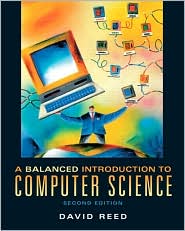
Review: A Balanced Introduction to Computer Science, 2nd ed. by David Reed

Have you ever been curious how exactly your computer works? Maybe you’d like to learn a little HTML to have more control over your blog or website? Are you a tiny bit intimidated to learn anything “technical”? Fear no more! Computer Science introduces the basics of computers and computer language and is geared for beginners. You won’t need anything extra, no fancy software, just your computer with a Web browser like Internet Explorer or Firefox. Having Internet access will help but isn’t completely necessary.

This is a textbook so expect each chapter to read like a lesson. There are exercises, some explained and some which challenge you to put new concepts to work on your own. I liked the hands on approach of the textbook and really, diving in and doing the assignments is the only way to really know how to use HTML and JavaScript in your Web Pages. Instead of memorization this book encourages experience.

What will you learn from this book? 
  • The basic architecture of modern computers (like how on earth a computer “remembers” anything) 
  • HTML basics to create Web Pages 
  • The history of computers 
  • The history of the Web (which is not the same thing as the Internet) 
  • JavaScript basics for creating interactive Web Pages
  • Algorithm basics – what are they and how they are used in computers
I don’t think this text makes a great reference book. It’s really for instruction. There are only a few times I felt the instructions weren’t very clear. In these cases the assignments began to assume great familiarity with the material already covered. So, keep up with the exercises! I did like the online resources available, for free, to supplement the text. Often, Reed asks you to access Web sites he's created for instruction so you can see the HTML/JavaScript and build off it.

I’ve used the word “basic” many times. If you’re looking to roll up your sleeves and become a Web designer or computer scientist this text may be too simple for you. But, if you’re a beginner like me, A Balanced Introduction to Computer Science is a good place to begin.

Publisher: Pearson, 2008     Pages: 342 (380 to the index)
Rating: 3.5 Stars     Source: Purchased on Amazon 
P.S. I read this book for a MLIS class.

Thursday, September 30, 2010

Review: The Impostor's Daughter: A True Memoir by Laurie Sandell

The graphic novel is a format I’ve discovered in the past year. The complexity and skill which graphic novelists posses ranges from simple and flat to extraordinarily moving. If you haven’t read a graphic novel before I urge you to give them a try.

“Laurie Sandell grew up in awe – and sometimes in terror – of her larger-than-life father. A former Green Beret with a law degree, a Ph.D, and fluency in several languages… Beguiled and repelled by his outrageous behavior, she grew into a young woman as restless as her father, roaming the globe, trying on her outsized personalities – Tokyo striper, seducers of Yeshiva girls, yogi, Ambien addict.”

This first part of The Impostor's Daughter was jaw-dropping. It was hard to believe the mind games going on in her family. Sandell’s father sounds like a fictional character which is probably why she inserted “true” into the title, just to emphasize that these events actually happened to her.

At times, I didn’t know who I disliked more – Laurie, her father or her mother. I don’t mean to sound harsh. I think Sandell means for the reader to see how selfishly everyone, including herself, behaves. She is honest about her incredible need to be loved by her father which leads her to attempt to be someone just as crazy sounding as her dad is. It’s a roller coaster ride.

“Laurie finally lucked into the perfect job: interviewing celebrities for a top women’s magazine. Growing up with her extraordinary father gave her a knack for relating to the stars… Yet even after meeting so many of entertainment’s most intriguing people, it was her father she still desperately wanted to understand. Her Investigation uncovered a staggering secret: her father wasn’t the man he had always claimed to be, not even close.”

So, you may be thinking, how could anyone ever believe her father was telling the truth? Those are some big claims he makes, after all. There are lots of red flags that make Laurie question him, but within this family dynamic, the truth is buried so deep that it takes all the strength she can muster to uncover it.

While she tries to figure out who her father really is, Laurie must face her own demons as well. She checks herself intro rehab (a place which Ashley Judd recommended to her) and realizes that obsessing over her father has lead her down a path she doesn’t want to follow anymore. It takes a lot of guts, but she confronts her father, her mother and her own addictions.

It may seem a little cheesy, the whole rehab bit, but hey, this is a real person’s life and I’m glad she found a way to deal with the craziness around her.

And this was the good part – she finds a way to forgive and let go of her anger even when it’s totally justified. This is what made the book stand out for me.

I’m not an artist so take this with a grain of salt: I wasn’t too impressed with the drawings. The story flowed really well and I didn’t have trouble following the story-board. But the artwork was flat. It did not add to the story in the way I’ve come to expect from graphic novels. However, I did appreciate the bright colors and style. So, while the art may leave graphic novel connoisseurs unimpressed the story was still worthwhile.
Publisher: Little, Brown and Company, 2009 – All quotes are from the dust jacket cover.
Source: I won this book from Zia!
Parent alert: there are several nude scenes so it may not be appropriate for young children
Rating: 3.5 Stars      Pages: 247

Thursday, September 23, 2010

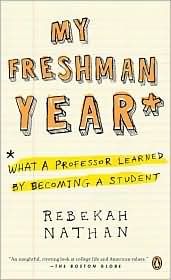
Review: What a Professor Learned By Becoming a Student by Rebekah Nathan

As someone who’s had a wide range of experiences with different educational institutions (see my about me page), I find this memoir/study to be perceptive and reflective of my undergraduate experience. My non-traditional background left me feeling like an “outsider” to mainstream American college culture and I could identify with several of Nathan’s findings of how “outsiders” are perceived and treated. Many of Nathan’s perceptions are, incidentally, not flattering. And I think this is why I’ve read so many upset and negative reviews by college students for this book (which I find unwarranted).


But before I get carried away, here's an abbreviated summary from Shelfari: "After fifteen years of teaching anthropology at a large university, Rebekah Nathan had become baffled by her own students. Their strange behavior—eating meals at their desks, not completing reading assignments, remaining silent through class discussions—made her feel as if she were dealing with a completely foreign culture. So Nathan decided to do what anthropologists do when confused by a different culture: Go live with them. She enrolled as a freshman, moved into the dorm, ate in the dining hall, and took a full load of courses".


First of all, Nathan does not submit this book as “proof” or as a sound study. She recognizes upfront the limitations of her investigations and realizes that in the end, her freshman year was a personal experience that may or may not be indicative of college life across the board. This point is reiterated several times. However, this does not mean Nathan doesn’t make good observations. She shares the view of an outsider looking in. So, if your college prof. assigned this book and you don’t think its “academic” enough, that’s not Nathan’s fault. It’s your prof.’s for assigning it. Something to keep in mind.

So, why should you read this book and who should read it? Anyone interested in educational institutions like college-bound high schoolers, professors (especially those who find themselves dismayed with their students), students, and those interested in cultural studies should read this book because it holds a mirror up to our faces. And sometimes that’s what we need.

This isn’t investigative journalism. Nathan isn’t out to get “the scoop,” nasty secrets or expose outlandish behaviors. We’re all aware of the antics that go on around campus. Rather, it’s a sincere investigation to understand the berth between college students and their professors. It attempts to find out why students act the way they do, how they manage academic demands with cultural and social demands. Nathan has attempted to get inside the freshman mindset. She was often surprised to find herself engaging in behaviors she saw her own students do and wondered why they did. Her freshman experience gave her an appreciation for her students and informed her teaching strategies when she returned to professorhood.

I don’t know how much longer this book will be relevant before it turns into historical data. But for now, it’s still an engaging and worthwhile read.
Publisher: Penguin, 2005    Source: Purchased at a used bookstore
Rating: 4 Stars

Thursday, September 9, 2010

Review: Library: An Unquiet History by Matthew Battles

Library: An Unquiet History by Matthew Battles chronicles, you guessed it, the history of the library! The book follows the evolution of the “book” from clay tablets to today’s more recognizable codex form. It tracks the cultural significance and rising symbolism associated with libraries over time such as elitist, propaganda machines, scenes of victory and democracy.  It subtly confronts and debunks myths and stereotypes about these people we call librarians and the mystical auras that surround the library.

I read this book for an intro course for my MLS degree. It’s one of my favorite reads so far. I liked the overview this text provided and felt it gave me insight into how traditions have influenced the field of librarianship, the relationship between the library and its users and the library’s function.

While each chapter has a theme the book more or less moves chronologically forward making the narrative fairly easy to follow. While the text is literary and not a textbook there were times when the prose gets a bit tedious, especially with the ancient quotes and digressions. These digressions held up the flow for me. The middle section began to lose my interest and I read quickly to get through.

The later chapters really began to shine. The chapter “Knowledge On Fire” was fun in a demented sort of way. Who knew libraries were such targets and have endured one physical attack after another. Books have been burned, lost, recovered and recreated so that even when some wish for a text’s destruction it proves to be an incredibly difficult task to actually burn a book out of existence. I didn’t know anything about libraries in ghettos during the WWII and found this section fascinating.

What I enjoyed most is the characterization of famous librarians, scholars and certain libraries. I met some people I never heard about like Panizzi whose radical ideas for cataloging made him unpopular with some and beloved by others. The chapter with Dewey, famous for the Dewey Decimal System, was fun and interesting as well.

This is a book written by a lover of libraries. As my classmates and I decided, it’s philosophical as much as it’s historical. It’s emotional and nostalgic as much as it is factual and informative. I certainly fall within the targeted audience and I felt it was a worthwhile read.
Publisher: Norton, 2003    Pages: 245
Rating: 3.5 Stars        Source: Purchased from Amazon

Saturday, July 31, 2010

Review and Confession: Extra Lives: Why Video Games Matter by Tom Bissell

My name is Chelle, and I’m a gamer. I’ve been known to scream out loud in panic and jam my fingers on all available buttons when caught off guard. Those of you who know what I’m talking about will sympathize (or laugh), those of you who do not… you’re missing out!

If you want to get to the review and skip my nostalgia, scroll down to the asterisks.

There is a secret I’ve kept hidden from you, my book blogging friends. I play video games. It all started at an early age with the Atari – with Frogger, River Raid and the most primitive version of Donkey Kong I’ve ever seen. I progressed to PC games and grew fond of Wolfenstein (it was years before I realized those were swastikas on the walls and that I was killing Nazis!), Duke Nukem, Keen and a little known game called Colonize. Doom I and II scared me to death but I still loved it. Myst was very difficult for me but I enjoyed spending hours each evening with my Dad trying to solve the puzzles in its beautiful yet creepy world. I’ve built skyscrapers and entire cities as well as managed huge farms all brought to me by SIM. I’ve wandered fantastic worlds wielding huge weapons in Fantasy Star on my Dream Cast as well as mastered the bow and arrow and “sneak” in Oblivion for my PS3. I’ve eaten numerous eggs as Yoshi. I’m working on my kill-death ration in Call of Duty: Modern Warfare 2. My Donkey Kong Country skills on the Super Nintendo are off the charts. My favorite game ever is Grandia II. I even own the soundtrack. I’m in love with Sackboy from Little Big Planet, enjoy creating my own levels (5 I’ve published), and will be first among those who buys LBP2.

**************************************
In Extra Lives: Why Video Games Matter, Tom Bissell explores how video game narrative structure differs from that of movies and literature. He broaches the subject of video games as art and discusses the obstacles they face in the artistic community (i.e. most game developers are NOT writers so their stories are often on the lame side). All throughout, Bissell discusses what video games mean to him and why he spends hours of his life playing them.

Ultimately, this book left me unsatisfied. It started out well but the bigger concepts were not followed up on. For instance, I wanted to know more about this “shock of the new” and why new things are so attractive in video games (nay, addictive when you first buy a game) (Bissell 26). Also, there were way too many spoilers! He mentions several times how these games takes 40 hours or more to finish the story-line but several times he reveals how certain scenes go down at critical game play moments! A spoiler alert would have been nice.

The beginning was intriguing, the middle boring and the end felt way off course as Bissell describes his addiction to cocaine. I suspect that he fell victim to this addiction after he began writing and needed to simply end the book so he could deal with real life. He has my sympathy and best wishes towards staying clean… but his personal addiction to drugs had little to do with this book’s initial subject: why video games matter.

I’m going to leave you with my favorite quotes from the text. Despite its many detractors, this book makes some interesting arguments that any gamer will appreciate. Non-gamers? I fear you’ll get lost in long game descriptions.

“…video games favor a form of storytelling that is, in many ways, completely unprecedented” (13).

“More than any other form of entertainment, video games tend to divide rooms into Us and Them. We are, in effect, admitting that we like to spend our time shooting monsters, and They are, not unreasonably, failing to find the value in that” (35).

“…no one is sure what purpose 'story' actually servers in video games” (36).

Unlike books or movies which largely control you, in video games… “You get control and are controlled” (39). I think this is a huge part of video games’ appeal.

“…modern game design is too complex and collaborative for any individual to feel propriety about his or her own ideas” (62). How different from writers who are highly territorial about their work!

“…the industry, which began as an engineering culture, transformed into a business, and now, like a bright millionaire turning to poetry, had confident but uncertain aspirations toward art” (87).

“So what have games given me? Experiences. Not surrogate experiences, but actual experiences, many of which are as important to me as any real memories” (182). I don’t doubt that he’s had a certain type of experience. But there is no replacement for real life adventures spent with real life, ever unpredictable, people. How can memories in real life be equal to those made with make-believe characters? This is a question for book fiends as well.

I love video games. I’ve clocked what might seem like an outrageous amount of time playing them – up to 12 hours a day on Christmas break when I got Oblivion. But while the world of Oblivion is incredible with its colors and people (truly it’s remarkable), there’s no replacement for the real Sun and Moon outside my window. We gamers (and book lovers!) must make time for people and the real world lest we lose touch with things that are important. Now, I can’t wait to get home to play some Call of Duty.
Publisher: Pantheon, 2010     Pages: 218 (183 to additional information)
Rating: 2.5 Stars     Source: U of Iowa Libraries

Sunday, July 4, 2010

Review of Summer at Tiffany by Marjorie Hart: A Memoir

There are many reasons why I liked this memoir. First of all, I must confess that I do enjoy perusing Tiffany’s online catalog. I’ve been in a couple Tiffany stores before with my mom in Chicago and Kansas City (My mom and I have taken some fun trips just to go window shopping in the big towns and keep our eyes peeled for a bargain or a little treasure to take home). It’s such fun to look at all the sparklies. And the salespeople always treated us with respect even when we were just looking.

But Marjorie Hart’s memoir, Summer at Tiffany, is about more than just expensive jewelry and timeless heirlooms. It’s about war and loss. It’s about growing up. It’s about friends. About taking risks. And probably my favorite theme, it’s about women forging their way into the work world.

During World War Two, the United States began recruiting women to fill what were traditionally men’s roles as much of the male population had enlisted. One such role was a page at Tiffany, responsible for relaying packages within the Tiffany building to repair shops or the shipping department. Marjorie Hart and her friend Marty were the first women to work as pages at Tiffany let alone work on the show floor. The friends saw actors, actresses and many other famous people which totally tripped their triggers.

Another reason I enjoyed this read was because Marjorie and Marty are from my home state and attended my University. It was fun to see how New Yorkers responded to these small-town Iowan girls. Many still have the same responses today – we must be quaint, naïve and very cute in our small-town ways. And maybe we are, but no more than most young women I dare say. Here’s another reaction Marjorie encountered when helping a well-to-do shopper:
‘I’m from Iowa.’ I said, flustered by the attention.
‘Oh, dear!’ She shook her head, her feather bobbing. ‘Here on the East Coast – we pronounce it O-hi-o!”
I bit my lip… (Hart 185)
Ha! That’s actually happened to me and when I try to tell people it’s IOWA they don’t get it! There were lots of moments like this that had me laughing.

The text is written in a present tense style akin to journal writing. I think it helps the book feel immersed in the 1940s as Marjorie worries about sugar rationing, painting pretend stocking lines on the backs of her legs and getting her hair pinned up for the perfect curls. I remember my grandma talking about painting that line on her legs because pantyhose production was cut for the war effort. Until this past year she always put her hair up in pin curls, too! Marjorie shares many humorous stories that had me chuckling. I enjoyed Summer at Tiffany and recommend it for someone looking for a fun read or for those who like memoirs.

Publisher: Harper Collins, 2007    Pages: 266
Rating: 4 Stars        Source: Purchased at a library sale for 10₵! Can you say bargain!?!

Thursday, May 13, 2010

This Book is Overdue!: How Librarians and Cybrarians Can Save Us All by Marilyn Johnson

In case you didn’t know, I begin classes this fall in Information and Library Science. So, the title of this book caught my attention right away. Johnson’s book gave me a nice overview of the changes in the field. She talks about the transformation from the card catalog to the digital age, from shushing librarian to reference activists providing 24 hour service. It’s a quickly changing field and Johnson captures the excitement as one who embraces the opportunities change brings.

My favorite chapters were: “On the Ground” in which Johnson discusses what the process of keeping up with current technology is like for librarians and IT specialists (who often butt heads); “The Blog People” because, obviously, I like blogging. Here are a couple librarian blogs which Johnson mentions and I found interesting: Miss Information (anecdotes and personal stories) and Tame the Web (with a current events and tech focus). And last but not least, I really liked “Gotham City” that explores the massive New York Public Library – its branches and services, changes and adaptations to budget cuts and community needs. If I ever make it to NYC the library is on my “to see” list.

The video is one I’ve seen before on another review about This Book is Overdue! by a fellow blogger. Believe it or not, each year the ALA holds a drill cart competition. Johnson attended one in 2007 and reported it was hilarious. The video is of the 2009 winners’ drill. Enjoy.


Johnson’s writing style is informal giving the text a personal quality as she focuses on individual librarians and their accomplishments. Some places were a bit dry. Personal descriptions tended to be long-winded. I wasn’t interested in a librarian’s mustache or glasses frame but his/her achievements. Otherwise, the text was very readable. Anyone working in a library or similar setting will likely enjoy this book. I’m glad I read it. I feel like I have a better idea of what I’m getting myself into! I can’t wait.
Publisher: Harper, 2010     Pages: 272
Rating: 4 Stars                     Source: Bought on Amazon