Owly is a popular graphic novel at my library. I had to place a hold on it and I took that as a good sign, that kids must really like this book. I was not disappointed.
An unlikely friendship forms between an owl and a worm. Together, they search for Wormy's home and parents. In the second adventure, they befriend a pair of hummingbirds. Both stories focus on friendship as they help each other out of tough situations. Owly is particularly sensitive to his friends' needs. It's impossible not to love him.
Owly is nearly wordless but I was impressed with how Runton conveyed conversations and emotions. I "heard" their conversations in my head even though there weren't any words on the page. Instead of text, the speech bubbles hold pictures and other symbols. The artwork is skillful in conveying meaning. The simplest strokes, like the arch of an eyebrow, tell readers if Owly is thinking, scared, happy, etc. So, while there isn't much traditional text, I found I was scrutinizing the pictures and reading everything -- expressions, gestures, background and the "speech" bubbles. I'm not used to paying so much attention to the pictures but I really enjoyed doing so with Owly.
Owly is a great book to read with a young child to ask him/her "What's going on in this picture?" or "What are they saying now?" to help encourage a child's narration skills and to draw on their vocabulary to describe what's happening on the page.
The artwork is as cute as the story. Runton's cartoon-like style and the brief use of text will appeal to reluctant readers and graphic novel readers. An innocent tale of friendship, I thoroughly enjoyed Owly.
Publisher: Top Shelf Productions, 2004. Pages: 160
Rating: 4 Stars Source: Public Library
Showing posts with label graphic novel. Show all posts
Friday, July 13, 2012
Monday, April 2, 2012
Review: Best Shot in the West by Patricia C. McKissack and Fredrick L. McKissack, Jr.
Nat Love, or “Deadwood Dick,” was among the greatest cowboys who ever lived. Daring and dangerous when he needed to be, Nat was a natural at breaking broncs and shooting straight. A freed slave from Tennessee, Nat journeyed west to find work that rewarded his abilities.
A graphic novel, Best Shot in the West, is a dramatized version of Nat’s story mostly adapted from his autobiography. Is this fiction or nonfiction? Nat was a real cowboy. But the author’s note explains they dramatized certain scenes for the sake of the story’s flow. The inside cover describes the book as historical fiction while the Library of Congress subject heading inside says “Biography.” My library has it under Biography as well. It may be that the availability of factual materials on Nat and legends and myths about him make it difficult to create a totally factual story of Nat’s life. Ultimately, I am unsure but still enjoyed the story.
Like comic books, the story and illustrations are broken into panels with speech bubbles and blocks. Illustrator DuBurke’s paintings are muted but dramatically portray cattle stampedes and shootouts. The backgrounds are colorful while people and objects in the foreground are greyish. It’s an interesting technique but sometimes I wanted a clearer picture of people’s faces.
So, we all know that Hollywood tends to skew reality and Wild West films are no exception. But the exact ways that movies skew things may allude us...we know things are inaccurate but we’re not sure how exactly. This is the second book I’ve read about men from the Wild West and they were both African American and had amazing life stories, legends of their time, and worthy of movies of their own. I would totally watch a movie about Nat Love. While reasons for Indian/Cowboy conflict are alluded to, especially when Nat is captured by an unusual tribe, adults may need to point out the complexities of why Indians conducted raids and why they captured Nat (instead of killing him) as the story is focused only on Nat’s perspective as a loyal cowboy.
Best Shot in the West is a story for kids interested in cowboys, horses, outlaws and crack shots. I recommend this story since it provides an important perspective on what it took to be a cowboy and what type of people cowboys were. This book counts towards the POC Reading Challenge!
Publisher: Chronicle Books, 2012 Pages: 133
Full Title: Best Shot in the West: The Adventures of Nat Love
Illustrator: Randy DuBurke
Rating: 3.5 Stars Source: Public Library
A graphic novel, Best Shot in the West, is a dramatized version of Nat’s story mostly adapted from his autobiography. Is this fiction or nonfiction? Nat was a real cowboy. But the author’s note explains they dramatized certain scenes for the sake of the story’s flow. The inside cover describes the book as historical fiction while the Library of Congress subject heading inside says “Biography.” My library has it under Biography as well. It may be that the availability of factual materials on Nat and legends and myths about him make it difficult to create a totally factual story of Nat’s life. Ultimately, I am unsure but still enjoyed the story.
Like comic books, the story and illustrations are broken into panels with speech bubbles and blocks. Illustrator DuBurke’s paintings are muted but dramatically portray cattle stampedes and shootouts. The backgrounds are colorful while people and objects in the foreground are greyish. It’s an interesting technique but sometimes I wanted a clearer picture of people’s faces.
So, we all know that Hollywood tends to skew reality and Wild West films are no exception. But the exact ways that movies skew things may allude us...we know things are inaccurate but we’re not sure how exactly. This is the second book I’ve read about men from the Wild West and they were both African American and had amazing life stories, legends of their time, and worthy of movies of their own. I would totally watch a movie about Nat Love. While reasons for Indian/Cowboy conflict are alluded to, especially when Nat is captured by an unusual tribe, adults may need to point out the complexities of why Indians conducted raids and why they captured Nat (instead of killing him) as the story is focused only on Nat’s perspective as a loyal cowboy.
Best Shot in the West is a story for kids interested in cowboys, horses, outlaws and crack shots. I recommend this story since it provides an important perspective on what it took to be a cowboy and what type of people cowboys were. This book counts towards the POC Reading Challenge!
Publisher: Chronicle Books, 2012 Pages: 133
Full Title: Best Shot in the West: The Adventures of Nat Love
Illustrator: Randy DuBurke
Rating: 3.5 Stars Source: Public Library
Sunday, April 24, 2011
Review: Lost & Found by Shaun Tan
Tan’s paintings create a surreal reading experience that is fantastic and poignant. The paintings themselves are exquisite but difficult to define. Their concepts are rather abstract in that Tan represents emotions and everyday experiences by slightly altering traditional metaphors. Tan uses the unexpected and foreign to create a different perspective on the familiar. From observing the pictures, it appears Tan uses many different substances including oil, pencil and text clippings that look like they are from newspapers or books.
Lost & Found is a collection of three previously published stories, The Red Tree (my favorite), The Lost Things, and The Rabbits (written by John Marsden and illustrated by Tan). While the stories can be dark they remain stories about humanity and the human experience. The themes are presented in such a way that anyone should be able to relate.
Categorizing this book, defining its genre and audience, is difficult. On his website, Tan explains that he does not write or paint with children in mind yet, it is children who often pick up on the subtleties in his paintings. It is a testament to his ability that Tan’s books reach a wide audience. If you have not heard of or read anything by Shaun Tan, I highly suggest you give his books a try.
Publisher: Author A. Levine Books, 2011 Pages: 128
Rating: 4 Stars Source: Public Library
Lost & Found is a collection of three previously published stories, The Red Tree (my favorite), The Lost Things, and The Rabbits (written by John Marsden and illustrated by Tan). While the stories can be dark they remain stories about humanity and the human experience. The themes are presented in such a way that anyone should be able to relate.
Categorizing this book, defining its genre and audience, is difficult. On his website, Tan explains that he does not write or paint with children in mind yet, it is children who often pick up on the subtleties in his paintings. It is a testament to his ability that Tan’s books reach a wide audience. If you have not heard of or read anything by Shaun Tan, I highly suggest you give his books a try.
Publisher: Author A. Levine Books, 2011 Pages: 128
Rating: 4 Stars Source: Public Library
Friday, March 25, 2011
Review: American Born Chinese by Gene Luen Yang
In American Born Chinese three tales are woven together, contributing to one overarching theme. Unlike a traditional short story collection, in which a story can be read at random, Yang’s short story cycle works best when the tales are read chronologically. Each story builds on the last story’s theme or lesson. Yang uses three characters to explore the construction of identity.
Opening the cycle is the Chinese folktale of The Monkey King. Yang’s adaptation of this “journey to the west” myth is hilarious and surprising. The Monkey King works hard mastering Kung Fu and wants to be recognized as an equal among other deities. Alas, his superiors are not impressed and The Monkey King undergoes many trials before realizing who he is and who he wants to be. The second story introduces Jin Wang, the son of Chinese immigrants, living in California and combating stereotypes as he tries to fit in, make friends and woo an all-American girl at high school. Chin-Kee visits his cousin Danny every year. Danny is horrified to be seen with Chin-Kee who exhibits extremely stereotypical Chinese behaviors.
Adaptation is a major theme connecting each story. The characters realize they must adapt to the culture already established. Each character struggles to adapt while deciding whether or not to embrace his own cultural heritage. Eventually, they take control of their identity but not before making a few mistakes. The text explores what it means to be a nation of immigrants and how the American identity is continuously forged. The three tales are linked in a surprising way which is slowly revealed.
When reading a short story the reader must look for information left off the page. Similarly, graphic novel readers must interpret the narrative when the full story is not supplied in text. In other words, you can’t skip over the pictures without losing significant parts of the narrative. This is true of American Born Chinese. The words and pictures complement each other. American Born Chinese leans heavily on its comic roots. Yang uses onomatopoeia with words like “SMACK” and “WHUMP” creating a fun sensorial reading experience.
Yang manages to bring humor and tenderness to a serious subject. While the format is sure to draw reluctant readers I would not hesitate to hand American Born Chinese to any teen reader. It has a little something for everyone. Yang speaks about A.B.C. in the video found below!
Publisher: First Second, 2006 Pages: 233
Rating: 4 Stars Source: IC Public Library
This text counts towards the POC Reading Challenge!
Opening the cycle is the Chinese folktale of The Monkey King. Yang’s adaptation of this “journey to the west” myth is hilarious and surprising. The Monkey King works hard mastering Kung Fu and wants to be recognized as an equal among other deities. Alas, his superiors are not impressed and The Monkey King undergoes many trials before realizing who he is and who he wants to be. The second story introduces Jin Wang, the son of Chinese immigrants, living in California and combating stereotypes as he tries to fit in, make friends and woo an all-American girl at high school. Chin-Kee visits his cousin Danny every year. Danny is horrified to be seen with Chin-Kee who exhibits extremely stereotypical Chinese behaviors.
Adaptation is a major theme connecting each story. The characters realize they must adapt to the culture already established. Each character struggles to adapt while deciding whether or not to embrace his own cultural heritage. Eventually, they take control of their identity but not before making a few mistakes. The text explores what it means to be a nation of immigrants and how the American identity is continuously forged. The three tales are linked in a surprising way which is slowly revealed.
When reading a short story the reader must look for information left off the page. Similarly, graphic novel readers must interpret the narrative when the full story is not supplied in text. In other words, you can’t skip over the pictures without losing significant parts of the narrative. This is true of American Born Chinese. The words and pictures complement each other. American Born Chinese leans heavily on its comic roots. Yang uses onomatopoeia with words like “SMACK” and “WHUMP” creating a fun sensorial reading experience.
Yang manages to bring humor and tenderness to a serious subject. While the format is sure to draw reluctant readers I would not hesitate to hand American Born Chinese to any teen reader. It has a little something for everyone. Yang speaks about A.B.C. in the video found below!
Publisher: First Second, 2006 Pages: 233
Rating: 4 Stars Source: IC Public Library
This text counts towards the POC Reading Challenge!
Sunday, February 13, 2011
Review: The Little Prince Graphic Novel adaped by Joann Sfar
The classic tale by Antoine de Saint-Exupéry gets a face-lift in this graphic novel adaptation. The water colors found in the original have been replaced by Sfar's more whimsical style. The little prince's big eyes give him a slightly alien look, something akin to those found in manga. The text is very close to the original with only minor changes keeping the spirit of the original story intact. I found myself partial to the original text and art-work but the graphic novel was still fun to read. The new format may appeal to wider audience as well. It's interesting to note that Sfar's work was approved by Antoine de Saint-Exupéry's family. Though at first not my style of art, I find the more I look at these pages the more I like them. | Summary:"After being stranded in a desert after a crash, a pilot comes in contact with a captivating little prince who recounts his journey from planet to planet and his search for what is most important in life. For more than sixty-five years Antoine de Saint-Exupery's The Little Prince has captured the hearts and minds of its readers." |
Publisher: Houghton Mifflin Harcourt, 2010 (first published in the U.S.)
Translator: Sarah Ardizzone Pages: 110 Rating: 3 Stars Source: Purchased
Thursday, September 30, 2010
Review: The Impostor's Daughter: A True Memoir by Laurie Sandell
The graphic novel is a format I’ve discovered in the past year. The complexity and skill which graphic novelists posses ranges from simple and flat to extraordinarily moving. If you haven’t read a graphic novel before I urge you to give them a try.
“Laurie Sandell grew up in awe – and sometimes in terror – of her larger-than-life father. A former Green Beret with a law degree, a Ph.D, and fluency in several languages… Beguiled and repelled by his outrageous behavior, she grew into a young woman as restless as her father, roaming the globe, trying on her outsized personalities – Tokyo striper, seducers of Yeshiva girls, yogi, Ambien addict.”
This first part of The Impostor's Daughter was jaw-dropping. It was hard to believe the mind games going on in her family. Sandell’s father sounds like a fictional character which is probably why she inserted “true” into the title, just to emphasize that these events actually happened to her.
At times, I didn’t know who I disliked more – Laurie, her father or her mother. I don’t mean to sound harsh. I think Sandell means for the reader to see how selfishly everyone, including herself, behaves. She is honest about her incredible need to be loved by her father which leads her to attempt to be someone just as crazy sounding as her dad is. It’s a roller coaster ride.
“Laurie finally lucked into the perfect job: interviewing celebrities for a top women’s magazine. Growing up with her extraordinary father gave her a knack for relating to the stars… Yet even after meeting so many of entertainment’s most intriguing people, it was her father she still desperately wanted to understand. Her Investigation uncovered a staggering secret: her father wasn’t the man he had always claimed to be, not even close.”
So, you may be thinking, how could anyone ever believe her father was telling the truth? Those are some big claims he makes, after all. There are lots of red flags that make Laurie question him, but within this family dynamic, the truth is buried so deep that it takes all the strength she can muster to uncover it.
While she tries to figure out who her father really is, Laurie must face her own demons as well. She checks herself intro rehab (a place which Ashley Judd recommended to her) and realizes that obsessing over her father has lead her down a path she doesn’t want to follow anymore. It takes a lot of guts, but she confronts her father, her mother and her own addictions.
It may seem a little cheesy, the whole rehab bit, but hey, this is a real person’s life and I’m glad she found a way to deal with the craziness around her.
And this was the good part – she finds a way to forgive and let go of her anger even when it’s totally justified. This is what made the book stand out for me.
I’m not an artist so take this with a grain of salt: I wasn’t too impressed with the drawings. The story flowed really well and I didn’t have trouble following the story-board. But the artwork was flat. It did not add to the story in the way I’ve come to expect from graphic novels. However, I did appreciate the bright colors and style. So, while the art may leave graphic novel connoisseurs unimpressed the story was still worthwhile.
Publisher: Little, Brown and Company, 2009 – All quotes are from the dust jacket cover.
Source: I won this book from Zia!
Parent alert: there are several nude scenes so it may not be appropriate for young children
Rating: 3.5 Stars Pages: 247
“Laurie Sandell grew up in awe – and sometimes in terror – of her larger-than-life father. A former Green Beret with a law degree, a Ph.D, and fluency in several languages… Beguiled and repelled by his outrageous behavior, she grew into a young woman as restless as her father, roaming the globe, trying on her outsized personalities – Tokyo striper, seducers of Yeshiva girls, yogi, Ambien addict.”
This first part of The Impostor's Daughter was jaw-dropping. It was hard to believe the mind games going on in her family. Sandell’s father sounds like a fictional character which is probably why she inserted “true” into the title, just to emphasize that these events actually happened to her.
At times, I didn’t know who I disliked more – Laurie, her father or her mother. I don’t mean to sound harsh. I think Sandell means for the reader to see how selfishly everyone, including herself, behaves. She is honest about her incredible need to be loved by her father which leads her to attempt to be someone just as crazy sounding as her dad is. It’s a roller coaster ride.
“Laurie finally lucked into the perfect job: interviewing celebrities for a top women’s magazine. Growing up with her extraordinary father gave her a knack for relating to the stars… Yet even after meeting so many of entertainment’s most intriguing people, it was her father she still desperately wanted to understand. Her Investigation uncovered a staggering secret: her father wasn’t the man he had always claimed to be, not even close.”
So, you may be thinking, how could anyone ever believe her father was telling the truth? Those are some big claims he makes, after all. There are lots of red flags that make Laurie question him, but within this family dynamic, the truth is buried so deep that it takes all the strength she can muster to uncover it.
While she tries to figure out who her father really is, Laurie must face her own demons as well. She checks herself intro rehab (a place which Ashley Judd recommended to her) and realizes that obsessing over her father has lead her down a path she doesn’t want to follow anymore. It takes a lot of guts, but she confronts her father, her mother and her own addictions.
It may seem a little cheesy, the whole rehab bit, but hey, this is a real person’s life and I’m glad she found a way to deal with the craziness around her.
And this was the good part – she finds a way to forgive and let go of her anger even when it’s totally justified. This is what made the book stand out for me.
I’m not an artist so take this with a grain of salt: I wasn’t too impressed with the drawings. The story flowed really well and I didn’t have trouble following the story-board. But the artwork was flat. It did not add to the story in the way I’ve come to expect from graphic novels. However, I did appreciate the bright colors and style. So, while the art may leave graphic novel connoisseurs unimpressed the story was still worthwhile.
Publisher: Little, Brown and Company, 2009 – All quotes are from the dust jacket cover.
Source: I won this book from Zia!
Parent alert: there are several nude scenes so it may not be appropriate for young children
Rating: 3.5 Stars Pages: 247
Wednesday, July 14, 2010
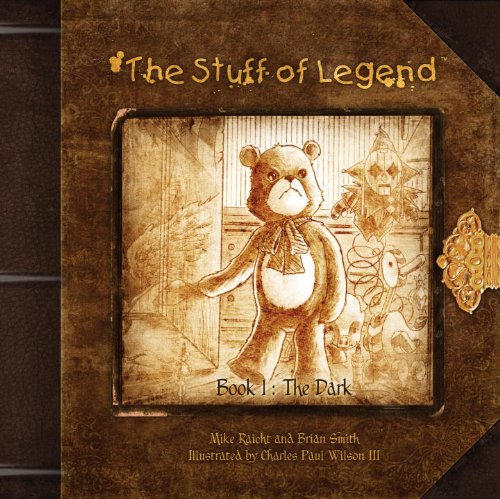
The Stuff of Legend, Book 1: The Dark - A Graphic Novel Review
In many ways The Stuff of Legend, Book One: Into the Dark, written my Mike Raicht and Brian Smith, Illustrated by Charles and Paul Wilson III, reminds me of a fairy tale. Its pages are dark, dangerous and strangely pleasant. This is a story about a band of toys on a rescue mission to save “the boy,” their friend and master, from the Boogeyman, Lord of The Dark. Where the boy has been taken we do not know. We only know his toys and puppy, led by the Colonel, are desperate to save him.
The Boogeyman is scary. When I was very little I was sure there was something sinister hiding in the shadows beneath my bed. I would get a running start and leap into my bed so that there was no way I could be snatched by an arm from under my box springs. The opening pages perfectly capture that horrifying feeling I had for a split second whilst sailing through the air before hitting my pillow – that terrifying feeling that something was about to drag me under. One of my favorite frames is drawn from the boy’s perspective. We see the boy’s hands stretched out towards Maxwell, the teddy bear lying helpless in his frozen state, watching as the boy is dragged off by the Boogeyman. Can you imagine watching someone you love being abducted while you are unable to move or speak? The boy’s kidnapping is a heavy blow to Maxwell.
The sepia tone leant a serious feel to the book which worked well considering the book’s themes. Each character was vital to the story, adding something important to each other’s characterization. The “natural” representation of each toy was just what I thought they’d be like. I actually enjoyed the way book one dropped off. I don’t want to give much away but I thought it was clever.
There are many themes in this graphic novel: war, friendship and loyalty stand out the strongest. The toys’ resolve is tested as they face foes from within and without their party. Worst of all, they can’t seem to find out anything about the boy. I found this to be the most frustrating part of the story. As much as I enjoyed the toys’ adventures, I wanted to know more about why the boy was taken in the first place. Perhaps unanswered questions are customary with comic books but I felt this first installment, especially as a graphic novel, would have been stronger with more information here. However, I thoroughly enjoyed The Dark and want to read the next book.
What do you think of the cover? Doesn’t Maxwell’s face epitomize determination? I love it.
Publisher: Villard, 2010 Pages: 128 Source: Purchased on Amazon
Rating: 4 Stars Recommended Age: 12 and up (There's a few pictures very young children might find too scary.)
The Boogeyman is scary. When I was very little I was sure there was something sinister hiding in the shadows beneath my bed. I would get a running start and leap into my bed so that there was no way I could be snatched by an arm from under my box springs. The opening pages perfectly capture that horrifying feeling I had for a split second whilst sailing through the air before hitting my pillow – that terrifying feeling that something was about to drag me under. One of my favorite frames is drawn from the boy’s perspective. We see the boy’s hands stretched out towards Maxwell, the teddy bear lying helpless in his frozen state, watching as the boy is dragged off by the Boogeyman. Can you imagine watching someone you love being abducted while you are unable to move or speak? The boy’s kidnapping is a heavy blow to Maxwell.
The sepia tone leant a serious feel to the book which worked well considering the book’s themes. Each character was vital to the story, adding something important to each other’s characterization. The “natural” representation of each toy was just what I thought they’d be like. I actually enjoyed the way book one dropped off. I don’t want to give much away but I thought it was clever.
There are many themes in this graphic novel: war, friendship and loyalty stand out the strongest. The toys’ resolve is tested as they face foes from within and without their party. Worst of all, they can’t seem to find out anything about the boy. I found this to be the most frustrating part of the story. As much as I enjoyed the toys’ adventures, I wanted to know more about why the boy was taken in the first place. Perhaps unanswered questions are customary with comic books but I felt this first installment, especially as a graphic novel, would have been stronger with more information here. However, I thoroughly enjoyed The Dark and want to read the next book.
What do you think of the cover? Doesn’t Maxwell’s face epitomize determination? I love it.
Publisher: Villard, 2010 Pages: 128 Source: Purchased on Amazon
Rating: 4 Stars Recommended Age: 12 and up (There's a few pictures very young children might find too scary.)
Monday, May 31, 2010
Smile by Raina Telgemeier: Another Great Graphic Novel
I am usually a read-one-book-at-a-time type of reader. But I could not resist that cover. It begs to be picked up. I ended up reading the book straight through.
When twelve year old Raina loses her two front teeth – her permanent teeth – it seems like the end of the world. Through years of braces, headgear, retainers, middle school and high school Raina learns who her true friends are and how to be happy with herself.
I’ve yet to read a graphic novel I haven’t liked. And Smile by Raina Telgemeier is no exception. It has such an uplifting message for young girls and is an enjoyable read. Telgemeier is not only a great writer but a great artist. The pictures are all in color and do a nice job of capturing the emotion of each moment. There were some funny moments when I chuckled and some tender ones when I teared up. From experiencing your first crush to worrying about pimples, there’s something in this book for every girl. In a time of life when girls feel pressured to mature quickly, I appreciated how Smile portrays an innocent who’s happy to be that way. Raina realizes she doesn’t have to follow her friends into makeup and kissing if she’s not ready. As you likely noticed, the character and author’s name are the same. That’s because this is a true story which makes it even better!
Publisher: Scholastic, 2010 Pages: 218
Rating: 5 Stars Recommended Age: 10 and up Source: IC Public Library
When twelve year old Raina loses her two front teeth – her permanent teeth – it seems like the end of the world. Through years of braces, headgear, retainers, middle school and high school Raina learns who her true friends are and how to be happy with herself.
I’ve yet to read a graphic novel I haven’t liked. And Smile by Raina Telgemeier is no exception. It has such an uplifting message for young girls and is an enjoyable read. Telgemeier is not only a great writer but a great artist. The pictures are all in color and do a nice job of capturing the emotion of each moment. There were some funny moments when I chuckled and some tender ones when I teared up. From experiencing your first crush to worrying about pimples, there’s something in this book for every girl. In a time of life when girls feel pressured to mature quickly, I appreciated how Smile portrays an innocent who’s happy to be that way. Raina realizes she doesn’t have to follow her friends into makeup and kissing if she’s not ready. As you likely noticed, the character and author’s name are the same. That’s because this is a true story which makes it even better!
Publisher: Scholastic, 2010 Pages: 218
Rating: 5 Stars Recommended Age: 10 and up Source: IC Public Library
Friday, March 5, 2010
Persepolis II: The Story of a Return by Marjane Satrapi
In Persepolis II, Marjane’s parents send her to Vienna where she lives by herself and grows up quickly. It is an extremely difficult time for Marjane. After four years, she returns to Iran at age 18 with emotional baggage and conflicted feelings. In this poignant sequel, Marjane is a woman of two worlds, feeling western and Iranian but not fully accepted by either culture.
Persepolis II highlights the subjugation and chauvinism exuded by the state that makes it hard for free thinkers to live in Iran. Although the war with Iraq is over, fear is ever prevalent as Marjane and her friends dodge the “guardians of the Islamic revolution.” Marjane struggles to find companions with similar ideologies and often feels alone. This text shows how precious our freedom of speech is as we watch Marjane become paranoid about how she speaks, dresses and draws advertisements for work.
Book two is much more serious as Marjane deals with the burdens of adulthood. She turns to radical friends, smoking, drinking and relationships in an attempt to find a place and purpose for herself. It is her strong will that keeps her going, but even her will wavers when she experiences a severe depression leading to an attempted suicide. As she realizes the extent of the state’s control over her life, Marjane’s perception of and hope in her country changes. I found Marjane’s story to be captivating. She has lead a challenging life to say the least. Her memoir allows readers a peek into a very conservative and foreign culture and how many people there continue to hope for change and peace.
Publisher: Pantheon, 2004 Recommended Age: 15 and up
Source: IC Public Library Pages: 187
Rating: 4 Stars
Persepolis II highlights the subjugation and chauvinism exuded by the state that makes it hard for free thinkers to live in Iran. Although the war with Iraq is over, fear is ever prevalent as Marjane and her friends dodge the “guardians of the Islamic revolution.” Marjane struggles to find companions with similar ideologies and often feels alone. This text shows how precious our freedom of speech is as we watch Marjane become paranoid about how she speaks, dresses and draws advertisements for work.
Book two is much more serious as Marjane deals with the burdens of adulthood. She turns to radical friends, smoking, drinking and relationships in an attempt to find a place and purpose for herself. It is her strong will that keeps her going, but even her will wavers when she experiences a severe depression leading to an attempted suicide. As she realizes the extent of the state’s control over her life, Marjane’s perception of and hope in her country changes. I found Marjane’s story to be captivating. She has lead a challenging life to say the least. Her memoir allows readers a peek into a very conservative and foreign culture and how many people there continue to hope for change and peace.
Publisher: Pantheon, 2004 Recommended Age: 15 and up
Source: IC Public Library Pages: 187
Rating: 4 Stars
Thursday, March 4, 2010
Persepolis: The Story of a Childhood by Marjane Satrapi
Marjane Satrapi chronicles her life when growing up during the Islamic revolution. When the Shah is overthrown Marjane and her family are overjoyed but soon realize that their hopes for liberty are being thwarted by a new and powerful regime. While she and her family hold onto their freedom (with clandestine card parties and music bought from the black market) the war with Iraq breaks out, increasing tensions among Iranians as they fight over religion and food supplies. From the innocent and often naïve perspective of childhood, Satrapi presents a dissident voice during a troubling time.
Can one be patriotic and dissident at the same time? The Satrapi family loves their country so much they do not want to leave despite the increasing violence and subjugation. They love their culture, friends and family and feel their life in Iran is better than what it could be anywhere else, including the United States. They want to make their home a better place by staying rather than leaving. It is the people that define a nation and Marjane’s parents want to be a part of that definition. Despite the context she grows up in, Marjane is a typical teenager who wants to go to parties and listen to popular music. Marjane is resilient after all she sees and experiences during protests and war. Seeing Marjane as a typical kid should make it easier for U.S. kids to identify with her and put themselves in her shoes and to ask how they would have felt if they were Marjane’s maid, neighbor or if they were Marjane herself.
I read this book in one sitting and enjoyed it a lot. The text offered an inside perspective of a third-world country that I would likely have never seen otherwise. It shows us what it was/is like for women who are forced to wear the veil. Marjane’s spunky attitude kept me hooked. It was amazing that she never asked the reader for sympathy or pity but to simply listen to her story. She just wants her side of the story, the unheard part of the truth, to be told.
Publisher: Pantheon Books, 2004 Source: IC Public Library Pages: 160
Rating: 5 Stars Recommended Age: 13 and up
Can one be patriotic and dissident at the same time? The Satrapi family loves their country so much they do not want to leave despite the increasing violence and subjugation. They love their culture, friends and family and feel their life in Iran is better than what it could be anywhere else, including the United States. They want to make their home a better place by staying rather than leaving. It is the people that define a nation and Marjane’s parents want to be a part of that definition. Despite the context she grows up in, Marjane is a typical teenager who wants to go to parties and listen to popular music. Marjane is resilient after all she sees and experiences during protests and war. Seeing Marjane as a typical kid should make it easier for U.S. kids to identify with her and put themselves in her shoes and to ask how they would have felt if they were Marjane’s maid, neighbor or if they were Marjane herself.
I read this book in one sitting and enjoyed it a lot. The text offered an inside perspective of a third-world country that I would likely have never seen otherwise. It shows us what it was/is like for women who are forced to wear the veil. Marjane’s spunky attitude kept me hooked. It was amazing that she never asked the reader for sympathy or pity but to simply listen to her story. She just wants her side of the story, the unheard part of the truth, to be told.
Publisher: Pantheon Books, 2004 Source: IC Public Library Pages: 160
Rating: 5 Stars Recommended Age: 13 and up
Sunday, February 28, 2010
The Invention of Hugo Cabret by Brian Selznick
Hugo, an orphan living in Paris in the 1930s, is good with building and repairing mechanical things. He devotes himself to repairing a special automaton and many secrets are brought to light by his efforts. The inspiration for the book was a real automaton. In the acknowledgments, Selznick gives this address for watching the original automatons write and draw: http://www.fi.edu/learn/sci-tech/automaton/automaton.php?cts=instrumentation. Pretty cool!
This book is most easily defined as a graphic novel, but it is more a hybrid between a novel and a graphic novel. The drawings have their own pages as do the written parts which read like a traditional story, not like cartoons with speech bubbles. The drawings inform the reader as much as the text. They are not simply illustrations but are a part of the narrative. Reading the book is similar to watching an old silent movie with black and white pictures followed by text. This is fitting since the book explores the work of early movie maker Georges Melies as well as other early films. Original pictures from these early movies are in the book including a picture of the very first film of a train pulling into a station. I can envision this book being very popular with elementary students who are interested in how movies were invented and why people began making them. There is a lot of interactive material available via the web to enhance the reading experience.
The Invention is unique because of the way it presents the story. However, the story was a little slow. I was disappointed with the “secret” that is unveiled. I expected something more dramatic considering all the effort that Hugo gave in order to reveal it. But it is a really cute story and Hugo is a likable character.
Publisher: Scholastic, 2007 Recommended Age: 8 and up
Source: IC Public Library Pages: 533 (284 are drawings)
Rating: 3.5 Stars More on this author at: http://www.theinventionofhugocabret.com/index.htm
This book is most easily defined as a graphic novel, but it is more a hybrid between a novel and a graphic novel. The drawings have their own pages as do the written parts which read like a traditional story, not like cartoons with speech bubbles. The drawings inform the reader as much as the text. They are not simply illustrations but are a part of the narrative. Reading the book is similar to watching an old silent movie with black and white pictures followed by text. This is fitting since the book explores the work of early movie maker Georges Melies as well as other early films. Original pictures from these early movies are in the book including a picture of the very first film of a train pulling into a station. I can envision this book being very popular with elementary students who are interested in how movies were invented and why people began making them. There is a lot of interactive material available via the web to enhance the reading experience.
The Invention is unique because of the way it presents the story. However, the story was a little slow. I was disappointed with the “secret” that is unveiled. I expected something more dramatic considering all the effort that Hugo gave in order to reveal it. But it is a really cute story and Hugo is a likable character.
Publisher: Scholastic, 2007 Recommended Age: 8 and up
Source: IC Public Library Pages: 533 (284 are drawings)
Rating: 3.5 Stars More on this author at: http://www.theinventionofhugocabret.com/index.htm
Friday, February 26, 2010
Maus: A Survivor's Tale: And Here My Troubles Began by Art Spiegelman
Another great graphic novel! Maus II picks up where book one left off. Art, the graphic novelist, is still recording conversations with his father. Vladek Spiegelman begins his story again, entering the gates of Auschwitz to endure unimaginable terrors. The novel opens with Art’s misgivings about drawing Vladek’s experience during WWII and about the man he became after the war. Art admits feeling presumptuous and feels the weight of his project. Perhaps more than the first novel, Maus II highlights Art’s conflicted feelings for Vladek. He feels deep respect for his father but struggles to love the miserly and racist man his father is. Moments of such honesty keep readers from idolizing Vladek but to respect his story, to learn what we can from it and to understand each person has his or her own history. And from our personal histories we construct our world view. I think that is one lesson (even though the novelist says he intended no “message”) I get out of reading Maus. Art finds it difficult to be around his father and I think he wants to know Vladek’s story so badly because he desires to understand Vladek’s history, to know the whole person who is his father. Vladek and his wife survive the war but are forever altered.
Maus I/II is a wonderful text to introduce young people to WWII/ the holocaust. It is honest about war cruelties but is not gory. There is some swearing and a few naked mice but nothing graphic or sexual. My recommended age is 13 only because I feel kids much younger may not appreciate the relationship between Art, a grown man, and his elderly father. But don’t let the YA tag fool you. Adults can appreciate Maus as much as young people. It's not strictly a children's story by any stretch. Highly recommended!
Publisher: Pantheon Books, 1991 Recommended Age: 13 and up
Source: IC Public Library Pages: 136
Rating: 5 Stars
Maus I/II is a wonderful text to introduce young people to WWII/ the holocaust. It is honest about war cruelties but is not gory. There is some swearing and a few naked mice but nothing graphic or sexual. My recommended age is 13 only because I feel kids much younger may not appreciate the relationship between Art, a grown man, and his elderly father. But don’t let the YA tag fool you. Adults can appreciate Maus as much as young people. It's not strictly a children's story by any stretch. Highly recommended!
Publisher: Pantheon Books, 1991 Recommended Age: 13 and up
Source: IC Public Library Pages: 136
Rating: 5 Stars
Labels:
graphic novel,
Holocaust,
nonfiction,
survival,
WWII,
YA,
young adult
Thursday, February 25, 2010
The Book of Genesis Illustrated by R. Crumb
From the creation of the world to the death of Joseph, Crumb displays the first book of the Bible with blunt black and white drawings. The depictions sway from respectful to sardonic but on the whole Crumb appears to have presented the text without adding much of his own commentary. Of course, any artistic interpretation of Biblical passages, from Bernini to Crumb, cannot help but reflect personal readings. In the intro, Crumb plainly states that he believes the Bible to be only myth. And he seems to put women into scenes, as active participants in daily life, even if the text doesn’t mention them being there. Obviously, women were there doing something to keep children fed and crops from dying.
What I liked best about this graphic novel is that Crumb didn’t try to sum up an episode by adding his own text of what he felt an individual might say but he draws straight from the Old Testament book– all 50 chapters as the cover advertises. What I didn’t like was all the nudity. If the text says so and so has sex with so and so then I can at least understand why a sex scene is included. But there were a lot of naked women randomly sprinkled throughout the text that just didn’t need to be there. I got tired of looking at boobies. If you haven’t read Genesis in awhile then let me remind you – it is a mature book. We send children to Sunday school to get the G version. Crumb’s text is the R version. It’s one thing to read or hear about people having sex and another to actually see it. But this was Crumb’s artistic license and he chose to depict every sexual reference. There is no use of prolific fig leaves and few strategically placed pillows. So, there you have it. You’ve been warned.
The people appear simple and stocky. Their emotions are easy to read which emphasizes the love, hatred, fear, jealousy, in essence, all the human emotions that are experienced by the first humans and their decedents. I’m not sure why, but Sarah, who’s supposed to be beautiful, looked ugly to me. As with most of the women she was robust and thick legged but lacked the beauty to capture Pharaoh’s attention. In the back, Crumb admits he doesn’t feel a beautiful woman could attract such attention but just look around at the way beautiful women are treated today and it seems perfectly plausible that Sarah was just a sex object to most men. Sarah’s was the only depiction I felt Crumb didn’t do justice. The clothing, living quarters and terrain felt realistic and enhanced the fact that this is an ancient text with very real and normal humans living out the stories. I liked the depictions of the nine hundred-year-old men all wrinkled and shriveled grasping for their last breaths.
My final thoughts: If you’ve never read the original text do so first. After thousands of years of preservation and compilation it would be a shame to miss out on, arguably, the most influential and revered piece of writing in the world. So, read Genesis from the Bible first. It was not meant to be a visual book or that’s how it would have been done in the first place. That being said, I enjoyed Crumb’s version overall and say, take in stride, with the understanding that Crumb is not a believer, what you find objectionable in his depictions.
Publisher: W.W. Norton and Company, 2009 Recommended Age: 17 and up
Source: IC Public Library Pages: 224
Rating: 4 Stars
What I liked best about this graphic novel is that Crumb didn’t try to sum up an episode by adding his own text of what he felt an individual might say but he draws straight from the Old Testament book– all 50 chapters as the cover advertises. What I didn’t like was all the nudity. If the text says so and so has sex with so and so then I can at least understand why a sex scene is included. But there were a lot of naked women randomly sprinkled throughout the text that just didn’t need to be there. I got tired of looking at boobies. If you haven’t read Genesis in awhile then let me remind you – it is a mature book. We send children to Sunday school to get the G version. Crumb’s text is the R version. It’s one thing to read or hear about people having sex and another to actually see it. But this was Crumb’s artistic license and he chose to depict every sexual reference. There is no use of prolific fig leaves and few strategically placed pillows. So, there you have it. You’ve been warned.
The people appear simple and stocky. Their emotions are easy to read which emphasizes the love, hatred, fear, jealousy, in essence, all the human emotions that are experienced by the first humans and their decedents. I’m not sure why, but Sarah, who’s supposed to be beautiful, looked ugly to me. As with most of the women she was robust and thick legged but lacked the beauty to capture Pharaoh’s attention. In the back, Crumb admits he doesn’t feel a beautiful woman could attract such attention but just look around at the way beautiful women are treated today and it seems perfectly plausible that Sarah was just a sex object to most men. Sarah’s was the only depiction I felt Crumb didn’t do justice. The clothing, living quarters and terrain felt realistic and enhanced the fact that this is an ancient text with very real and normal humans living out the stories. I liked the depictions of the nine hundred-year-old men all wrinkled and shriveled grasping for their last breaths.
My final thoughts: If you’ve never read the original text do so first. After thousands of years of preservation and compilation it would be a shame to miss out on, arguably, the most influential and revered piece of writing in the world. So, read Genesis from the Bible first. It was not meant to be a visual book or that’s how it would have been done in the first place. That being said, I enjoyed Crumb’s version overall and say, take in stride, with the understanding that Crumb is not a believer, what you find objectionable in his depictions.
Publisher: W.W. Norton and Company, 2009 Recommended Age: 17 and up
Source: IC Public Library Pages: 224
Rating: 4 Stars
Friday, February 19, 2010
Maus: A Survivor's Tale: My Father Bleed's History by Art Spiegelman
Maus (pronounced mouse) is a graphic novel that is easily in my top twenty if not my top ten favorite books. This is not simply a comic book about super heroes. Maus is a true story of love and survival during the Holocaust. The narrative shifts between the present and past while the graphic novelist interviews his father about living in Poland during World War Two. It is a riches to rags story as Spiegelman, Sr. loses all his worldly possessions while dodging the Gestapo for as long as possible. Wars may end but their devastating effects are felt for several generations. The narrative structure allows the reader to see how an entire family, born and unborn, are affected by the persistence of and memory of war. World War Two shaped many lives directly and indirectly as seen in the relationships in the Spiegelman family, especially between father and son.
The graphic part of this novel is genius. Spiegelman chose to portray Jews as mice, Germans (presumably all Nazis) as cats and the Polish as pigs. Apparently, the popular German nickname of Poles was pigs, hence their depiction as such in the novel. The mice motif, depicting Jew as victims hiding in holes in the walls, is challenged by the narrative as we see them, not just as victims but as individuals actively fighting for survival. The way people looked was hugely important, race even more so. Imagine people trying desperately to not “look Jewish” and in the novel trying not to look like a mouse. The symbolism of the animals enhances the feeling of isolation as well as camaraderie in the novel. The art allows for body language to become a visible part of the reading experience which allows emotions to come through in a way that words often fail to capture.
Maus was a big surprise. I didn’t expect this kind of experience from a graphic novel. This is my favorite WWII text for sure followed by The Hiding Place and then Last Man Out. Oddly they are all nonfiction which is something I usually don’t get into. But it makes sense that true stories are the most touching and inspiring. I could go on but if you read it for yourself you’ll understand why I like it.
Publisher: Random House, 1986 (originally, 1973) Recommended Age: 13 and up
Source: IC Public Library Pages: 159
Rating: 5 Stars
The graphic part of this novel is genius. Spiegelman chose to portray Jews as mice, Germans (presumably all Nazis) as cats and the Polish as pigs. Apparently, the popular German nickname of Poles was pigs, hence their depiction as such in the novel. The mice motif, depicting Jew as victims hiding in holes in the walls, is challenged by the narrative as we see them, not just as victims but as individuals actively fighting for survival. The way people looked was hugely important, race even more so. Imagine people trying desperately to not “look Jewish” and in the novel trying not to look like a mouse. The symbolism of the animals enhances the feeling of isolation as well as camaraderie in the novel. The art allows for body language to become a visible part of the reading experience which allows emotions to come through in a way that words often fail to capture.
Maus was a big surprise. I didn’t expect this kind of experience from a graphic novel. This is my favorite WWII text for sure followed by The Hiding Place and then Last Man Out. Oddly they are all nonfiction which is something I usually don’t get into. But it makes sense that true stories are the most touching and inspiring. I could go on but if you read it for yourself you’ll understand why I like it.
Publisher: Random House, 1986 (originally, 1973) Recommended Age: 13 and up
Source: IC Public Library Pages: 159
Rating: 5 Stars
Labels:
graphic novel,
Holocaust,
nonfiction,
survival,
WWII,
YA
Subscribe to:
Posts (Atom)