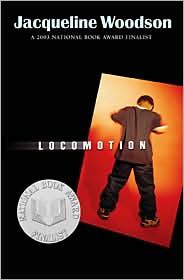
After Lonnie's parents died he and his sister live in separate foster homes. Lonnie uses writing assignments in school to cope. The result is a short novel in verse -- a book of poems that tells a story. Lonnie deals with some heavy stuff for an eleven year old. Grief, loss, separation, loneliness and uncertainty are a few of the themes. But Lonnie also talks of hope and his affection for his sister.
The poems are short, ranging from three lines to a little over a page. From free verse to Haiku there is a variety of poetry Lonnie experiments with to express what he sees, feels and remembers. Locomotion would make great teaching material to use as examples of poetry. The book may also appeal to elementary kids who are ready to move beyond strictly rhyming and silly poems (not that there anything wrong with silly rhyming poems!).
From my perspective, Locomotion was a little sad and ended abruptly. There is a follow up novel called Peace Locomotion in which Lonnie writes letters to his sister. For such a short book it took me a long time to read. The text was often introspective. I don't think I was in the mood for it. Yet, I would recommend this text to kids interested in poetry or for someone looking for a book about grieving. This text counts towards to the POC Reading Challenge!
Publisher: Speak, 2003 Pages: 100
Rating: 3 Stars Source: Public Library
Showing posts with label orphans. Show all posts
Tuesday, August 2, 2011
Monday, June 13, 2011
Review: Harry Potter and the Sorcerer's Stone by J. K. Rowling
Finally, I've read Harry Potter! Wow, what great characters! I loved Hagrid, the giant "gamekeeper," who befriends Harry and sees him through his first year at the wizards' school, Hogwarts. Harry's story as "the boy who lived" is so endearing yet sometimes I found him dry... that is, until he meets Ron and Hermione and they get into some close calls while tracking mysterious happenings at the school. Need a plot summery? Click here.
The interactions between characters felt so real and there was some great dialogue. Despite the fact that they have magical abilities, it felt like I was reading about otherwise normal kids who worry about wearing hand-me-downs and meeting expectations. The professors were equally as interesting. I liked never knowing what to think about professor Snape - is he good, bad? Don't tell me! I want to read the books without spoilers!
The Hogwarts world is very creative with it's own candy, newspaper and sport, quidditch. Reading about the quidditch tournaments was a little boring for me but they worked into the plot of the story so well that I was soon happily reading again. I enjoyed the academic environment of Hogwarts and got a chuckle out of the library scenes with magical books and a very old-fashioned librarian guarding them.
There were a few dark moments (that unicorn scene, ick!) but that's the nature of fantasy. In order to have an epic tale of good vs. evil there must be dark moments. I didn't find the dark parts too overwhelming for young readers.
I'm glad I made time for Harry Potter. I'll slowly make my way through the series. Has anyone listened to them on CD? Are they any good?
Publisher: Scholastic, 2008 Pages: 330
Stars: 4 Source: Public Library
The interactions between characters felt so real and there was some great dialogue. Despite the fact that they have magical abilities, it felt like I was reading about otherwise normal kids who worry about wearing hand-me-downs and meeting expectations. The professors were equally as interesting. I liked never knowing what to think about professor Snape - is he good, bad? Don't tell me! I want to read the books without spoilers!
The Hogwarts world is very creative with it's own candy, newspaper and sport, quidditch. Reading about the quidditch tournaments was a little boring for me but they worked into the plot of the story so well that I was soon happily reading again. I enjoyed the academic environment of Hogwarts and got a chuckle out of the library scenes with magical books and a very old-fashioned librarian guarding them.
There were a few dark moments (that unicorn scene, ick!) but that's the nature of fantasy. In order to have an epic tale of good vs. evil there must be dark moments. I didn't find the dark parts too overwhelming for young readers.
I'm glad I made time for Harry Potter. I'll slowly make my way through the series. Has anyone listened to them on CD? Are they any good?
Publisher: Scholastic, 2008 Pages: 330
Stars: 4 Source: Public Library
Thursday, April 1, 2010
The Willoughbys by Lois Lowry
The Willoughbys uses a lot of dark humor. The four children wish their parents would die so they can be orphans like ones in books. And their parents find their kids annoying and plot to get rid of them. In the end, Mr. and Mrs. meet their demise on vacation. I found much of the humor harmless and think most kids would enjoy it. However, I disliked the way the oldest sibling, Tim, acted like a tyrant and belittled Jane by telling her she wouldn’t ever do anything important because she’s a girl. It’s all meant to be funny, and clearly everyone has flaws in this story. But I felt Tim just wasn’t funny or cute. He begins to mend his ways in the later half but his attitude towards women is never directly addressed. For this reason, Tim’s character never sat right with me. I appreciated the “big words” throughout the story. And the glossary is there for kids to learn what words like “surreptitious” and “obsequious” mean. There are several references to classics about orphans and nannies. I think I’ll have to read some of them. A cute story but The Willoughbys was a bit of a letdown.
Publisher: Houghton Mifflin, 2008 Recommended Age: 8 and up
Rating: 2.5 Stars Pages: 157, 174 with Glossary and Bibliography
Publisher: Houghton Mifflin, 2008 Recommended Age: 8 and up
Rating: 2.5 Stars Pages: 157, 174 with Glossary and Bibliography
Monday, March 22, 2010
The Good Thief by Hannah Tinti
For this text I will begin with the negative and move into the positive. That’s the simplest way, I think, to do a review for it.
This novel has been on my bookshelf for several months and, after a previous attempt to read it, I finally made a point to finish it. So, as you can imagine the text was not an attention grabber. Although I liked Ren, the twelve-year-old orphaned protagonist, I had a difficult time connecting with him and caring about what happened to him (or the rest of the characters). Tinti does a good job at capturing childhood in poverty. Ren is naive, likes to collect rocks and gets into fist fights with his friends – a pretty normal boy for the most part save his missing hand. The elements for character development are all there but maybe I’m too old (and perhaps being a girl doesn’t help me) to really connect with Ren. The story was a bit unbelievable but I could suspend my beliefs enough to enjoy the plot; however, the plot was predictable. When the answers behind Ren’s missing hand were revealed I felt disappointed. I don’t like being able to see every twist coming and I saw too many beforehand. And the ending is very happily ever after. Now, I do like happy endings, and not everything is perfect for Ren, but the ending seemed too good to be true (even with suspended beliefs). I did like Dolly, the good-hearted murderer (yes, the murderer was my favorite character). Otherwise the players in the plot didn’t do much to enhance the story for me. The real villains needed to be much darker and menacing. As to the prose, it is good in the sense that it is grammatically correct. But it stinks in the sense of enjoyable reading. Tinti can write very well but the prose was too standard and well, boring. I fell asleep reading more than once. There were some high moments when action started happening in which I became excited to read on. I kept thinking, ok, it’s going to get better now, but then those moments passed and it was a long time before another came along.
On to the positive. The Good Thief is a recipient of the Alex Award which, in a nut shell, is given to adult books which appeal to young adult readers (age 12-18). I can see this novel appealing to teachers who are tired of reading/teaching Oliver Twist. There are many similarities between the two novels: orphans, con-men, poverty. The depth of Dickens is hard to achieve and his work is definitely better. But I think many a ninth-grader would rather read Tinti than Dickens. I remember reading Oliver Twist as an adult and it was hard to get through. What I appreciate about YA in general (70% of the time, perhaps) and the Alex recipients (I’ve read two so far) is that the stories are fast passed, the foul language is toned down or non-existent and there are few if any “sex scenes.” These are not hard and fast guarantees but definitely factors that draw me to the genre. On top of these qualities, the Alex recipients I’ve read manage to retain an edginess – sometimes scary or unexpected moments – which I enjoy. I plan to read more in the future. I enjoyed the historical info on American dentistry and medicine during the 19th century which adds that edginess I mentioned (think cadavers). The story shows the resiliency of the human spirit and how one good deed can open the door to many positive outcomes. So, wrapping up, I liked this book for its potential to offer young adults different reading. But personally I wasn’t that into The Good Thief. I hope Tinti digs deeper into her writing well and comes back with something better.
Publisher: Dial Press Trade, 2008 Source: Barnes and Noble Pages: 327
Rating: 3 Stars Recommended Age: 14 and up
This novel has been on my bookshelf for several months and, after a previous attempt to read it, I finally made a point to finish it. So, as you can imagine the text was not an attention grabber. Although I liked Ren, the twelve-year-old orphaned protagonist, I had a difficult time connecting with him and caring about what happened to him (or the rest of the characters). Tinti does a good job at capturing childhood in poverty. Ren is naive, likes to collect rocks and gets into fist fights with his friends – a pretty normal boy for the most part save his missing hand. The elements for character development are all there but maybe I’m too old (and perhaps being a girl doesn’t help me) to really connect with Ren. The story was a bit unbelievable but I could suspend my beliefs enough to enjoy the plot; however, the plot was predictable. When the answers behind Ren’s missing hand were revealed I felt disappointed. I don’t like being able to see every twist coming and I saw too many beforehand. And the ending is very happily ever after. Now, I do like happy endings, and not everything is perfect for Ren, but the ending seemed too good to be true (even with suspended beliefs). I did like Dolly, the good-hearted murderer (yes, the murderer was my favorite character). Otherwise the players in the plot didn’t do much to enhance the story for me. The real villains needed to be much darker and menacing. As to the prose, it is good in the sense that it is grammatically correct. But it stinks in the sense of enjoyable reading. Tinti can write very well but the prose was too standard and well, boring. I fell asleep reading more than once. There were some high moments when action started happening in which I became excited to read on. I kept thinking, ok, it’s going to get better now, but then those moments passed and it was a long time before another came along.
On to the positive. The Good Thief is a recipient of the Alex Award which, in a nut shell, is given to adult books which appeal to young adult readers (age 12-18). I can see this novel appealing to teachers who are tired of reading/teaching Oliver Twist. There are many similarities between the two novels: orphans, con-men, poverty. The depth of Dickens is hard to achieve and his work is definitely better. But I think many a ninth-grader would rather read Tinti than Dickens. I remember reading Oliver Twist as an adult and it was hard to get through. What I appreciate about YA in general (70% of the time, perhaps) and the Alex recipients (I’ve read two so far) is that the stories are fast passed, the foul language is toned down or non-existent and there are few if any “sex scenes.” These are not hard and fast guarantees but definitely factors that draw me to the genre. On top of these qualities, the Alex recipients I’ve read manage to retain an edginess – sometimes scary or unexpected moments – which I enjoy. I plan to read more in the future. I enjoyed the historical info on American dentistry and medicine during the 19th century which adds that edginess I mentioned (think cadavers). The story shows the resiliency of the human spirit and how one good deed can open the door to many positive outcomes. So, wrapping up, I liked this book for its potential to offer young adults different reading. But personally I wasn’t that into The Good Thief. I hope Tinti digs deeper into her writing well and comes back with something better.
Publisher: Dial Press Trade, 2008 Source: Barnes and Noble Pages: 327
Rating: 3 Stars Recommended Age: 14 and up
Subscribe to:
Posts (Atom)