Showing posts with label WWII. Show all posts

Saturday, June 11, 2011

Review: Number the Stars by Lois Lowry

My library's summer reading slogan for children this year is "One World, Many Stories." I've been trying to read a few titles off our book list so I can be helpful when kids or parents ask about them. So far, I've read The Breadwinner and now Number the Stars.

Summary: "Ten-year-old Annemarie Johansen and her best friend, Ellen Rosen, often think about life before the war. But it's now 1943, and their life in Copenhagen is filled with school, food shortages, and the Nazi soldiers marching in their town. The Nazis won't stop. The Jews of Denmark are being "relocated," thus Ellen moves in with the Johansens and pretends to be part of the family. Then Annemarie is asked to go on a dangerous mission. Somehow she must find the strength and courage to save her best friend's life. There's no turning back now."

Historical fiction comes in many forms. Some texts strain for historical accuracy while others take liberties for the sake of an engaging story. Lowry creates an engaging story while adhering closely to actual events. Readers will gain an appreciation for the Danish resistance during WWII while being swept away by Annemarie's bravery. My great grandfather was from Denmark so I had fun picking up a bit of Danish history. If you know an elementary or early middle school reader who likes historical fiction I highly suggest Number the Stars.

Publisher: Yearling, 1990     Pages: 137
Rating: 4 Stars     Source: Public Library

Tuesday, January 18, 2011

Review: The Reader by Bernhard Schlink

The Reader examines adolescence, pubescence and sexuality while questioning what it means to be a grandchild of Nazi Germany. What should they feel towards elders who went along with or participated in the Nazi regime. What responsibility should they place on parents who were relatively powerless and did nothing. Are justice and assigning blame the same thing?  

The Reader is not concerned with answering these questions as much as it is with pointing out the complexity of the situation made more complex by the protagonist’s teenage love affair with a strange women twice his age with a murky past.

In the first part, the protagonist, Michael, is sexually assaulted but goes back for more. Calling it a love affair is misleading. It’s infatuation to the extreme. The second book revolves around the woman’s trial for alleged war crimes. The “twist” is that she is illiterate and had this been publicly known would have exonerated her. Who would go to prison for life rather than admit they can’t read? Totally unbelievable for me but then again I’ve had the luxury of an education. The third part continues with Michael’s selfish introspection on the the woman’s importance to him and how her absence is why he never had a stable relationship...whine, whine, whine. Slightly more thoughts on the role of his generation towards their parents.’ Dull writing screwed this book over. If the prose had been beautiful in German it did not translate well.

What are we to take away from The Reader? Michael’s selfishness and moral misgivings prevent him from forgiving the woman enough to genuinely demonstrate his love for her. He makes it clear there will always be a barrier separating them - one he feels neither he nor anyone else can remove. Is this supposed to be symbolic of the divide between generations? Any thoughts? 

Another thing that struck me is the lack of forgiveness in this novel. Blame and punishment are doled out. Regrets are voiced. But not much forgiveness. How can one who is wronged heal if he cannot forgive? How can one who has wronged another be changed if they never ask for forgiveness? Saying "I'm sorry" is easy. Saying, "Will you please forgive me" is hard. It puts oneself at the mercy of another. Does Hanna, the woman, ever really ask for forgiveness? Does she ever receive forgiveness? 

Publisher: Vintage, 2008     Pages: 218
Rating: 2.5 Stars                 Source: IC Public Library

Thursday, December 30, 2010

Review: Extremely Loud and Incredibly Close by Jonathan Foer

Without much of an opening, I’m going to get to the point… There were too many themes and I didn’t feel the novel adequately covered any of them. Is this book about WWII and the bombings at Dresden, 9/11 and terrorism, growing up, growing old,  post-traumatic stress disorder, family, death, childhood … is it a quest book? A great book is able to seamlessly merge several themes. To put it nicely, Extremely Loud and Incredibly Close bit off more than it could chew.

I did enjoy the writing style. It’s rather a stream-of-consciousness narration. The point of view shifts between the main protagonist, nine year old Oskar Schell, and his grandfather (who goes by the same name), and his grandmother. We come to know the grandfather through the letters he writes to his son, Oskar’s dad. He writes about Dresden and what it was like during the bombings. I felt these reflections were the strongest part of the novel. However, these reflections didn’t tie in well with Oskar’s story. The grandfather could have been removed without drastically altering the story. So, I’m not sure what the grandfather is doing in it. 

Young Oskar is a very clever and witty boy – too clever. The prose felt very contrived and pushed the “I’m a sad little boy genius” theme too heavily for me. I’ve no doubt smart boys like Oskar do exist. It’s just that Oskar as a character in this novel didn’t work well for me. Oskar’s quest, which takes him all over NYC, was fun to follow but I didn’t feel his encounters with NYC residents added anything to a story about 9/11, war or grieving.The quest itself may have helped Oskar, but the encounters added very little.

I found myself laughing quite a bit. And that’s a good thing because honestly, I found the book to be a downer. There is very little genuine love between the characters (except perhaps between Oskar and his mom) and very little is resolved between characters at the book’s end. For a book about 9/11 and grieving, etc., I don’t like that what I’m taking away from this book is “funny.”

I’ve been harsh, perhaps. I did enjoy Extremely Loud and Incredibly Close well enough. I read it in a couple days. The novel did make me want to come back to it and turn pages. Final Thoughts: Reading this book felt like putting together a puzzle and I enjoyed the exercise.

Publisher: Houghton Mifflin, 2006 (eBook)     Pages: 368
Rating: 3 Stars     Source: Purchased through Kindle Storefront

Wednesday, July 14, 2010

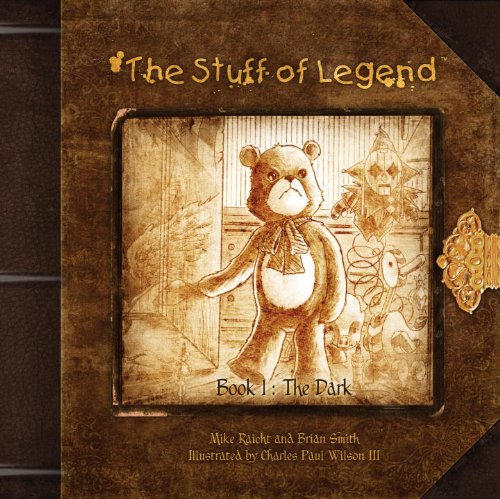
The Stuff of Legend, Book 1: The Dark - A Graphic Novel Review

In many ways The Stuff of Legend, Book One: Into the Dark, written my Mike Raicht and Brian Smith, Illustrated by Charles and Paul Wilson III,  reminds me of a fairy tale. Its pages are dark, dangerous and strangely pleasant. This is a story about a band of toys on a rescue mission to save “the boy,” their friend and master, from the Boogeyman, Lord of The Dark. Where the boy has been taken we do not know. We only know his toys and puppy, led by the Colonel, are desperate to save him.

The Boogeyman is scary. When I was very little I was sure there was something sinister hiding in the shadows beneath my bed. I would get a running start and leap into my bed so that there was no way I could be snatched by an arm from under my box springs. The opening pages perfectly capture that horrifying feeling I had for a split second whilst sailing through the air before hitting my pillow – that terrifying feeling that something was about to drag me under. One of my favorite frames is drawn from the boy’s perspective. We see the boy’s hands stretched out towards Maxwell, the teddy bear lying helpless in his frozen state, watching as the boy is dragged off by the Boogeyman. Can you imagine watching someone you love being abducted while you are unable to move or speak? The boy’s kidnapping is a heavy blow to Maxwell.

The sepia tone leant a serious feel to the book which worked well considering the book’s themes. Each character was vital to the story, adding something important to each other’s characterization. The “natural” representation of each toy was just what I thought they’d be like. I actually enjoyed the way book one dropped off. I don’t want to give much away but I thought it was clever.

There are many themes in this graphic novel: war, friendship and loyalty stand out the strongest. The toys’ resolve is tested as they face foes from within and without their party. Worst of all, they can’t seem to find out anything about the boy. I found this to be the most frustrating part of the story. As much as I enjoyed the toys’ adventures, I wanted to know more about why the boy was taken in the first place. Perhaps unanswered questions are customary with comic books but I felt this first installment, especially as a graphic novel, would have been stronger with more information here. However, I thoroughly enjoyed The Dark and want to read the next book.

What do you think of the cover? Doesn’t Maxwell’s face epitomize determination? I love it.
Publisher: Villard, 2010     Pages: 128     Source: Purchased on Amazon
Rating: 4 Stars     Recommended Age: 12 and up (There's a few pictures very young children might find too scary.)

Sunday, July 4, 2010

Review of Summer at Tiffany by Marjorie Hart: A Memoir

There are many reasons why I liked this memoir. First of all, I must confess that I do enjoy perusing Tiffany’s online catalog. I’ve been in a couple Tiffany stores before with my mom in Chicago and Kansas City (My mom and I have taken some fun trips just to go window shopping in the big towns and keep our eyes peeled for a bargain or a little treasure to take home). It’s such fun to look at all the sparklies. And the salespeople always treated us with respect even when we were just looking.

But Marjorie Hart’s memoir, Summer at Tiffany, is about more than just expensive jewelry and timeless heirlooms. It’s about war and loss. It’s about growing up. It’s about friends. About taking risks. And probably my favorite theme, it’s about women forging their way into the work world.

During World War Two, the United States began recruiting women to fill what were traditionally men’s roles as much of the male population had enlisted. One such role was a page at Tiffany, responsible for relaying packages within the Tiffany building to repair shops or the shipping department. Marjorie Hart and her friend Marty were the first women to work as pages at Tiffany let alone work on the show floor. The friends saw actors, actresses and many other famous people which totally tripped their triggers.

Another reason I enjoyed this read was because Marjorie and Marty are from my home state and attended my University. It was fun to see how New Yorkers responded to these small-town Iowan girls. Many still have the same responses today – we must be quaint, naïve and very cute in our small-town ways. And maybe we are, but no more than most young women I dare say. Here’s another reaction Marjorie encountered when helping a well-to-do shopper:
‘I’m from Iowa.’ I said, flustered by the attention.
‘Oh, dear!’ She shook her head, her feather bobbing. ‘Here on the East Coast – we pronounce it O-hi-o!”
I bit my lip… (Hart 185)
Ha! That’s actually happened to me and when I try to tell people it’s IOWA they don’t get it! There were lots of moments like this that had me laughing.

The text is written in a present tense style akin to journal writing. I think it helps the book feel immersed in the 1940s as Marjorie worries about sugar rationing, painting pretend stocking lines on the backs of her legs and getting her hair pinned up for the perfect curls. I remember my grandma talking about painting that line on her legs because pantyhose production was cut for the war effort. Until this past year she always put her hair up in pin curls, too! Marjorie shares many humorous stories that had me chuckling. I enjoyed Summer at Tiffany and recommend it for someone looking for a fun read or for those who like memoirs.

Publisher: Harper Collins, 2007    Pages: 266
Rating: 4 Stars        Source: Purchased at a library sale for 10₵! Can you say bargain!?!

Wednesday, March 31, 2010

The Book Thief by Markus Zusak

At my library, The Book Thief is constantly checked out. Now I know why. This text is worth a reread someday. If you think you’ve read every version of WWII there is to be told, I ask: have you seen it from Death’s perspective? Have you seen from a German’s point of view? Zusak takes on the challenge to present Nazi Germany from within and to show the challenges for those opposed to the Fuhrer. The story is narrated by Death, who tells us about Liesel, a young German girl with a passion for books, her family and friends. As the story unfolds, Liesel understands the power of words and how the Third Reich uses them to break apart her family and everything she loves.

Zusak’s writing style is enjoyable. He gives Death a unique voice and personality. Death is constantly breaking the narrative with short facts and asides about characters, events or his personal observations. These interruptions are a fun part of the narrative and keep the story interesting. I enjoyed how many chapters begin with a teaser, a fact or future event yet to unfold, that Death uses to get us interested in how the story will play out. Here’s an example of what I’m talking about:

Of course, I’m being rude. I’m spoiling the ending, not only of the entire book, but of this particular piece of it. I have given you two events in advance, because I don’t have much interest in building mystery. It’s the machinations that wheel us there that aggravate, perplex, interest, and astound me. (Zusak 243)

What an interesting commentary on story-telling – from Death. Normally, I do not like narrators that directly address the reader. It is often tacky and takes me out of the story. But Zusak caries it off beautifully because, I think, Death has such a real presence in the plot and his voice is so real. And moments as the one quoted remind us that this story is already over and he is telling us this in retrospect, which allows him some authority to talk to us about it. Zusak uses nonstandard English, meaning incomplete sentences and “sporadic” punctuation. I don’t count myself among the “grammar police” (notice my many “mistakes”) but I think it is hard to pull nonstandard English off and make the book strong and the reading experience fluid (thinking of Cormac McCarthy who is brilliant at doing this). Zusak does a fine job but some incompletes did throw me off a couple times. Overall though, it worked, especially as Death’s voice. No one talks in complete sentences all the time and it made him seem real. I also enjoyed the spatial aspect of the text – how some lines stand alone and other pieces are centered. It made for an interesting reading experience.

This book is dehydrating. Literally. I cried practically nonstop through the last fifty pages. Prior to that, I didn’t cry at all. It just all happened so fast, the ending that is. I couldn’t put the book down. This is a thick novel, with plenty of time to develop the characters, yet it never became stagnate. The Book Thief is definitely one worth reading.
Publisher: Knopf, 2006     Recommended Age: 14 and up (the reading and content is pretty heavy for younger readers)
Rating: 5 Stars                   Pages: 552               Source: IC Public Library

Friday, February 26, 2010

Maus: A Survivor's Tale: And Here My Troubles Began by Art Spiegelman

Another great graphic novel! Maus II picks up where book one left off. Art, the graphic novelist, is still recording conversations with his father. Vladek Spiegelman begins his story again, entering the gates of Auschwitz to endure unimaginable terrors. The novel opens with Art’s misgivings about drawing Vladek’s experience during WWII and about the man he became after the war. Art admits feeling presumptuous and feels the weight of his project. Perhaps more than the first novel, Maus II highlights Art’s conflicted feelings for Vladek. He feels deep respect for his father but struggles to love the miserly and racist man his father is. Moments of such honesty keep readers from idolizing Vladek but to respect his story, to learn what we can from it and to understand each person has his or her own history. And from our personal histories we construct our world view. I think that is one lesson (even though the novelist says he intended no “message”) I get out of reading Maus. Art finds it difficult to be around his father and I think he wants to know Vladek’s story so badly because he desires to understand Vladek’s history, to know the whole person who is his father. Vladek and his wife survive the war but are forever altered.

Maus I/II is a wonderful text to introduce young people to WWII/ the holocaust. It is honest about war cruelties but is not gory. There is some swearing and a few naked mice but nothing graphic or sexual. My recommended age is 13 only because I feel kids much younger may not appreciate the relationship between Art, a grown man, and his elderly father. But don’t let the YA tag fool you. Adults can appreciate Maus as much as young people. It's not strictly a children's story by any stretch. Highly recommended!
Publisher: Pantheon Books, 1991 Recommended Age: 13 and up
Source: IC Public Library              Pages: 136
Rating: 5 Stars

Friday, February 19, 2010

Maus: A Survivor's Tale: My Father Bleed's History by Art Spiegelman

Maus (pronounced mouse) is a graphic novel that is easily in my top twenty if not my top ten favorite books. This is not simply a comic book about super heroes. Maus is a true story of love and survival during the Holocaust. The narrative shifts between the present and past while the graphic novelist interviews his father about living in Poland during World War Two. It is a riches to rags story as Spiegelman, Sr. loses all his worldly possessions while dodging the Gestapo for as long as possible. Wars may end but their devastating effects are felt for several generations. The narrative structure allows the reader to see how an entire family, born and unborn, are affected by the persistence of and memory of war. World War Two shaped many lives directly and indirectly as seen in the relationships in the Spiegelman family, especially between father and son.

The graphic part of this novel is genius. Spiegelman chose to portray Jews as mice, Germans (presumably all Nazis) as cats and the Polish as pigs. Apparently, the popular German nickname of Poles was pigs, hence their depiction as such in the novel. The mice motif, depicting Jew as victims hiding in holes in the walls, is challenged by the narrative as we see them, not just as victims but as individuals actively fighting for survival. The way people looked was hugely important, race even more so. Imagine people trying desperately to not “look Jewish” and in the novel trying not to look like a mouse. The symbolism of the animals enhances the feeling of isolation as well as camaraderie in the novel. The art allows for body language to become a visible part of the reading experience which allows emotions to come through in a way that words often fail to capture.

Maus was a big surprise. I didn’t expect this kind of experience from a graphic novel. This is my favorite WWII text for sure followed by The Hiding Place and then Last Man Out. Oddly they are all nonfiction which is something I usually don’t get into. But it makes sense that true stories are the most touching and inspiring. I could go on but if you read it for yourself you’ll understand why I like it.
Publisher: Random House, 1986 (originally, 1973) Recommended Age: 13 and up
Source: IC Public Library                                        Pages: 159
Rating: 5 Stars