Showing posts with label U.S. history. Show all posts

Sunday, March 31, 2013

Review: Superman Versus the Ku Klux Klan by Rick Bowers

Rick Bowers weaves two seemingly disconnected histories, the creation and immense popularity of Superman with the long and disturbing history of the Ku Klux Klan, to produce a surprising story of how the entertainment industry promoted social justice. The two narratives are brought together when the the Adventures of Superman radio show uses its national popularity to combat the pervasive influence of the KKK in its 1946 “Clan of the Fiery Cross” episodes. 

Bowers provides a brief but insightful history of the KKK, its beginning after the Civil War, and cycle of influence in the U.S. Alternating chapters discuss the modest beginnings of Superman and his rise from comic book to radio show to T.V. and the silver screen. Though not a deep exploration of either subject I learned a lot about both. And so did the teens who read this book in my discussion group.

My book group teens were surprised by the long history and real power the KKK exercised. They also enjoyed the chapters about Superman and how a couple of teenagers were responsible for his creation. In book discussion, we listened to the first episode of the “Clan of the Fiery Cross” (below) and laughed at the Kellogg’s cereal commercials as well as the out-of-date insults used by the teens. They found it hard to believe that millions of kids tuned into this show just because it sounds so cheesy to us today.

Many reviews I’ve read recommend this book for late elementary and middle school readers. Both my teens and I strongly disagreed. This is a great book for high school students and I recommend it for a history class. Bowers shows the significance of using primary sources when doing research as he debunks myths about the broadcast’s use of KKK code words (which Wikipedia still says is true!). The text is dry. I wanted to learn about the subject but it was often simply boring. The original photographs opening each chapter offered little relief. When I asked my teens who would enjoy this book they said: Anyone really interested in Superman or general U.S. history. When asked what age it was for they said: high school students and adults. They were shocked anyone would recommend this to younger students or to reluctant readers. I would add that this is a good choice for a teen who doesn’t care for fiction.

Overall, this is a thumbs up. I learned a lot. My book group teens did, too. We had a great discussion about primary versus secondary sources. We also made a pro con list of who was the better superhero: Superman or Batman. It was an enthusiastic debate.


Publisher: National Geographic Society, 2012     Pages: 160
Rating: 3.5 Stars     Source: Public Library
Full Title: Superman Versus The Ku Klux Klan: The True Story of How the Iconic Superhero Battled the Men of Hate

Thursday, March 21, 2013

The Midwest: God's Gift to Planet Earth by Mike Draper

The Midwest, the heartland, fly-over country: this is my home.

“Like most foreign countries, outsiders have heard of it, but the details of what goes on inside are pretty hazy” (19). So says Mike Draper, narrator of The Midwest: God’s Gift to Planet Earth!

The Midwest gets overlooked. People really don’t seem to know what we do here and so assume that we don’t do much of anything but grow corn. Well, there’s quite a bit that goes on here, let me tell ya!

With the zippy wit and humor a t-shirt shop owner (yes, he really does run a t-shirt shop in Des Moines), Draper enlightens readers of the glory of the Midwest. It really is a surprising place. Sure, there’s stuff to complain about but every region of the U.S. has its baggage. Draper focuses on the positive, though, he does poke fun at Midwestern stereotypes. From famous people and inventions to geography and the weather, this book gives a brief and biased overview of the 12-state region.

Midwesterners will get a kick out of reading this book. But for those who’ve never spent time in the Midwest, if you are guilty of overlooking the heartland (gasp!), and are looking for a fun read, then I recommend this “Illustrated Guide to the History and Culture of the Galaxy’s Most Important Region.” 

Publisher: RAYGUN, 2012     Pages: 239
Rating: 4 Stars     Source: Public Library

Monday, April 2, 2012

Review: Best Shot in the West by Patricia C. McKissack and Fredrick L. McKissack, Jr.

Nat Love, or “Deadwood Dick,” was among the greatest cowboys who ever lived. Daring and dangerous when he needed to be, Nat was a natural at breaking broncs and shooting straight. A freed slave from Tennessee, Nat journeyed west to find work that rewarded his abilities.

A graphic novel, Best Shot in the West, is a dramatized version of Nat’s story mostly adapted from his autobiography. Is this fiction or nonfiction? Nat was a real cowboy. But the author’s note explains they dramatized certain scenes for the sake of the story’s flow. The inside cover describes the book as historical fiction while the Library of Congress subject heading inside says “Biography.” My library has it under Biography as well. It may be that the availability of factual materials on Nat and legends and myths about him make it difficult to create a totally factual story of Nat’s life. Ultimately, I am unsure but still enjoyed the story.

Like comic books, the story and illustrations are broken into panels with speech bubbles and blocks. Illustrator DuBurke’s paintings are muted but dramatically portray cattle stampedes and shootouts. The backgrounds are colorful while people and objects in the foreground are greyish. It’s an interesting technique but sometimes I wanted a clearer picture of people’s faces.

So, we all know that Hollywood tends to skew reality and Wild West films are no exception. But the exact ways that movies skew things may allude us...we know things are inaccurate but we’re not sure how exactly. This is the second book I’ve read about men from the Wild West and they were both African American and had amazing life stories, legends of their time, and  worthy of movies of their own. I would totally watch a movie about Nat Love. While reasons for Indian/Cowboy conflict are alluded to, especially when Nat is captured by an unusual tribe, adults may need to point out the complexities of why Indians conducted raids and why they captured Nat (instead of killing him) as the story is focused only on Nat’s perspective as a loyal cowboy.

Best Shot in the West is a story for kids interested in cowboys, horses, outlaws and crack shots. I recommend this story since it provides an important perspective on what it took to be a cowboy and what type of people cowboys were. This book counts towards the POC Reading Challenge!

Publisher: Chronicle Books, 2012     Pages: 133     
Full Title: Best Shot in the West: The Adventures of Nat Love
Illustrator: Randy DuBurke
Rating: 3.5 Stars     Source: Public Library

Wednesday, April 6, 2011

Review: Ruth and the Green Book by Calvin Alexander Ramsey

Ruth and the Green Book shows how racial segregation affected an average African American family. When Ruth's dad buys a car the family decides to drive from Chicago to Alabama to visit her grandma. There were few places the Jim Crow laws didn't reach and the "open road" was no exception. Many hotels, restaurants and service stations refused to serve Ruth's family. After eating and sleeping in the car, Ruth's excitement about her vacation is tainted with worry and fatigue.

A friendly traveler gives Ruth's family a copy of The Negro Motorist Green Book. Published by Victor H. Green from 1936-'64, The Green Book listed gas stations, barber shops and homes of those willing to give African American travelers a place to rest, eat a good meal and fix up their cars between destinations. Ruth enjoys picking out  "Tourist Homes" from the book. Cooper's illustrations capture the scenic countryside and intimate family dynamics as Ruth's family travels to grandma's house.

If you are interested in The Green Book you can view a full 1949 edition in PDF here. It's a lot of fun to look up your state and see the names of people and businesses from a town near you that accommodated traveling families like Ruth's during the Jim Crow era. Ruth and the Green Book is a touching story great for early elementary students. Listen to a podcast with illustrator Floyd Cooper here. This book counts towards the POC Reading Challenge!

Publisher: Carolrhoda Books, 2010     Pages: 32    
Illustrator: Floyd Cooper     Source: Public Library
Rating: 3.5 Stars

Friday, April 1, 2011

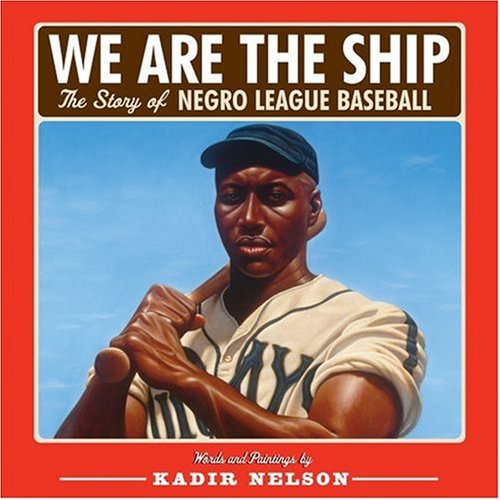
Review: We Are the Ship: The Story of Negro League Baseball by Kadir Nelson

If you like history, sports or awesome art then you need to read We Are the Ship by Kadir Nelson. It turns out "America's favorite pastime" has a complex and fascinating history.

The players in the Negro League lived for baseball. Conditions weren't always great for these ball players, and sometimes conditions were terrible, but they knew they were doing something important.    

Nelson's oil paintings are fantastic. Several reminded me of trading cards with players striking a pose. Some show the team on the road and others catch players in action swinging the bat or pitching the ball.

The book immerses the reader in baseball. Each chapter is an "inning" building suspense to the end of the League's history. The book also immerses readers in the history of racial segregation and shows how these men wouldn't let anything stop them from playing ball - their way.
Summary: "Using an 'Everyman' player as his narrator, Kadir Nelson tells the story of Negro League baseball from its beginnings in the 1920s through its decline after Jackie Robinson crossed over to the majors in 1947. The voice is so authentic... But what makes this book so outstanding are the dozens of full-page and double- page oil paintings--breathtaking in their perspectives, rich in emotion, and created with understanding and affection for these lost heroes of our national game."

While I found this book in the kids section the narrator is compelling and has an adult voice. Baseball enthusiasts of any age will appreciate this amazing true story.  This book counts towards the POC Reading Challenge! For more information visit the book's website!

Publisher: Hyperion Book, 2008      Pages: 96
Rating: 4 Stars      Source: Public Library

Saturday, March 19, 2011

Review: Young Adult Literature: From Romance to Realism by Michael Cart

Michael Cart’s latest work chronicles the development of young adult literature from its recognition in the 1960s to its present boom in the 21st century. Expanding upon his 1996 edition, Cart includes new discussions about poetry, nonfiction, graphic novels, audiobooks and the role of young adult literature in a multimedia age. Cart showcases various breakthrough texts and awards in the category revealing his role as an expert in and contributor to young adult literature.   

In “That Was Then,” the first of two sections, Cart and investigates how cultural shifts influenced YA lit in the 1960s-1990s. Realism emerged in issue-oriented/problem novels like Robert Cormer’s The Chocolate War.  But many were plagued by formulaic plots and imitation in the late 70s. Cart perceives “the problem novel is to YA what soap operas are to good dramas” (32). Eventually, readers rejected the problem novel and to some extent realistic fiction.

Providing escape, romance dominated most of the 80s and one can sense Cart’s dismay as problem novel sales plummeted  in the early 90s.  Cart blames sensational TV (like Jerry Springer) for reality’s unpopular status in literature. In part two, “This Is Now,” Cart explores the rise of new genres and formats in the 21st century. He delves into the Harry Potter phenomenon and consequent appeal of crossover novels.

Clearly Cart prefers darker, edgier literary titles, which he believes reflect reality. Whether this is true or not, his zeal for young adult literature is impossible to escape. Pointing out YA lit awards, such as the Printz Award which he helped create, Cart continuously reveals how libraries help shape and are shaped by young adult literature. Cart leaves the reader pondering creative formats which champion realism such as nonfiction graphic novels and photoessays. The text provides a comprehensive history of young adult literature and is an insightful and often humorous text. It is likely to interest MLIS students, current practitioners interested in improving readers’ advisory skills to young adults or those doing literary studies.  If you’re looking to understand how YA literature is created today there’s no better way than to study its history in From Romance to Realism.

Publisher: ALA, 2020     Pages: 242
Rating: 4.5 Stars     Source: U of Iowa Libraries

Saturday, February 26, 2011

Review: Bad News for Outlaws by Vaunda Micheaux Nelson

This book was awesome! Gun fights, chases, escapes! Indians, cowboys and slaves. Hardship, justice and honor. It’s the Wild West folks and this is the true story of a slave who became a U.S. deputy Marshal. His name is Reeves. Bass Reeves. And he is Bad News for Outlaws!

This is nonfiction done right. I loved the art work (looks like oil paintings) and the story was fascinating. Both totally captured the spirit of the old West. Many of the text blocks look like they are printed on yellowed paper. The font looks Western, too, big and bold. R. Gregory Christie’s illustrations capture the emotion of each moment being described. Bass’ gaze is piercing. There’s no messing with that man. 

This is well researched book and it shows. There are many amazing anecdotes pieced together from historical records. There are extra resources in the back including a glossary of Western terms used in the book, a timeline, a further reading list and much more.

I was completely captivated with Bass’ story. Although it’s aimed at 2nd-5th grade readers, if you know anyone who enjoys all things Western I urge you to put this book in their hands. This title counts towards the POC Reading Challenge! Well, this was a hard review to write. I just wanted to use the word "awesome" over and over! 

Publisher: Carolrhoda, 2009     Pages: 40     Illustrator: R. Gregory Christie
Full Title: Bad News for Outlaws: The Remarkable Life of Bass Reeves, Deputy U.S. Marshal
Rating: 5 Stars     Source: IC Public Library

Tuesday, February 8, 2011

Review: The Dismissal of Miss Ruth Brown by Louise S. Robbins

History, what we know of the past, is often told by the victors. Having transcribed countless interviews, faithfully scoured dusty files and coils of microfilm, Louise S. Robbins forms a more complete account of Ruth Brown’s career as a librarian. The text is a scholarly endeavor to bring about a more accurate picture of a “perfect town” that wasn’t so perfect after all. It’s a true story about racism and about standing up for what you believe. About censorship and the public library’s role towards it at a critical time in American history.

An abbreviated summary: “In 1950 Ruth W. Brown, librarian at the Bartlesville Public Library, was dismissed from her job after thirty years of exemplary service, ostensibly because she had circulated subversive materials. In truth, however, Brown was fired because she was active in a group affiliated with the Congress of Racial Equality.”

If you are interested in the civil rights movement, information and library science, libraries generally, censorship or American history I definitely recommend this book to you. It is told like an elongated form of investigative journalism and tends to be fact heavy. What I most enjoyed about Ruth Brown’s personality was how, despite her appearance, she was anything but a stereotypical librarian (especially for her day).


Publisher: University of Oklahoma Press, 2001     Pages: 256
Rating: 3 Stars     Source: purchased

Wednesday, May 5, 2010

The Help by Kathryn Stockett

By now, what has not been said about this number one, top selling novel? That’s more of a statement than a question. I doubt I can say anything that hasn’t been said before. My hope is that if you haven’t read The Help you’ll beg it off your friend, get in the hold line at your library or break down and purchase it because why? Because it is worth it. I know some people have a few complaints that run along the lines of: the ending was anti-climatic or the dialect bothered them. Some more serious complaints are that it’s just one more bash on Mississippi. Even if you finish and wonder what all the fuss is about I promise you won’t be disappointed that you read it.

I wasn’t sure what this book was about when I decided to buy it. I knew it was set in the Southern U.S. during the 1960s and there was something about a lot of women afraid to follow after whatever it was they wanted. And that there would be racial issues thrown in there. This is a terrible summary. However, not knowing what I was in for left me deliciously and delightfully surprised. I didn’t expect to become engrossed by a maid’s daily life. I didn’t expect to laugh out loud on several occasions. I didn’t expect to learn and this novel enlightened me about how complicated the civil rights movement was for many different (but not so different) people.

This book was a pleasure to read. As a rule, I don’t mind dialect but I find it slows my pace down. Truly though, I savored every page. The story alternates between three women’s point of view: one young white woman, one middle-aged black maid and one not-quite-old black maid. I adored all the voices but Aibileen’s (the eldest’s) was my favorite. There is so much tension, anxiety and fear in these women’s lives because of their desire to tell the truth. I felt nervous for them and kept hoping they’d find a way to iron out the wrinkles (hehe. Aibileen hates ironing pleats). I feel this book is a must read for those living in the U.S., perhaps especially my 20-something generation who have grown up in a different era and have little understanding of what daily life was like in the South during the 1960s.

So, I have this great thing called a public library. And mine hosted the author, Kathryn Stockett, who stopped by on her way to the Windy City to speak, read and sign our books! Hearing her speak was a blast. If you have the opportunity to see her, do it! She spoke a bit about her anxieties being a white woman writing in the voice of black women. Stockett had a black maid growing up and this book is her way of expressing many of the things she has learned about what life was like for the help. In case you’re curious, she said two of her favorite authors are Lee Smith and Kaye Gibbons (among many others). She has an awesome southern accent! And in response to a question said that no, she is not Skeeter (the young white protagonist), that she was never as brave as Skeeter or able to ask those kinds of difficult questions when she was a child. I think she was rather brave to write this story, though. Ms. Stockett was gracious enough to let me take my picture with her so, there we are. Now, go get yourself a copy of The Help and settle in for a good read.
Publisher: Amy Einhorn Books, 2009     Pages: 451
Rating: 5 Stars                                             Source: Purchased on Amazon

Tuesday, April 27, 2010

Esperanza Rising by Pam Munoz Ryan

When I picked up this book I thought I knew what I was in for. But apparently I was ignorant of the largest involuntary migration in the U.S. – that of Mexican workers, many legal citizens, who were forced to move to Mexico during the Great Depression. Esperanza’s story is set during this turbulent time. The daughter of a wealthy Mexican rancher, Esperanza has everything she could ever desire. But in one night her life changes and she and her mother migrate to California to work on a farm labor camp. While the Great Depression rages, Esperanza adjusts to the difficulties of her new life.

I enjoyed Esperanza’s story, based off Ryan’s grandmother’s life. The writing is interspersed with Spanish making this a very cultural text. I think this is an excellent book for kids to learn about the difficulties of emigrating families, the richness of Mexican culture as well as the history surrounding the Great Depression. I find this story particularly relevant today as we come out of our economic slump. With so many unemployed, sympathy for non-citizen workers definitely fades. Esperanza’s story reminds us that everyone deserves humane treatment and that stereotyping has never helped our country in the past. That’s what I got out of this text, anyways! I will tuck away this title in my memory bank for my future kid someday.
Publisher: Scholastic, 2000      Pages: 262          Source: IC Public Library
Rating: 4 Stars                             Recommended Age: 10 and up

Sunday, March 28, 2010

American Lion: Andrew Jackson in the White House by Jon Meacham

To fulfill my reading quest for the seventh President of the United States, Andrew Jackson, I chose a substantial and more recent text. I was really excited to read about this dynamic president known as Old Hickory. I wanted to hear about his gallantry at New Orleans during the War of 1812 as well as his coercion and cruelties towards Native Americans. For some reason I thought the head title American Lion meant this text would delve into Jackson’s rough temperament. And it does touch on these subjects; however, the subtitle, in the White House, should have told me that this text focuses on the inner life at the White House during his presidency and not as much on pre or post White House events. In fact, much of the information was about Jackson’s family and how it played an important role in his moods and politics. I became bored with his niece, Emily, whose ideas on who was or was not respectable practically lead to the breakup of Jackson’s cabinet. His family life was important to politics but I felt the text lingered on these issues for far too long. I wanted more about the war hero and less about his family. I got hardly a paragraph on the War of 1812 and am disappointed by that. The text does deal fairly about Jackson’s managing of the Indians and I felt satisfied on that point even if it was sort of brief. Jackson’s issues with the U.S. Bank drag on forever as Jackson became consumed with crushing the institution. Jackson did face serious adversaries from within that threatened the Union which he carefully dealt with to avoid (or postpone) civil war. The text shows how Jackson singlehandedly increased the power of the Executive by the force of his will. So, he did exercise shrewdness in these respects.


I think the text would be more accurately called American Father: Jackson in the White House since Meacham constantly refers to him as a father and how Jackson referred to himself as a father to his supporters, extended family and even Native Americans. This bio hardly touched on the aspects that made Jackson a lion. We rarely see him on the attack during his time as president (save the bank issue) but more as a protective father figure. The prose has a tendency to wander. In one paragraph we hear about Emily and her parties and in the next, Clay and Calhoun’s plots to undermine the president. Subjects are not well weaved together. On the other hand, this text does give the reader a look at the intimate life of Jackson during his two terms. It tells us what it was like for family who lived with a president subject to swings of temperament and a need to control his surroundings. Ultimately, I wish I chose a bio that encompassed Jackson’s entire life to get a better view of his lion-like image. I may have to find a text with a chapter or two that focuses on pre-White House Jackson to get my Battle of New Orleans fix.
Publisher: Random House, 2008     Source: IC Public Library
Rating: 2.5 Stars                                          Pages: 361, 483 with acknowledgments, notes and index

Monday, March 1, 2010

John Quincy Adams by Robert V. Remini

After a two year break (mostly because of school), my quest to read biographies/autobiographies of each president in chronological order continues with Prez number 6.

This is the second biography from “The American Presidents” collection I’ve read. They are concise and compact bios with enough substance to be informative without getting into the nitty-gritty details. This makes the series nice for those with general interest who don’t want to commit to a detail oriented (and much thicker) bio. This text was exactly what I was looking for. Having read David McCullough’s excellent biography on John Adams, Sr. (all 752 pages), I felt I knew enough about JQA that I didn’t need minute details of his youth repeated to me. Considering JQA kept lengthy journals nearly all his life, I wish there had been even more quotes from him. Other than that, I’ve no complaints with Remini's text.

John Quincy was a genius in several areas, perhaps most notably language. His command at an early age of languages (including French, German and Latin) gave him a great advantage in foreign countries in which he represented the United States for many years. His skill as a foreign diplomat was a great asset to a country that desperately needed foreign recognition as a sovereign power. There’s much more to this man but I’ll let you read his bio for yourself. =)

As always, reading Presidential bios is a great way to learn about U.S. history, the creation of political parties, early journalism and different interpretations of the Constitution throughout time not to mention what early life in America was like. Bios make two-hundred-year-old history come to life by revealing how those lives were lived. How did Mrs. Adams like the White House? What was family life like for a Presidential dynasty? Did you know JQA swam in the Potomac on a regular basis? Presidents are unique people to say the least and John Quincy was no exception.
Publisher: Times Books/ Holt, 2002      Source: IC Public Library
Rating: 3.5 Stars                                   Pages: 155 (172 to the index)