Showing posts with label survival. Show all posts

Thursday, October 24, 2013

Review: The Immortal Rules by Julie Kagawa

Allison lives in the outermost circle of a walled-in city. Inside, humans are herded like cattle for vampires. Outside the walls live another blood-thirsty terror -- rabids. “Registered” humans give blood annually to vampires in exchange for food and clothing. Unregistered, like Allison, do not give their blood willing and are forced to scavenge. An unfortunate run-in on a scavenging raid forces Allison to become what she hates most.

The premise of The Immortal Rules caught my attention quickly and I enjoyed the overall storyline. Kagawa complicates the the zombie theme by introducing vampires into their origins. I enjoyed how the story unfolded, learning as Allison discovers how the vampire hierarchy has created a ruling elite across the country.

Allison is a survivor. She does what she must to live another day. She takes risks which lead to steep consequences. She also struggles to keep her new bloodlust in check so that she might protect herself and others. There is a seemingly doomed romance and plenty of action to keep teen readers turning pages.

Those who can’t get enough vampires stories will want to put The Immortal Rules on the their list. It is the first in a trilogy so get ready for an open ending. 

I'm really mixed on this book; I liked it but didn't love it. The action scenes were good, the vampire history and relationships interesting, the rabids fierce, the human nomads strangely rustic. But for me, the first person narration and obligatory-but-nothing-special romance detracted from an intriguing  premise. I’ve added the second book, The Eternity Cure, to my reading list but it may wait for some time.

Publisher: Harlequin Teens, 2012     Pages: 485
Rating: 3 Stars     Source: Public Library

Tuesday, June 12, 2012

Review: A Confusion of Princes by Garth Nix

Taken from his parents as a toddler, Khemri was groomed to be a Prince of the Empire -- a biologically, technologically and psychologically upgraded human, one of thousands who rule the Empire, governed only by the Imperial Mind. Having come of age, Khemri is elated to take a post as Prince. But the Empire is a more dangerous place than he was lead to believe and power and glory more elusive and less thrilling than he expected.

The book begins with a great hook: “I have died three times, and three times been reborn...” (1). Nix quickly introduces the technologically advanced world via Khemri’s voice. He tells his story of transformation from an obnoxious and egotistical teen (an gross exaggeration of teenagers generally?) to a more thoughtful, mature adult. As with Nix’s Abhorsen series, I enjoyed how the protagonist deals with real coming-of-age issues, albeit in a sci-fi setting here. Khemri’s transformation is that of many teens’. While Khemri may fight his battles in a spaceship, his transformation from identity/thrill-seeking teen to a more mature adult is relatable.

I was excited to read A Confusion of Princes as I am a fan of Nix’s Abhorsen/Old Kingdom series. I’m re-listening to Lirael now. I enjoyed the hierarchy within the Empire with its unique system of mental communication. Yet, the novel could have used another hundred pages. The plot moved too swiftly and didn’t leave time to explore this interesting world and its characters. As a survival story, A Confusion of Princes did not disappoint. But more character development was needed.

On an aside, Khemri’s character is repeatedly defined as being brown-skinned with dark eyes. Yet, the character on the cover, though hard to see clearly, looks to be white. I like the cover on its own but would have liked it more if the guy on the cover clearly represented the character in the book.

Nix fans won’t want to miss A Confusion of Princes with its unique, technologically advanced world. Khemri’s story will please teens who enjoy Star Wars, space operas and survival stories. Overall, I think I’m more of a fantasy fan than science fiction fan but I still enjoyed this story. This book counts towards the POC Challenge. Favorite Quote: "'There is always a choice,' said Morojal. 'Even if the alternatives don't appear to be equal'" (134). Publisher: HarperCollins, 2012 Pages: 337 Rating: 3 Stars Source: Public Library

Monday, April 2, 2012

Review: Best Shot in the West by Patricia C. McKissack and Fredrick L. McKissack, Jr.

Nat Love, or “Deadwood Dick,” was among the greatest cowboys who ever lived. Daring and dangerous when he needed to be, Nat was a natural at breaking broncs and shooting straight. A freed slave from Tennessee, Nat journeyed west to find work that rewarded his abilities.

A graphic novel, Best Shot in the West, is a dramatized version of Nat’s story mostly adapted from his autobiography. Is this fiction or nonfiction? Nat was a real cowboy. But the author’s note explains they dramatized certain scenes for the sake of the story’s flow. The inside cover describes the book as historical fiction while the Library of Congress subject heading inside says “Biography.” My library has it under Biography as well. It may be that the availability of factual materials on Nat and legends and myths about him make it difficult to create a totally factual story of Nat’s life. Ultimately, I am unsure but still enjoyed the story.

Like comic books, the story and illustrations are broken into panels with speech bubbles and blocks. Illustrator DuBurke’s paintings are muted but dramatically portray cattle stampedes and shootouts. The backgrounds are colorful while people and objects in the foreground are greyish. It’s an interesting technique but sometimes I wanted a clearer picture of people’s faces.

So, we all know that Hollywood tends to skew reality and Wild West films are no exception. But the exact ways that movies skew things may allude us...we know things are inaccurate but we’re not sure how exactly. This is the second book I’ve read about men from the Wild West and they were both African American and had amazing life stories, legends of their time, and  worthy of movies of their own. I would totally watch a movie about Nat Love. While reasons for Indian/Cowboy conflict are alluded to, especially when Nat is captured by an unusual tribe, adults may need to point out the complexities of why Indians conducted raids and why they captured Nat (instead of killing him) as the story is focused only on Nat’s perspective as a loyal cowboy.

Best Shot in the West is a story for kids interested in cowboys, horses, outlaws and crack shots. I recommend this story since it provides an important perspective on what it took to be a cowboy and what type of people cowboys were. This book counts towards the POC Reading Challenge!

Publisher: Chronicle Books, 2012     Pages: 133     
Full Title: Best Shot in the West: The Adventures of Nat Love
Illustrator: Randy DuBurke
Rating: 3.5 Stars     Source: Public Library

Tuesday, December 6, 2011

Review: The Death Cure by James Dashner

The Maze Runner trilogy comes to a dramatic conclusion in The Death Cure. Thomas and the Gladers escaped the Maze (book 1) only to be thrown into the zombie infested Scorch (book 2) as part of a desperate experiment to save mankind from the Flare -- the zombie disease. Now, as all the variables have been tested for, Thomas realizes his role in the testing runs deeper than he knew.

The setting of each book is distinct, creating unique environments which the characters must survive in. The Death Cure's is an urban setting in the dead of winter. The last surviving towns are walled off to ensure the Flare is quarantined but civilization is crumbling as more and more people succumb to the disease.

Thomas realizes that fleeing is not an option as the city of Denver goes mad with disease and desperation. Instead, he confronts WICKED, the organization responsible for the tests, in order to get the answers he needs  about his past so he can decide what to do with his future.

Confronting WICKED results in a lot of fighting and near death escapes much like the first two books. Yet, I felt like The Death Cure dragged on a bit. Unlike the first two, this book did not keep my attention. I wasn't hanging on at the end of each chapter. The answers to some of the long-standing questions throughout the series were a little flat. I expected something slightly more clever or more grey. And the grand conclusion was a tad too easy and felt unusual for Thomas' character.

Fans of the series won't want to miss The Death Cure because if you're like me you'll have to know the ending to the story. Many characters from the first two books resurface to play interesting roles. This series isn't for the faint of heart. There's gore, death and destruction. Don't get too attached to a character because you never know when someone will turn zombie or turn coat. Despite the slight let down in book three, I have really enjoyed this young adult series and recommend it to dystopia fans.

Publisher: Delacorte, 2011     Pages: 336
Rating: 3 Stars     Source: Public Library

Tuesday, June 28, 2011

Review: Zan-Gah by Allan Richard Shickman

Zan-Gah is eager to become a man but his journey towards adulthood is perilous. The story opens with an exciting lion hunt which captured my attention right away. Later we learn that Zan’s twin brother, Dael, is missing and Zan-Gah is determined to find and bring Dael home. Like most quest stories the object sought is less important than journey. Zan’s travels test his strength and wisdom as he crosses the borders of hostile clans and landscapes.

The novel left me wanting more. I enjoyed the descriptions of the landscape and liked watching Zan survive harsh environments. Yet I wanted even more description. Sometimes I felt the plot moved too quickly, skimming over things I wanted to know more about, like Zan’s time with the Wasp people where he spends a year which is briefly mentioned in one sentence. Shickman’s writing was clear and never confused me. The tenor of the prose gave me the feeling that the story is very old which is fitting since the subtitle is A Prehistoric Adventure. Yet the simplicity of the prose, and its many well-used figures of speech, again left me wanting more.

The story has a lot of action and brief but strong violence which kept my attention. It also has some great themes like learning to forgive and asking for help. I was a little surprised at the ending. Shickman chose to end the novel talking about Dael, and not the hero Zan-Gah. I found this a bit anti-climactic. Though he fit into the storyline, Dael was a bit of a downer character and since it’s not a story about Dael I was confused why it ended talking about him. There is a sequel, Zan-Gah and The Beautiful Country which I suspect will fill in some of the blanks and looks like it will continue the twins’ story.

While reading, I kept thinking about Gary Paulsen’s Hatchet. Personally, I enjoyed Zan-Gah more than Hatchet but they are very similar in that a boy is on his own surviving in the wilderness for a good part of the story. I would recommend Zan-Gah to middle school boys who enjoy survival stories. This text counts towards the PoC Reading Challenge!

Publisher: Earthshaker Books, 2007     Pages: 148
Rating: 3 Stars     Source: Received for free from the publisher. Thanks, Earthshaker!

Wednesday, December 15, 2010

Review: Mockingjay by Suzanne Collins

Collins did a fabulous job! What a great ending to The Hunger Games trilogy. The plot had many little unexpected moments that thrust Katniss into difficult situations. I felt the secondary characters really came to life in Mockingjay. They all had important roles to play. The love triangle endures until the choice becomes clear to Katniss who, finally able to let the “act” drop for the cameras, can make up her own mind. I think she made the right choice.

I feel like I need to defend Katniss, our heroine. I know most people enjoyed Mockingjay but I’ve seen a few reviews of some who didn’t like it. They thought there was not enough gore or that Katniss became weak and allowed herself to be bullied. I didn’t find either circumstance to be true, especially the later.

What I liked about Mockingjay:

***************************Mild Spoiler Alert*****************************

-It gave a fairly realistic look at what happens to someone who goes through a traumatic experience. The truth is, that unless one is cold hearted, then killing someone, even in self-defense, is going to affect a person. Also, knowing someone you love is in constant danger is hard to cope with. I’ve been a military wife. I know what I’m talking about. But I can’t imagine having to watch someone I love be used and abused.

-When you’re sick physically, emotionally and psychologically it is easier to be taken advantage of. Even if Katniss had been unscathed by her circumstances it still would be difficult to know who to trust and how to act. What was a 17 year old to do? Spit in the face of district 13 who gave her people shelter just because she had suspicions? I don’t think so. 

******************************End Spoiler*********************************
Throughout the series, but especially in Mockingjay, I liked the focus on media. Almost as much as on the battle field, the war for the districts is waged on television. Katniss’ appearances on T.V. cause the balance of power to rock back and forth. The Fourth Estate, the watchdog, a.k.a. the media, is supposed to watch out for the interests of Everyman. But who’s watching the watchdog? I like the opportunities this series gives 
kids to think of larger issues in our society. 

Publisher: Scholastic, 2010           Pages: 390
Rating: 5 Stars                                 Source: I won this book from The Nerd’s Wife! Thanks!

Thursday, December 2, 2010

Review: The Scorch Trials by James Dashner

You know you’ve caught the Flare when:
  • Your thoughts are hard to focus
  • You aren’t afraid to drop 30 feet to the ground
  • You’ve forgotten why you ever wanted to escape the Scorch
Thomas and the Gladers left the Maze only to begin another round of trials by WICKED (World in Catastrophe Killzone Experiment D). If you thought The Maze Runner was exciting then you won’t be disappointed with The Scorch Trials.

As Thomas’ memories slowly come back he figures out he is more connected to WICKED than he ever knew. The mind games keep the Gladers in a constant state of confusion and cause Thomas to question everything he knows about himself and his friends. To top it off, the Gladers are informed they have a disease known as the Flare which causes people to lose their minds and slowly mutate into zombie-like creatures known as cranks.

The cranks were creepy and not your typical zombies. Some of the not quite full-blown cranks are still able to talk and groups of cranks roam together in groups according to the stage of the disease. Definitely creepy. As was the setting. Dashner does a good job describing the crispy, sun-baked Scorch which the Gladers must travel across. Some of the descriptions were a little gruesome. This is a violent book. People get hurt and die which only adds to the mystery surrounding WICKED’s intentions.

Like Thomas, I never knew exactly what was going on, who to trust or what to expect. The only thing you can expect is that WICKED is going to run its experiments on the Gladers and will stop at nothing to get the data it’s looking for. I’m with Thomas – how can WICKED by good (no pun intended)? I’m really looking forward to the third book to find out what the trials are all about and how Thomas and Teresa are connected to it all. So, no you won’t get any definitive answers in this book – just the kind of answers that make you ask more questions.

As with the first book, The Scorch Trials is fast paced. Each chapter is short, only 3-5 pages long and ends with a teaser making it a good book for reluctant readers. The prose is fairly simple and linear but the plot is interesting and exciting. Dashner knows how to create suspense. It was the perfect book while I was busy in school and needed something fun to read.

The Scorch Trials is book two in the Maze Runner Trilogy.
Publisher: Delacorte, 2010.     Pages: 368       Recommended Age: 13 and up
Rating: 4 Stars                           Source: IC Public Library

Wednesday, October 27, 2010

Review: The Higher Power of Lucky by Susan Patron

What is a children's book? What exactly constitutes a children's book? Before you continue reading I'd like you to take a moment and list three attributes that you think are essential to children's literature. I'm not asking for what makes "good"children's lit but rather just what makes a book a kids book.

Here are my off-the-cuff conclusions:
  • The writing style must be geared for children. It must be at a level which they can read and understand.
  • The text must engage children with a subject or theme in some way that it highlights the interests of children regarding the subject.
  • The entire book (its format, images and print) must acknowledge the psychological and developmental needs of the intended reader age group.
I realize the first and last points are similar but it was hard to define children's lit. In fact, I don't think I can come up with any more "must have" attributes.

Are there attributes that, under no circumstances, could (or should) never be found in a children's book?

Excepting the logical opposites to my three criteria above, my answer (for now) is no. I think that every issue- social, political, etc. - can be broken down (I don't really like this phrase) in such a way that kids can digest it. The Higher Power of Lucky by Susan Patron attempts to do this. It takes some real life issues and scrutinizes them under kid-savvy glasses.

Have you ever encountered a children's book that made you wonder why it's considered a children's book? The Higher Power of Lucky is one of these children's books that makes me wonder at the definition. It seems that many "children's" movies are geared for adults and so are some books.

It was C.S. Lewis who said, "A children's story that can only be enjoyed by children is not a good children's story in the slightest." 

And I agree. I think this book is one which may be enjoyed at all ages - a sign of a really good book in my opinion.

Now, The Higher Power of Lucky created quite a stir after it received the Newberry Medal. Librarians were banning it. People were trash talking it. And as is usual, people doing so were often ignorant of the book's message. People were getting hung up on the use of the word "scrotum" on page one (a poor dog is bitten there) and were uncomfortable with young children knowing this word and what it meant.

Personally, I am in favor of teaching children about their bodies and that of the opposite sex. We do not live in the dark ages. Knowledge is paramount to raising healthy well-adjusted people. But at what age to we "reveal" these secrets (that aren't really secrets at all because kids have bodies, too)? When is it age appropriate? I'm not talking about having an in-depth sex-talk with your 3rd grader. But if Lucky, the ten-year-old protag, like most kids her age, is simply growing up and learning about genitalia by incidental means, is it not a good time to be straight forward about the subject instead of being secretive and making the child feel uncomfortable because the adults are talking about something (s)he's not supposed to know? But sex education is not at all what this book is about.

Lucky lives with her Guardian, her out-of-the-picture father's first wife, because her mother has died. Lucky deals with insecurity about her Guardian's affection for her, about (her town) Hard Pan's ability to survive poverty, and about her self-worth. She seeks to create a "higher power" for herself to guard against the day she might hit "rock-bottom" like many of the inhabitants of Hard Pan.

Lucky's best friend, Lincoln, offers a different perspective on the issues surrounding her. He always has a listening ear and some insightful comment to make. He helps Lucky figure out her place in the confusing world of adults. But things come to a head for Lucky and she decides to take matters into her own hands, ultimately leading to an epiphany.

I did like this book. But a part of me knew that if I read it as a child I would not have thought much of it. The text is very well written, beautifully so, while still at a child's level. But some of the themes are so deep that I know I would have missed them and probably thought the book was boring. Besides Lucky running away, there was not much adventure. And I'm sure I would have thought the supporting characters were annoying instead of cute like I do now. This story is a quest for personal enlightenment and growth - not necessarily something kids eat up. However, many kids do like the text. I guess what I'm saying is, it's very literary for a 9 year old.

Is this book for adults? Definitely.
Is this book for kids? Yes and no. I don't say "no" because of the controversy but rather because of the heavy themes.

Tell me, what do you think makes a kids book a kids book? And if you've read it, is The Higher Power of Lucky a kids book? An adult book? Both?

Publisher: Atheneum, 2006     Pages: 134     Source: Purchased on Amazon
Rating: 4 Stars     Recommended Age: 9 and up

Monday, July 26, 2010

Review and Giveaway: Sapphique by Catherine Fisher

Sapphique is the sequel to Incarceron (my review), an epic fantasy by Catherine Fisher. I read Incarceron a couple months ago and really enjoyed it and couldn’t wait to read more about Finn the cell-born, Claudia the proud aristocrat, Jared the wise, Keiro the “oath brother,” and Attia the “dog-slave” girl not to mention the plotting Warden and the conniving Queen of the Realm.

Things don’t look good for those trapped in the heinous intestines of the world’s largest prison. Will the Queen win and obliterate Incarceron, damning its inhabitant? Or will Incarceron triumph and take total control. Where is the Warden? Where are the Keys? Does Escape exist? Who is this legendary hero, Sapphique? Does Finn even know who he is? Will Keiro’s bravado help or make things worse? If you’ve read Incarceron you’re probably dying to know the answers.

The characters are well developed and I enjoyed getting to know them more. Without his oath-brother’s presence, Finn is given the chance to step-up and prove himself. It was interesting to watch his development from tortured soul to commanding heir.

Claudia matures as she learns to see life through others’ eyes. She understands more fully that ending Protocol, the enforced low-tech aristocratic society, will mean her fall from luxury.

A new figure makes an appearance in the prison, the Enchanter. His role threw me a little and here’s why: I enjoyed the rational, “scientific” explanations for how the prison works and for how the Realm is run. As with most science fiction, there are devices that do amazing things – time travel, space travel, etc. – and the reader just accepts that they work, ya know? And I could accept how gadgets work in Fisher’s books, too. But the Enchanter brings the element of magic. Is it real, are we supposed to believe it’s real?

Mild Spoiler Alert: The asterisks below signal a spoiler-free zone.

Especially at the end, the explanations and loose ends were tied up with magic. I felt this was a cop-out and wanted what I had come to expect, a more “scientific” explanation if you will, for all the answers.

****************************************************

Ultimately, Sapphique was entertaining and a must read if you’ve read the first book. It did take awhile for me to become interested in the story again. But about half way through I began tearing up the pages to find out what the heck was going to happen! There are enough twists to keep things interesting. If you liked Graceling or enjoy fantasy with a sci-fi feel to it you might like these books, too.
Publisher: Hodder Children’s Books, 2008 (UK version)     Pages: 470     Source: I won this book!
Rating: 3.5 Stars     Recommended Age: 12 and up
 
I'm giving Sapphique away to one lucky winner in the U.S. Click HERE to fill out an entry form!

Thursday, July 8, 2010

Review: Catching Fire by Suzanne Collins

Catching Fire, book two in The Hunger Games trilogy, captured my attention right away and I was gripped by the story for the entire read. A couple times I had to put the book down for a second, look up at my husband and gasp “No way!” to which he looked at me confused and then I went back to reading. This is a seriously entertaining series. If you haven’t begun The Hunger Games yet, you really need to.

Katniss and Peeta survived the brutal Hunger Games only to become unwitting symbols of resistance to the Capitol. The Districts have become increasingly disgruntled by the Capitol’s abuses. And Katniss’ refusal to be a pawn in the arena has sparked a fire that neither she nor Peeta can control. The Capitol hits hard in retaliation in an attempt to control “the girl on fire.” My reivew of the first book can be found here.

The characters developed nicely in the sequel. I liked getting to know more about Haymitch, District Twelve’s only other survivor/victor of the Games and Katniss and Peeta’s mentor. We really get to see why he has turned to alcohol and also, why he has learned to care so much about Katniss and Peeta and vice versa. We get to see Katniss’ mother more as she springs to action (remember she was mostly depressed and defunct in the first book). I liked seeing the mother daughter relationship being healed. And we see more of Gale’s family so, even while Gale is often absent, we learn more about him through his family.

There’s just as much action and adventure in book two. Things get violent as the Capitol closes in. You can feel the stress riddling the characters. It’s only a matter of time before the spark turns into a fire. As usual, I enjoyed Katniss’ strong personality. She deals with events as best she can. She’s a little head-strong but that’s definitely a quality needed for survival.

The romance between Katniss and Peeta, a forced pretense on her part for survival and genuine on his part, becomes even more complicated. How should she feel about the boy responsible for saving her life? But then there’s her best friend Gale? Oh, dear. I’m not sure yet, but I think I’m voting for Peeta. I reserve the right to change my mind. Lol. The romance is still rather innocent but they do get close and kiss often for the cameras. My slight concern for young readers is Katniss’ melt-down when she gets drunk one night. It’s not something she’s proud of and doesn’t happen again. But adults may want to mention that Katniss’ behavior here is not normal and that alcohol didn’t help her at all to solve her problems. This is a very small incident in the book and I wouldn’t let it stop adults from letting kids read it.

The writing is written with the same POV as the book one – in first person, present tense from Katniss’ perspective. As with the first book, it took be a few pages before I adjusted to the writing style but it was less of a problem for me in book two. Overall, I think Collins is a great young adult writer. I can’t wait for Mockingjay’s release in August!
Publisher: Scholastic, 2009     Pages: 400     Source: U of Iowa Libraries
Rating: 5 Stars     Recommended Age: 13 and up

Sunday, June 27, 2010

Review of The Forest of Hands and Teeth by Carrie Ryan

When you think “zombies” what comes to mind? Do you think of the latest video game or horror movie that features some skinny chick lopping off heads? Not your thing? Not mine either. Yet, I have inadvertently read two zombie books in a row. But both are completely different and neither are what I would have expected from a zombie story.

The Forest of Hands and Teeth by Carrie Ryan is an eerie and proactive young adult novel. The writing was great. In fact, it’s some of the best writing I’ve come across in the YA genre. Mary tells the reader what it’s like to live in the confines of a village surrounded by a fence keeping out the Unconsecrated, also known as the infected or zombies. When the Sisterhood, entrusted with the village’s history and safety, betrays Mary’s trust and a breach occurs she must choose between the home she knows and the unknown world in the forest.

Mary’s story is completely believable. She is young and impetuous, even a bit reckless. Sometimes I liked Mary. Sometimes I didn’t. Overall, she felt like a real person whose future I was invested in. The confusion that Mary encounters, living in such a crazy world, is mirrored in her thoughts and actions. She tries to care for others but knows that she must trust her instincts if she is to have some peace of mind.

This is one of the big questions in the novel. Is survival enough? Is personal fulfillment selfish when others depend on you? Does falling in love give one the right to give up on life?  Does true love require the sacrifice of one’s dreams? How much sacrifice is acceptable? Personally, I think these are great questions for young adults to ponder.

The descriptions of the zombies were great in a not-too-overly gory but in a suspenseful, creepy and realistic way. There is lots of moaning and jaw snapping. Killing zombies is not what this book is all about, though several do get cut down at climactic moments. There is something of a love triangle, nay quadrangle, but it is seamlessly woven into the plot. So, those who like a little romance in their stories will be satisfied while those not huge on romances shouldn’t be put off either.

If you like suspense, fantasy or paranormal/paranormal romances then Ryan’s text is probably something you’ll like. Note, I don’t think this counts as horror even though it’s classified as such. I wasn’t horrified and I’m rather wimpy. If you’re looking to try out one of these other genres, The Forest of Hands and Teeth would make for a fun introduction. End of story, I loved this read and can’t wait to get my hands on the sequel.
Publisher: Delacorte, 2009    Pages: 310    Source: U of Iowa Library
Rating: 5 Stars        Recommended Age: 14 and up

Saturday, April 24, 2010

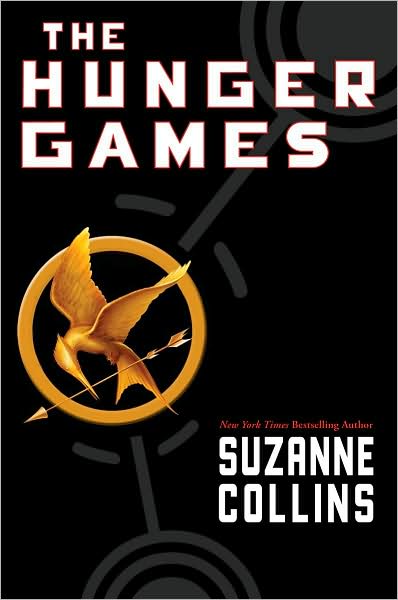
The Hunger Games by Suzanne Collins

The Hunger Games was a nice treat. I’ve been drifting awhile in the sci-fi/fantasy genre and, finally, I’ve found what I’m looking for. This is a dystopian plot set in a post-U.S.A. North America that is broken into twelve districts. It’s a clever set-up and serves as a nice backdrop for the lives of those forced to play the hunger games – a Coliseum-like event set in the 21st century. Sixteen-year-old Katniss Everdeen is in the unfortunate position of a “tribute” or a player of the Hunger Games. She must search and destroy the other players before they seek and destroy her.

This book has some great action and adventure while teenagers fight for survival in the expansive arena. Weapons are used. People die in not so good ways. But all in the name of entertainment. Or, is it that simple? No, no! Just as the emperors of Rome used the Coliseum, the games are meant to inspire a fearful loyalty as much as they are meant to entertain. As the protagonist so clearly sees, the Capitol city uses the games to say “Look at how we can make you destroy yourselves so, don’t question our rule.” But not everybody feels negatively about the games. Many are avid fans who support certain tributes and bet on them. Katniss is deeply conflicted between her instinct for self-defense and her aversion to killing another person. Although there is violence I find the text illustrates how not simple being a part of violence is. Every victory in the games comes with physical and emotional baggage which is not easily gotten over. There’s a lot to draw out of this book and the violence is just one aspect of The Hunger Games. The Capitol stands as a symbol for decadent living – the ultimate fashion, food and power center. But their luxuries come at a price. Perhaps more than the strict laws imposed upon the district people, the ultimate flaw is that the citizens of the Capitol have become blind to their greed and inhumanity. I could go on but I’ll get to the gist of it…

At first, the prose was not drawing me in. On page one the first-person present-tense narration turned me off and I thought “Oh, no. Not present tense and first person.” Not my favorite POV. However, the prose gradually improved until I really enjoyed Katniss’ narration. I felt inside her head, hearing a twig snap when she did, feeling panic when she did. I even teared up a couple times. By the middle of the book I was hooked and had to know how the games would end. It seems all great sagas tend to draw out the begining a bit. I’m looking forward to reading the sequel, Catching Fire. Besides the semi-slow draw, this was a great book. If you haven’t read it yet, hop on the wagon.
Publisher: Scholastic, 2008     Recommended Age: 12 and up
Rating: 4.5 Stars                        Pages: 374   Source: IC Public Library
P.S. The Coliseum picture is one I took when I was in Rome last summer. It was strange to stand in a place where people died. Can you imagine watching such a "game"?

Wednesday, March 31, 2010

The Book Thief by Markus Zusak

At my library, The Book Thief is constantly checked out. Now I know why. This text is worth a reread someday. If you think you’ve read every version of WWII there is to be told, I ask: have you seen it from Death’s perspective? Have you seen from a German’s point of view? Zusak takes on the challenge to present Nazi Germany from within and to show the challenges for those opposed to the Fuhrer. The story is narrated by Death, who tells us about Liesel, a young German girl with a passion for books, her family and friends. As the story unfolds, Liesel understands the power of words and how the Third Reich uses them to break apart her family and everything she loves.

Zusak’s writing style is enjoyable. He gives Death a unique voice and personality. Death is constantly breaking the narrative with short facts and asides about characters, events or his personal observations. These interruptions are a fun part of the narrative and keep the story interesting. I enjoyed how many chapters begin with a teaser, a fact or future event yet to unfold, that Death uses to get us interested in how the story will play out. Here’s an example of what I’m talking about:

Of course, I’m being rude. I’m spoiling the ending, not only of the entire book, but of this particular piece of it. I have given you two events in advance, because I don’t have much interest in building mystery. It’s the machinations that wheel us there that aggravate, perplex, interest, and astound me. (Zusak 243)

What an interesting commentary on story-telling – from Death. Normally, I do not like narrators that directly address the reader. It is often tacky and takes me out of the story. But Zusak caries it off beautifully because, I think, Death has such a real presence in the plot and his voice is so real. And moments as the one quoted remind us that this story is already over and he is telling us this in retrospect, which allows him some authority to talk to us about it. Zusak uses nonstandard English, meaning incomplete sentences and “sporadic” punctuation. I don’t count myself among the “grammar police” (notice my many “mistakes”) but I think it is hard to pull nonstandard English off and make the book strong and the reading experience fluid (thinking of Cormac McCarthy who is brilliant at doing this). Zusak does a fine job but some incompletes did throw me off a couple times. Overall though, it worked, especially as Death’s voice. No one talks in complete sentences all the time and it made him seem real. I also enjoyed the spatial aspect of the text – how some lines stand alone and other pieces are centered. It made for an interesting reading experience.

This book is dehydrating. Literally. I cried practically nonstop through the last fifty pages. Prior to that, I didn’t cry at all. It just all happened so fast, the ending that is. I couldn’t put the book down. This is a thick novel, with plenty of time to develop the characters, yet it never became stagnate. The Book Thief is definitely one worth reading.
Publisher: Knopf, 2006     Recommended Age: 14 and up (the reading and content is pretty heavy for younger readers)
Rating: 5 Stars                   Pages: 552               Source: IC Public Library

Thursday, March 4, 2010

Persepolis: The Story of a Childhood by Marjane Satrapi

Marjane Satrapi chronicles her life when growing up during the Islamic revolution. When the Shah is overthrown Marjane and her family are overjoyed but soon realize that their hopes for liberty are being thwarted by a new and powerful regime. While she and her family hold onto their freedom (with clandestine card parties and music bought from the black market) the war with Iraq breaks out, increasing tensions among Iranians as they fight over religion and food supplies. From the innocent and often naïve perspective of childhood, Satrapi presents a dissident voice during a troubling time.

Can one be patriotic and dissident at the same time? The Satrapi family loves their country so much they do not want to leave despite the increasing violence and subjugation. They love their culture, friends and family and feel their life in Iran is better than what it could be anywhere else, including the United States. They want to make their home a better place by staying rather than leaving. It is the people that define a nation and Marjane’s parents want to be a part of that definition. Despite the context she grows up in, Marjane is a typical teenager who wants to go to parties and listen to popular music. Marjane is resilient after all she sees and experiences during protests and war. Seeing Marjane as a typical kid should make it easier for U.S. kids to identify with her and put themselves in her shoes and to ask how they would have felt if they were Marjane’s maid, neighbor or if they were Marjane herself.

I read this book in one sitting and enjoyed it a lot. The text offered an inside perspective of a third-world country that I would likely have never seen otherwise. It shows us what it was/is like for women who are forced to wear the veil. Marjane’s spunky attitude kept me hooked. It was amazing that she never asked the reader for sympathy or pity but to simply listen to her story. She just wants her side of the story, the unheard part of the truth, to be told.
Publisher: Pantheon Books, 2004     Source: IC Public Library                  Pages: 160
Rating: 5 Stars                                  Recommended Age: 13 and up

Friday, February 26, 2010

Maus: A Survivor's Tale: And Here My Troubles Began by Art Spiegelman

Another great graphic novel! Maus II picks up where book one left off. Art, the graphic novelist, is still recording conversations with his father. Vladek Spiegelman begins his story again, entering the gates of Auschwitz to endure unimaginable terrors. The novel opens with Art’s misgivings about drawing Vladek’s experience during WWII and about the man he became after the war. Art admits feeling presumptuous and feels the weight of his project. Perhaps more than the first novel, Maus II highlights Art’s conflicted feelings for Vladek. He feels deep respect for his father but struggles to love the miserly and racist man his father is. Moments of such honesty keep readers from idolizing Vladek but to respect his story, to learn what we can from it and to understand each person has his or her own history. And from our personal histories we construct our world view. I think that is one lesson (even though the novelist says he intended no “message”) I get out of reading Maus. Art finds it difficult to be around his father and I think he wants to know Vladek’s story so badly because he desires to understand Vladek’s history, to know the whole person who is his father. Vladek and his wife survive the war but are forever altered.

Maus I/II is a wonderful text to introduce young people to WWII/ the holocaust. It is honest about war cruelties but is not gory. There is some swearing and a few naked mice but nothing graphic or sexual. My recommended age is 13 only because I feel kids much younger may not appreciate the relationship between Art, a grown man, and his elderly father. But don’t let the YA tag fool you. Adults can appreciate Maus as much as young people. It's not strictly a children's story by any stretch. Highly recommended!
Publisher: Pantheon Books, 1991 Recommended Age: 13 and up
Source: IC Public Library              Pages: 136
Rating: 5 Stars

Friday, February 19, 2010

Maus: A Survivor's Tale: My Father Bleed's History by Art Spiegelman

Maus (pronounced mouse) is a graphic novel that is easily in my top twenty if not my top ten favorite books. This is not simply a comic book about super heroes. Maus is a true story of love and survival during the Holocaust. The narrative shifts between the present and past while the graphic novelist interviews his father about living in Poland during World War Two. It is a riches to rags story as Spiegelman, Sr. loses all his worldly possessions while dodging the Gestapo for as long as possible. Wars may end but their devastating effects are felt for several generations. The narrative structure allows the reader to see how an entire family, born and unborn, are affected by the persistence of and memory of war. World War Two shaped many lives directly and indirectly as seen in the relationships in the Spiegelman family, especially between father and son.

The graphic part of this novel is genius. Spiegelman chose to portray Jews as mice, Germans (presumably all Nazis) as cats and the Polish as pigs. Apparently, the popular German nickname of Poles was pigs, hence their depiction as such in the novel. The mice motif, depicting Jew as victims hiding in holes in the walls, is challenged by the narrative as we see them, not just as victims but as individuals actively fighting for survival. The way people looked was hugely important, race even more so. Imagine people trying desperately to not “look Jewish” and in the novel trying not to look like a mouse. The symbolism of the animals enhances the feeling of isolation as well as camaraderie in the novel. The art allows for body language to become a visible part of the reading experience which allows emotions to come through in a way that words often fail to capture.

Maus was a big surprise. I didn’t expect this kind of experience from a graphic novel. This is my favorite WWII text for sure followed by The Hiding Place and then Last Man Out. Oddly they are all nonfiction which is something I usually don’t get into. But it makes sense that true stories are the most touching and inspiring. I could go on but if you read it for yourself you’ll understand why I like it.
Publisher: Random House, 1986 (originally, 1973) Recommended Age: 13 and up
Source: IC Public Library                                        Pages: 159
Rating: 5 Stars

Monday, February 8, 2010

Hatchet by Gary Paulsen

Stranded in the Canadian wilderness, thirteen-year-old Brian overcomes physical and psychological challenges in order to survive. Hatchet is fast-paced with short chapters making it a good choice for reluctant readers. The prose is simple and often repeats itself – the end of phrases being echoed in Brian’s mind. The repetition was frustrating for me and got in the way of enjoying the story. But this is likely a matter of personal preference. The fact that, not only does Brian survive, but he does very well by himself, with only shoe strings and a hatchet is rather unbelievable. That’s an adult talking. Every thirteen-year-old knows he or she is perfectly capable of doing just what Brian does. And that’s the magic of reading – a suspension of beliefs or seeing your “true” self reflected in the character. In the end, I enjoyed Hatchet and recommend it for late elementary/ early middle school students.
Publisher: Simon and Schuster, 1987     Recommended Age: 10 +
Source: IC Public Library                         Pages: 195
Rating: 3 Stars