Showing posts with label British Literature. Show all posts

Saturday, December 28, 2013

Review: My Sister Lives on the Mantelpiece by Annabel Pitcher

This was possibly the best book I’ve read in years. I rarely give a “5 Star” status but didn't even have to think about it. There were many reasons for me NOT to like this book. It’s contemporary fiction (I’m drawn to fantasy). It’s about “depressing” subjects, it’s akin to a “problem novel,” which I tend to find forced with see-through agendas taking on too many issues. But I loved this book. It wasn’t forced, it was genuine. Not depressing, but uplifting.

When children ask questions, and adults won't or can’t answer, they are left to make their own assumptions about life. Ten-year-old Jamie has a lot of questions and the first person narration captures his observations.

His older sister, Rose (a twin), died five years before the novel begins in a London terrorist attack. Jamie can hardly remember Rose, but his family has fallen apart because of the loss. His father harbors fear and hate for Muslims and holds onto his grief, forcing it onto others. His mother has checked out and left the family. His older sister, Jas, does her best to make sure Jamie knows he is cared for.

What shined was Jamie’s relationship with his classmate and best friend, Sunya, who wears a hijab to school. Though this relationship is a risk for Jamie (how furious would his father be if he knew?), it is Sunya who strengthens Jamie’s spirit when he is at his lowest. She sticks up for him, plays into his fascination with superheros and even calls Jamie out when he acts like a fair-weather friend.

Jamie’s belief that things can get better and that friendship is important carry this book. He loves his family despite their glaring problems and takes action, doing the best a 10-year-old can, to make things better. I laughed and I cried in no small part to Annabel Pitcher’s writing but also because of David Tennant’s amazing narration. Just fantastic.

The mantelpiece, the hearth, is supposed to be the center of home which conjures feelings of warmth and belonging, love and security. But in Jamie’s home, his dead sister lives on the mantelpiece and her ghostly presence looms large, scattering all positive emotions. But with help from Sunya and Jas, Jamie finds a way to make his presence known and remind a family what it means to be family. 

Though targeted at middle-grade readers, I'd recommend this book to anybody. Anybody! <3

Publisher: Findaway World, 2012     Length: 6 hours
Rating: 5 Stars     Source: Public Library

Friday, September 21, 2012

Review: Nation by Terry Pratchett

The beginning of Nation gripped me. I loved the alternate-reality Victorian setting that’s introduced. The narrative quickly shifts to an alternate-reality Pacific island. Mau is on a quest to prove his manhood when the tsunami strikes and obliterates his village and the prim and proper Daphne is stranded on his island. I enjoyed Daphne’s sea voyage and the entire crash scene.

Together, Mau and Daphne rebuild the Nation as they overcome their fears of one another, take in refugees and learn to work with each other. The novel became increasingly introspective as Mau reconsiders all the old ways and worship of the old gods. As the new leader, he must decide how to direct his people and as truths are uncovered he learns that letting go of the past is not the same as disrespecting it.

My interest waned significantly in the middle. I just wasn’t interested in the story anymore and the underlying ideological message of questioning “the way things have always been done” and “the things we’ve always believed” was so transparent that I just got bored. However, the serious minded teen may enjoy this thought-provoking YA novel. This book counts towards the POC Reading Challenge!

Publisher: HarperCollins, 2009    Pages: 384
Rating: 3 Stars     Source: Public Library

Tuesday, June 5, 2012

Review: North and South by Elizabeth Gaskell

I recently re-watched BBC’s North and South miniseries (2004) and liked it so well I downloaded the book to my kindle and began reading. This is one of the few times I felt the film adaptation was better than the book.

North and South tells the story of the Margaret Hale whose father, because of his conscience, leaves the ministry and relocates his family to the northern manufacturing town of Milton. Margaret languishes in Milton’s smog, missing friends while caring for an ailing parent. The only society to be found is with Milton’s elite tradesmen of whom Margaret thinks little. Meanwhile, Milton’s workmen go on strike (relatively novel in the mid 1800s as factory work was fairly new), causing trouble and unrest for the entire town.

Where Gaskell lost me is with the general characterization of Margaret. She’s too perfect. For instance, she tells one lie (to ensure someone’s safety) and, because she was caught in her lie by the man she cares about, she hates herself. With 20/20 hindsight, Margaret feels her lie was unnecessary and totally wrong and can’t get over the fact that her love interest thinks ill of her because he knows she lied. The self-loathing went on for far too many pages (and months in the story). Margaret: Girl, an innocent life was at stake so you told a lie. So what if that guy knows you lied. If he doesn’t care to understand the whole story, and you can’t bare to tell him, then move on.

Margaret Hale: misunderstood angel. Blah.

Where the novel was interesting was in the class conflict. Interactions between Margaret’s (demoted) family, the elite tradesmen and the workmen fueled the plot. I enjoyed the fiery conversations between Mr. Thornton (factory owner/love interest) and Margaret. I liked her spunk in speaking her opinion about the treatment of workmen as well as Mr. Thornton’s personal story. I’m not sure if they ever agree completely but they do influence each other enough to consider the other’s point of view.

Despite my frequent frustration with Margaret, I enjoyed Gaskell’s writing and her ability to weave a multi-layered story. It has a recognizable pattern (romance) but creates enough tension between characters to keep one reading to see their reactions. Though a friend of Charlotte Bronte’s, Gaskell’s writing lacks the darker shades of her friend’s writing. North and South does not explore the power struggle between Margaret and Mr. Thornton as well as it could have and like we see between Bronte’s Jane Eyre and Mr. Rochester. Yet, North and South was not a light book as it took the manufacturing strike seriously. There was really no humor at all (missing Jane Austen’s wit) and so this novel fizzled out for me.

Give me passion and action or at least some intelligent humor (shoot, any humor) but not  this “oh, no. He thinks me a fallen woman!” crap. The miniseries is excellent. The book is for die-hard Victorian novel lovers who, like myself, will find some level of enjoyment in the cultural aspect of the story as much or more than the supposed romance. It was a struggle to finish but I’m glad I did.

Have you seen the movie or read the book? Both? What do think?

Publisher: Kindle Edition, 2009 (First published: 1855)     Pages: 499
Rating: 3 Stars     Source: free on Amazon

Saturday, January 7, 2012

Review: A Christmas Carol by Charles Dickens


If you’re new to the classics scene, especially Victorian era classics, and have been previously daunted by the length of Victorian novels, I recommend trying A Christmas Carol. I enjoyed this novella. In only a few pages, Dickens creates interesting characters that you care about and a story you want to finish. Even if you've seen movies based on this tale the book is still worth reading. 

Dickens was a master at writing for his audience, pulling on just the right strings, and those strings still pull 21st century readers. The supernatural element creates a surprisingly spooky environment for a Christmas story. I have to wonder if people thought Dickens was crazy -- “You’re going to write a ghost story about Christmas?” -- but it works and is truly a wonderful, touching little story about a greedy man who reconnects with the important things in life -- people. Did you read A Christmas Carol? What did you think?

Publisher: Dover, 1991     Pages: 68
Rating: 5 Stars     Source: purchased copy

Tuesday, June 7, 2011

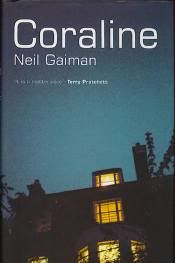
Review: Coraline by Neil Gaiman

Coraline goes exploring in her new house where she finds a door that opens to a brick wall. Little does Coraline know that she's opened a portal to a strange and eerily similar world. When the bricks disappear, Coraline steps through the door to find a house identical to her own but with fantastic toys and wonderful food. But there is another mother and father and the "other mother" intends to trap Coraline forever.

Gaiman's writing was fantastic. I kept thinking this guy can write. The story reminded me a lot of Alice in Wonderland -- there was even a snobbish cat. While I enjoyed Coraline it did not evoke much of a response from me; however, I think kids who enjoy fairy tales and those who like Alice's Adventures in Wonderland will appreciate this book. There is a movie out, too, which I plan to watch. I think it looks good. Have your read or watched Coraline?

Publisher: Boomsbury, 2002     Pages: 176
Rating: 3 Stars     Source: Public Library

Friday, May 13, 2011

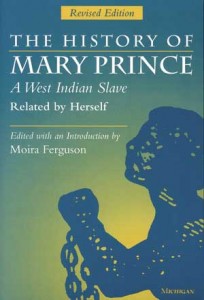
Review: The History of Mary Prince: A West Indian Slave, Related by Herself edited by Moira Ferguson

Mary Prince was born a slave in Bermuda (a British colony) around 1788. She became the first black women to escape to England (blacks were “free” as long as they stayed on English soil) and this account about her journey from slavery to freedom is as fascinating and inspiring as it is horrifying.

The History of Mary Prince is a rich narrative, in the genre of slave narratives, which is focused on enlightening readers on the brutal nature of slavery. Along the way, Mary’s narrative gives interesting accounts of salt harvesting in the West Indies, the politics of both the anti- and pro-slavery moments, and the precarious role of black women in the 19th century. Mary’s narrative is multi-layered. Since she could not write, Mary’s story was transcribed by another women. Mary’s editor, Mr. Pringle, was also the secretary for the Anti-slavery society and Mary’s employer in whose house she lived. With this knowledge, gaps arise in The History, little idiosyncrasies that appear to be censored or altered in some way that will make Mary’s story palatable to its intended audience.

The marginalia make The History absolutely fascinating. Moira Ferguson’s excellent introduction sheds light on English and West Indian politics that influenced Mary, her many owners and the the making of her narrative. Also, Pringle’s short preface and lengthy supplement prove the intensity of the anti-slavery campaign. In the appendix, Ferguson includes copies of newspaper articles of two court cases surrounding The History and other contemporary events which influenced the abolition of slavery in the West Indies in 1833. 

Those interested in slave narratives should put The History of Mary Prince at the top of their list. Also, those interested in the making of history through narrativity, autobiographies, black women narratives and British history will appreciate this text. This book counts towards the POC Reading Challenge!

Publisher: University of Michigan Press, 1997     Pages: 173
Rating: 5 Stars     Source: Purchased Copy

Monday, February 28, 2011

Review: The Curious Incident of the Dog in the Night-Time by Mark Haddon

The strength of this book lies in Christopher’s first-person voice. The reader is able to see the world through the eyes of one with Autism. I understood Christopher’s strange actions better because he explained his reasoning. But the point of view was also a weakness for me. The repetition became tiresome. I already know he doesn’t like yellow or brown. I don’t need to be reminded of it over and over.

Christopher’s story is not the only one being told. The Curious Incident examines what it is like living with and caring for someone with Autism. I found myself more interested in Christopher’s parents as the story continued. Professionals are trained and choose to work with special needs populations. Parents are not usually trained nor do they choose the child they get. Christopher’s parents are flawed, make mistakes, and I really felt for them. They want what is best for their son but are people with needs, too.

I’ve known autistic kids and while I saw some similarities to Christopher there were significant differences. The term autism covers a wide spectrum with vastly different manifestations. No one voice can even remotely represent it. If you’re looking to educate yourself on this disorder you’ll need to go beyond reading this book because truly, it does not represent the spectrum.
Summary: "Christopher John Francis Boone knows all the countries of the world and their capitals and every prime number up to 7,057. He relates well to animals but has no understanding of human emotions. He cannot stand to be touched. And he detests the colours yellow and brown. This improbable story of Christopher’s quest to investigate the suspicious death of a neighborhood dog makes for one of the most captivating, unusual, and widely heralded novels in recent years. Mark Haddon make this an excellent book for children and adults alike." "

I enjoyed the charts and diagrams which Christopher uses to explain things. Some readers find them distracting. I think they added to the story and helped me follow along. The humor is dark. It is funny but is tempered by Christopher’s serious situation. Overall, the book didn’t do much for me. However, I think it is an important text. It discusses a serious disorder that is increasing in our population and manages to make the reader laugh while making him aware.

Publisher: Vintage, 2004     Pages: 226
Rating: 3 Stars     Source: IC Public Library

Sunday, January 30, 2011

Review: Romeo and Juliet by William Shakespeare

Ok, so this post is less of a “review” and more of a book talk. I mean, Shakespeare has been dead for how long? (395 years!) But I find this play's long-lasting fame a bit of a mystery.

There’s a lot to draw from Shakespeare’s plays especially if you read them as historical texts. It’s great fun to read the plays from a feminist perspective. The whole “women as commodities” lens is just too easy to apply. (For an in depth look at this idea read Luce Irigaray’s “Women on the Market.”) Of course, we could read through a Marxist lends or a psychoanalyst lens.

But let’s put these lenses aside and explore what a reading of Romeo and Juliet is to the modern reader who has no direct interest in Elizabethan England but just wants to read a good story. Immediately we have a problem. Romeo and Juliet is a play not a book. I think it loses its magic when there are no actors to interpret the text and put it in action.

The reading experience, having the original text side-by-side with a modern interpretation, was strange. I had to stop and read the modern version so often it severely altered the flow of the play. While it added to my understanding, the modern version lacked the linguistic beauty of the original. However, I think high school students might benefit from the modern version. If the original is just too cumbersome to read they will still get the gist of the story by reading the interpretation. But I find I prefer knowledgeable footnotes.

The story is pretty straight forward. Two powerful families are fighting and their respective son and daughter fall in love at first sight. The young lovers are unable to successfully run off together because they are kids without powerful enough connections and the romance turns tragic and they die. The families learn their lesson. End of story.

Why does Romeo and Juliet get so much attention? The story is just ok. The original prose is not as captivating as other plays. There are a couple great monologues by the two protagonists but otherwise the lines drag on. It’s a story of young love so I guess that’s why they teach it in high school. But what’s wrong with The Tempest?  Or As You Like It which is much funnier? 

What about you guys? Do you love Romeo and Juliet? What is your favorite Shakespeare play?

Publisher: Barron’s, 1984     Pages: 282
Rating: 2.5 Stars     Source: Purchased at Walden Books (right before they closed. Boo!)

Thursday, August 19, 2010

Northanger Abbey Finale: Chapters 24-31

This post is part of a readalong and contains plot references/spoilers! Here are links to my other N.A. posts: Chatpers 1-9, 10-15, 16-23

I finished this novel while reading in the car so I didn't take any notes which means I don't have quotes or reactions to specific chapters. However, I'll give you my overall impression.

In many ways I was happy with this ending. Catherine finally realizes how absurd her gothic projections have been. She manages to learn from her mistakes and begins interpreting people and circumstances correctly.  I thought it was a sign of maturity that Catherine took Henry's mild chastisement and, realizing her errors, refused to let her imagination run wild anymore. I was worried Catherine would return to Isabella and was glad she did not renew the friendship.

Concerning the romance, I was left feeling mystified. What exactly drew Henry and Catherine together? I didn't feel privy enough to Henry's thoughts to know why he pursued Catherine. He didn't seem particularly passionate about her except at the end when he rode out to her house. Do you think Henry was motivated by love or by a desire to prove his independence to his father, the General? Perhaps a little of both? I'm thinking Henry knew he liked Catherine right away and only waited to to get to know her more before proposing. As far as I remember, Catherine was always transparent with Henry (correct me if you find places where she was not) even when it embarrassed her to be. Perhaps Henry was happy to find someone who was easy to read because she was honest - unlike the General Tilney, Captain Tilney and the Thorpes.

My favorite aspect of Northanger Abbey was Austen's way of reminding us we are reading a story and how this story differs from other Gothic novels. Austen tells us Catherine is the heroine even though she is rather ordinary. Austen tells us how anticlimactic scenes are, like Catherine's banishment from the Tilney's and uneventful journey home. It is not enough that Austen shows us these things but by telling us it reinforces the humor of each non-scary, non-special moment.

Overall, I give N.A. a thumbs up. This is my third Austen read and it did not disappoint.
Publisher:  Broadview, 2002 (originally in 1818)    Pages: 280
Rating: 4 Stars     Source: Purchased from Amazon

Friday, June 11, 2010

Review of A Room with a View by E.M. Forster and Italy Photos from My Honeymoon

The Plot: Young girl grows up in sheltered home. Girl travels to Florence, Italy. Girl meets boy. Girl scared of boy. Girl returns to England confused. Girl gets engaged to a jerk. Previous boy turns up causing more unrest. But not to worry, things more or less sort themselves out. Left is a photo of Bobbio Pellice in the Alps.

The dialogue is witty and fun to read. I wish there had been more of it. There is a lot of (what I would call) received narration. Forster is a master at this but there was just too much. I wanted more straightforward dialogue. The third person point of view seemed to shift between several characters – Lucy the protagonist, Mr. Beebe the rector, Miss Bartlett the chaperon, the mother, the brother…and on and on. I felt I did not intimately know any of the characters as a result. It left me feeling distant from them all. 

Forster pokes fun at each character's short-comings giving some mild comic relief. Mostly, he reveals upper class snobbery and self-delusions about their “liberal” and “rebellious” natures. There are many touristy blunders committed as well. I felt for Lucy who desperately wanted to see the “real” Italy but was too afraid to plunge into unknown territories on her own. This is a picture from Florence.

What I liked in this novel was the idea that passion is not wrong, nor is it something to run away from, but it is to be acknowledged as a truth and dealt with accordingly. Lucy fears censure so much that she cloisters herself off and relies upon her elders for advice on her every little move or thought. Yet she wants to believe she is independent. It’s only when she is able to know her own mind that she can take control of her future (though she still receives a push to get to this point). The novel is set in the end of the Victorian and early Edwardian period and the stifling nature of the time is exposed. Forster was able to see the fear in his own culture. I’m speaking of a fear of passion in general. Hand holding, helping a female into a carriage, etc. was a big deal then and could potentially be turned against a girl to ruin her reputation.

And this is where Italy comes in. Having been to Rome, I must say I think it is the most romantic place in the world. You should go there with someone special. It’s not a town for friends but for lovers. No one minds hand holding there! The fountains, the ancient ruins, the lights, the cool evenings, the sculptures and paintings, the cobblestone streets and charming people all create a mood of intense feeling. It’s no wonder Forster was impressed by Italy during his journey there and felt, as many others have, that the Italians have it right.The Trevi Fountain (Rome) is gorgeous at night!

I said the end mostly worked out. I’ve read Howard’s End as well and it too has a near happy-ending. The right couple ends up together but there is a cost. It’s not a completely happily-ever-after kind of end. I find this sort of ending realistic without being a downer. If you like Howard’s End or early Modern literature you may like A Room with a View. This photo is of the Pantheon, ancient pagan temple turned Christian church, and an engineering feat. I hope you enjoyed the pictures from my Italian honeymoon!
Publisher: Barnes & Noble, 1993 (originally published in 1908)     Pages: 232
Rating: 3 Stars                        Source: Purchased at a used book sale