Showing posts with label historical fiction. Show all posts

Friday, June 8, 2012

Review: Dead End in Norvelt by Jack Gantos

For a book about a kid being grounded all summer, Dead End in Norvelt by Jack Gantos, is surprisingly touching and funny. Jack Gantos’ character in the book (yes, he writes about himself), while mischievous, maintained an honest voice throughout the novel, enduring him to me, making me laugh.

Jack helps his elderly neighbor, Miss Volker, write obituaries as she is physically incapable of doing so. An unlikely relationship forms between them. Having an older person in a child’s life is such a gift. Though Jack is skeptical of Miss Volker at first, he comes to realize his great fortune at having her for a mentor. Miss Volker shows Jack what he’s truly capable of and what it means to be a friend.  

Somewhat tedious are the history lessons that accompany the obits Jack and Miss Volker write. It wasn’t that the histories weren’t interesting but I wanted to get back to the story and having so many obits written so closely together...it got slow. The history lessons felt like just that -- history lessons. As a kid, I probably wouldn’t have finished the book because of these history bits.

As an adult, I forged through the histories and was rewarded with a satisfying if somewhat far-fetched ending. I enjoyed the caught-in-the-middle relationship Jack has with his parents. He can’t please one without getting in serious trouble with the other. One sympathizes. The town's citizens were colorful and Jack's interactions with them humorous. I laughed out loud several times and recommend this book be read aloud (as it was to me to my great enjoyment).

Publisher: Farrar, Straus and Giroux, 2011     Pages: 352
Rating: 4 Stars     Source: Public Library

Monday, April 2, 2012

Review: Best Shot in the West by Patricia C. McKissack and Fredrick L. McKissack, Jr.

Nat Love, or “Deadwood Dick,” was among the greatest cowboys who ever lived. Daring and dangerous when he needed to be, Nat was a natural at breaking broncs and shooting straight. A freed slave from Tennessee, Nat journeyed west to find work that rewarded his abilities.

A graphic novel, Best Shot in the West, is a dramatized version of Nat’s story mostly adapted from his autobiography. Is this fiction or nonfiction? Nat was a real cowboy. But the author’s note explains they dramatized certain scenes for the sake of the story’s flow. The inside cover describes the book as historical fiction while the Library of Congress subject heading inside says “Biography.” My library has it under Biography as well. It may be that the availability of factual materials on Nat and legends and myths about him make it difficult to create a totally factual story of Nat’s life. Ultimately, I am unsure but still enjoyed the story.

Like comic books, the story and illustrations are broken into panels with speech bubbles and blocks. Illustrator DuBurke’s paintings are muted but dramatically portray cattle stampedes and shootouts. The backgrounds are colorful while people and objects in the foreground are greyish. It’s an interesting technique but sometimes I wanted a clearer picture of people’s faces.

So, we all know that Hollywood tends to skew reality and Wild West films are no exception. But the exact ways that movies skew things may allude us...we know things are inaccurate but we’re not sure how exactly. This is the second book I’ve read about men from the Wild West and they were both African American and had amazing life stories, legends of their time, and  worthy of movies of their own. I would totally watch a movie about Nat Love. While reasons for Indian/Cowboy conflict are alluded to, especially when Nat is captured by an unusual tribe, adults may need to point out the complexities of why Indians conducted raids and why they captured Nat (instead of killing him) as the story is focused only on Nat’s perspective as a loyal cowboy.

Best Shot in the West is a story for kids interested in cowboys, horses, outlaws and crack shots. I recommend this story since it provides an important perspective on what it took to be a cowboy and what type of people cowboys were. This book counts towards the POC Reading Challenge!

Publisher: Chronicle Books, 2012     Pages: 133     
Full Title: Best Shot in the West: The Adventures of Nat Love
Illustrator: Randy DuBurke
Rating: 3.5 Stars     Source: Public Library

Thursday, March 29, 2012

Review: Moon Over Manifest by Clare Vanderpool


Stories. Every day we tell each other stories. We read them, listen to them and share them with others. Stories take many forms: people “catching up,” movies and T.V. shows, music, video games, dirty footprints in the house and, of course, books. Rich in its layers, Moon Over Manifest shows how we are our histories and all our stories are connected.

Can you ever really understand a person or even a place until you know its story?

Abilene and her father, Gideon,  lived the life of hobos, hopping on and off trains until he found work. But now Abilene is too old to be drifting. So, Gideon sends Abilene to stay in Manifest, Kansas with people he knew long ago...

Abilene is looking for stories: a hidden box, with letters and trinkets, reveals a story central to who the townspeople of Manifest are; the story of the Ratler, an unknown townsperson acting as a spy, that Abilene and her friends try to reveal; Miss Sadie the diviner has stories to tell if only someone will listen. Abilene knows these stories are important but the story she most wants to hear is the story of her father who once lived in Manifest. What kind of person is her father? Why did he send her away to live with strangers? Is he coming back for her?

Moon Over Manifest reminds me of the movie Fried Green Tomatos (one of my all-time favorites) in a couple ways. Like the movie, the story is set in the Depression Area. Moon Over Manifest also shifts between the past (in the letters and through Miss Sadie’s stories) and the present as (Abilene narrates her experience in Manifest). The flashbacks take us to the town of Manifest during World War One while Abilene’s story takes place in Manifest during the 1930s. This switching technique worked well and I loved the flashbacks.

Stories are central to the human experience. We can’t always remember raw facts and data. But we can remember stories. They evoke emotion, sympathy and empathy. Stories explain the facts and help us make sense of them. Stories help us remember and help us share memories. Remember when dad did.... Remember when your sister... We’ve all heard stories like these, haven’t we? Stories bind us together and so we tell them over and over.

Stories connect people and I think that’s what Moon Over Manifest shows. No matter how different the townspeople are, no matter their country of origin, their wealth or social class, age or gender, everyone's stories are connected.

While marketed as a children’s book, Moon Over Manifest is nuanced and Vanderpool is an excellent writer. The prose is enjoyable as are the many characters. Adults as well as children will appreciate this work. I highly recommend it!

Publisher: Yearling, 2011 (paperback copy)     Pages: 351
Rating: 5 Stars     Source: purchased copy

Sunday, March 25, 2012

Review: The Firefly Letters by Margarita Engle

Set in Cuba, The Firefly Letters weaves together four voices: Fredrika the foreign traveler, Cecilia the wealthy daughter of the house, Elana the slave girl and Beni, Elana’s husband. It is interesting to watch the dynamics of power between characters and the social structures of Cuba. Those we assume have power are often powerless in certain situations. All the voices represent someone who is or has been enslaved. The idea of freedom is explored. Elana remarks that she is jealous of Elana, a slave, because Elana is free to explore the countryside with Fredrika while she, Cecilia, is not allowed to venture out. Yet, Elana is forced to labor when and where her master commands. The story ends with a struggle wherein the characters work together to find their own freedom.

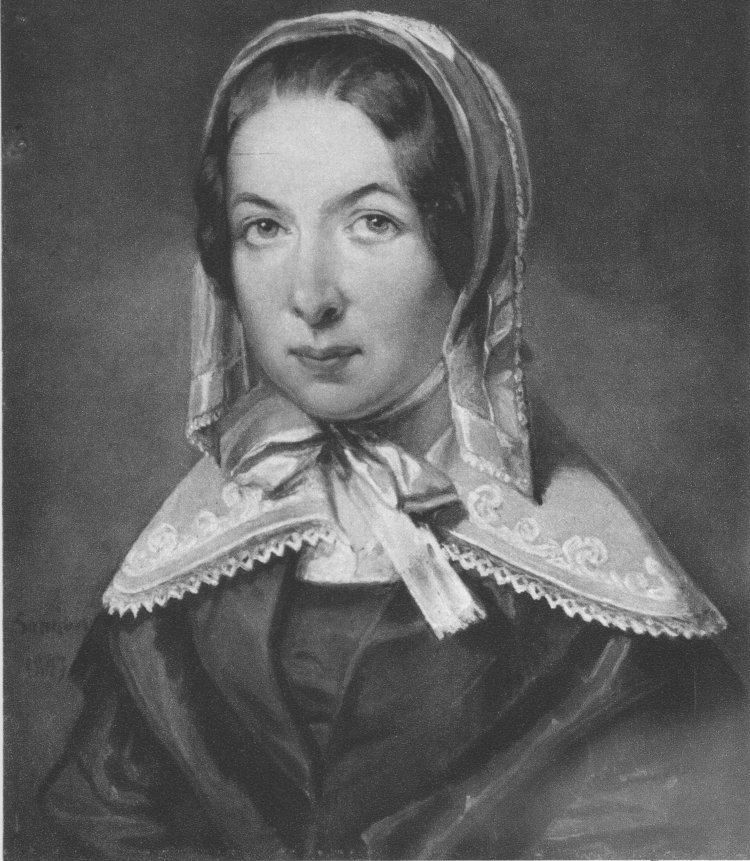
Fredrika Bremer was a Swedish writer and feminist who visited Cuba in 1851. As part of the aristocracy, her position was a privileged one though not necessarily a happy one as she was often forced to stay indoors and deliberately malnourished to have a “feminine” ballerina-like form. Groomed to be a wife for the aristocracy, Bremer never married but filled her life by writing, traveling and working to help the less fortunate.

As a piece of historical fiction, The Firefly Letters shines. But like fireflies, the illumination is brief as this is a short novel in verse. I found the story interesting but would have liked a longer narrative with a chance for deeper character development. I felt Cecilia's transformation was quick and so rather unlikely. However, the four voices offer distinct and insightful perspectives on freedom and Engle captures Cuba’s landscape to great effect. The Firefly Letters won the Pura Belpré Honor in 2011. This book counts towards the POC Reading Challenge!

Publisher: Henry Holt, 2010     Pages: 160     Full Title: The Firefly Letters: A Suffragette's Journey to Cuba     Rating: 3 Stars     Source: Public Library

Saturday, March 10, 2012

Review: Glory Be by Augusta Scattergood

It's the summer of 1964 in Hanging Moss, Mississippi and things are a changin'.

Town Council Man, James Smith, is against desegregation. So, he shuts down the community pool “for repairs.”

Glory’s birthday is the Fourth of July and she’s always had her party at the community pool...until this year. She unknowingly enters the fray as she outspokenly denounces the decision to close the pool.

Laura Lampert’s a Yankee whose mother is starting a freedom clinic in Hanging Moss. Friends are few for a white girl who drinks from the “coloreds only” drinking fountain.

Frankie Smith is caught between his family’s hatred and his friends’ readiness for change. Bullied into doing what’s wrong separates Frankie from his friends all summer.

Miss Bloom, Hanging Moss Librarian, refuses to be bullied and invites the entire town, black and white, to a celebration at the library. 

Emma is more than Glory’s family’s maid. She’s a “freedom fighter” who shelters activists at her home and bravely attends the library’s celebration as one of the few African Americans who do. 

Glory Be has be likened to The Help and I think it’s a good analogy though the two are different in presentation. In The Help, readers see events through many characters’ eyes with each chapter presenting a different character’s point of view. In Glory Be it is Glory’s voice that is the strongest and the book is written from her point of view. The strength in Glory’s point of view is that readers get a distinct feel for what is was like for a white child to participate in the Civil Rights Movement in the South. The other characters are shown how a child would understand them. Adults’ actions are often confusing to Glory and in her innocence she attempts to set them straight. Slowly, Glory begins to understand the implications of what’s going on around her. 

The story goes beyond the Civil Rights Movement and explores a young girl growing up. The relationship between Glory and her teenage sister, Jesslyn, is in flux and I enjoyed watching that relationship change. Their father is a reverend who is somewhat distant as he deals with professional duties. Emma is a stand-in mother to the girls but not there all day. Glory has learned to turn to her sister for support and friendship but now her sister is distancing herself from Glory, desiring more privacy and "grown-up" activities. 

Change is hard -- even good change. Glory Be was an enjoyable story about friendship and family during the Civil Rights Movement. Though I wished Emma’s voice had been louder this is ultimately a story about a white child’s experience and perspective and one well worth reading. This book counts towards the POC Reading Challenge!

Publisher: Scholastic Press, 2012     Pages: 202
Rating: 4 Stars     Source: Free Uncorrected Proof  (paperback)

Thursday, February 9, 2012

Review: Inside Out and Back Again by Thanhha Lai

Ha is ten when war comes to her home. She and her family leave Saigon on the last ship fleeing the city. Even after they land in the U.S. Ha, her  mother and brothers still feel adrift in a new and often hostile culture.

Inside Out and Back Again addresses war (in Vietnam), immigration, racism, bullying and family with simple verse. In each poem, Ha tells about her day, what went wrong and what went right. She talks about what it's like to learn a new language and what it's like to leave one's home not by choice but by necessity.

One feature that stood out for me was how simple cultural misunderstandings were dealt with by various characters. Some were willing to laugh and learn together while other characters let prejudice fuel cruel actions and prevent learning. Another interesting character interaction (or lack thereof) was between Ha and her teacher who seemed completely unequipped and uninterested in learning about Ha's situation and how best to help her feel comfortable and to learn.

Lai's book of free verse is told narratively, like a story, from Ha's perspective. So, don't let the poetry factor get in your way of reading this significant story which, Lai tells us at the end, is partially based off her personal experience. I tend to be critical of issue-oriented fiction and Inside and Back Again certainly is such a book; yet, I enjoyed it for it's rich description of setting and emotion and for the plain fact that it had a good story to tell. This book counts towards the POC Reading Challenge!


The above video is Lai reading her book. My favorite poem begins at 2:53!

Publisher: Scholastic, 2012     Pages: approximately 200
Rating: 4 Stars     Source: borrowed from my teacher =)

Saturday, June 11, 2011

Review: Number the Stars by Lois Lowry

My library's summer reading slogan for children this year is "One World, Many Stories." I've been trying to read a few titles off our book list so I can be helpful when kids or parents ask about them. So far, I've read The Breadwinner and now Number the Stars.

Summary: "Ten-year-old Annemarie Johansen and her best friend, Ellen Rosen, often think about life before the war. But it's now 1943, and their life in Copenhagen is filled with school, food shortages, and the Nazi soldiers marching in their town. The Nazis won't stop. The Jews of Denmark are being "relocated," thus Ellen moves in with the Johansens and pretends to be part of the family. Then Annemarie is asked to go on a dangerous mission. Somehow she must find the strength and courage to save her best friend's life. There's no turning back now."

Historical fiction comes in many forms. Some texts strain for historical accuracy while others take liberties for the sake of an engaging story. Lowry creates an engaging story while adhering closely to actual events. Readers will gain an appreciation for the Danish resistance during WWII while being swept away by Annemarie's bravery. My great grandfather was from Denmark so I had fun picking up a bit of Danish history. If you know an elementary or early middle school reader who likes historical fiction I highly suggest Number the Stars.

Publisher: Yearling, 1990     Pages: 137
Rating: 4 Stars     Source: Public Library

Thursday, May 5, 2011

Review: A Long Way from Chicago by Richard Peck

A Long Way from Chicago is a novel told in stories. Joey is nine when he and his sister, Mary Alice, begin visiting their Grandma in rural Illinois each summer. Their visits begin in 1929 and end in 1935. Grandma is an eccentric character, living on the edge of town, who takes matters into her own hands.

Each story is something of a tall tale. While Joey and Mary Alice are from “the big city” where Al Capone and Public Enemy Number one, John Dillinger, hang out, more often than naught, the kids are more scared of the bizarre adventures grandma takes them on than anything they knew in Chicago. The Depression is raging and they occasionally bump shoulders with drifters and poverty. Grandma’s questionable methods of doing good thrust Joey and Mary Alice into uncomfortable but funny situations.

Joey’s grandma reminded me much of my own grandma with her frugal ways and crisp manner. Grandma was tough but her chocolate chip cookies said I love you. If you’re looking to feel nostalgic about grandparents or would like to share fun stories with your kids then this book may be for you. As for me, I thoroughly enjoyed it.

Publisher: Dial, 1998     Pages: 192
Rating: 5  Stars   Source: Purchased Copy

Wednesday, April 6, 2011

Review: Ruth and the Green Book by Calvin Alexander Ramsey

Ruth and the Green Book shows how racial segregation affected an average African American family. When Ruth's dad buys a car the family decides to drive from Chicago to Alabama to visit her grandma. There were few places the Jim Crow laws didn't reach and the "open road" was no exception. Many hotels, restaurants and service stations refused to serve Ruth's family. After eating and sleeping in the car, Ruth's excitement about her vacation is tainted with worry and fatigue.

A friendly traveler gives Ruth's family a copy of The Negro Motorist Green Book. Published by Victor H. Green from 1936-'64, The Green Book listed gas stations, barber shops and homes of those willing to give African American travelers a place to rest, eat a good meal and fix up their cars between destinations. Ruth enjoys picking out  "Tourist Homes" from the book. Cooper's illustrations capture the scenic countryside and intimate family dynamics as Ruth's family travels to grandma's house.

If you are interested in The Green Book you can view a full 1949 edition in PDF here. It's a lot of fun to look up your state and see the names of people and businesses from a town near you that accommodated traveling families like Ruth's during the Jim Crow era. Ruth and the Green Book is a touching story great for early elementary students. Listen to a podcast with illustrator Floyd Cooper here. This book counts towards the POC Reading Challenge!

Publisher: Carolrhoda Books, 2010     Pages: 32    
Illustrator: Floyd Cooper     Source: Public Library
Rating: 3.5 Stars

Friday, April 1, 2011

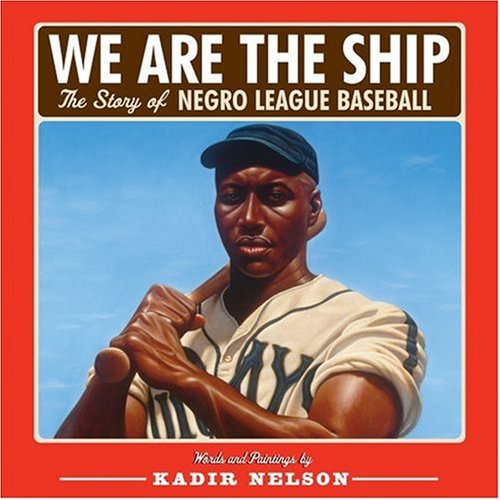
Review: We Are the Ship: The Story of Negro League Baseball by Kadir Nelson

If you like history, sports or awesome art then you need to read We Are the Ship by Kadir Nelson. It turns out "America's favorite pastime" has a complex and fascinating history.

The players in the Negro League lived for baseball. Conditions weren't always great for these ball players, and sometimes conditions were terrible, but they knew they were doing something important.    

Nelson's oil paintings are fantastic. Several reminded me of trading cards with players striking a pose. Some show the team on the road and others catch players in action swinging the bat or pitching the ball.

The book immerses the reader in baseball. Each chapter is an "inning" building suspense to the end of the League's history. The book also immerses readers in the history of racial segregation and shows how these men wouldn't let anything stop them from playing ball - their way.
Summary: "Using an 'Everyman' player as his narrator, Kadir Nelson tells the story of Negro League baseball from its beginnings in the 1920s through its decline after Jackie Robinson crossed over to the majors in 1947. The voice is so authentic... But what makes this book so outstanding are the dozens of full-page and double- page oil paintings--breathtaking in their perspectives, rich in emotion, and created with understanding and affection for these lost heroes of our national game."

While I found this book in the kids section the narrator is compelling and has an adult voice. Baseball enthusiasts of any age will appreciate this amazing true story.  This book counts towards the POC Reading Challenge! For more information visit the book's website!

Publisher: Hyperion Book, 2008      Pages: 96
Rating: 4 Stars      Source: Public Library

Tuesday, February 15, 2011

Review: One Crazy Summer by Rita Williams-Garcia

Imagine this is you: Eleven years old. Alone. In charge of two younger sisters. A girl. African American. 1968. Flying for the first time on an airplane. Meeting your mother years after she’s abandoned you – who still ignores you while you stay in her house.

This is Delphine’s life. Her father is crazy for shipping her and her sisters across the country to spend their summer in Oakland with her crazy mother. Delphine and her sisters attend a summer school run by the Blank Panthers. Things get crazy as Delphine finds herself drawn into a world she fears could lead to trouble.

Delphine narrates One Crazy Summer in an immensely introspective voice. It surprised me. I loved her, and I loved her sisters Vonetta and Fern. I loved how they stuck together and how Delphine looked out for them. I even loved their fights (that poor doll). But so much introspection makes me suggest this book is for advanced young readers or tweens. One Crazy Summer reminds me of a book adults want kids to read but kids find difficult to get through. There are a lot of historical figures and the writing utilizes dialect which slows the pace for me as a reader. I imagine some kids may have a similar experience. I think it will take the right kid to appreciate the narrative since there isn’t a whole lot of action. The action did pick up a bit in the last third and I felt rewarded for having made it through the slower parts. I enjoyed the conclusion and am glad I read the book.

This book counts towards the POC Reading Challenge.

Publisher: Amistad, 2010     Pages: 218
Rating: 3.5 stars     Source: IC Public Library

Wednesday, January 26, 2011

Review: The Sherwood Ring by Elizabeth Marie Pope

The American War of Independence takes on a whole new twist in Elizabeth Marie Pope’s classic young adult book The Sherwood Ring. Peggy lives in her uncle’s mansion, alone and bored when ancestral ghosts, dead for over a hundred years, appear to entertain her with stories of their victories and losses in battle and love during the Revolutionary War.

The young officer, Dick Grahame, eager to prove his worth in the Continental Army, is chosen by General George Washington to root out a Tory bandit, Peaceable Sherwood, who is stirring up trouble for rebel forces in New York. Like Robin of Locksley, Peaceable Sherwood is witty, cunning and altogether difficult to dislike. Sherwood slips through Grahame’s grasp time after time to Dick’s utter embarrassment.

An unlikely romance between a Rebel and Red Coat complicate Dick’s loyalty. By no coincidence (Pope loved Shakespeare), this romance mirrors that of Romeo and Juliet (without the dramatic deaths). Back in the present, Peggy is dealing with complications as Pat, a young scholar from England, pesters her uncle for family documents. Peggy’s relationship with Pat mirrors the romantic story told by the ghosts. It’s an enjoyable parallel even if it’s a bit predictable.

On the one hand, this book is completely charming and cute. There’s action, adventure, sword fights and romance. I enjoyed how the ghosts told their stories, creating a string of first person narratives to tell about a bigger picture. Yet there are some perplexing issues that arise.

Barbara Grahame is characterized as witty and sharp, a women of action, quick to think of solutions. Yet she pines hopelessly for her lover. Hmm, ok. I’m not sure what else she could have done.  And Peggy, dear Peggy, what trouble’s in store for her. Pat is not particularly nice to her calling her “idiot” and “lamb” more than once and she just takes it. They hardly know each other but at the end are engaged even though Peggy is only 17. Now, I’m a proponent of young love having married at 19 but...literally, they’ve only spent hours together.

One last issue. Pat repeats how his poor salary as a history professor means Peggy will live in a tiny house looking at a bad view darning his socks once they’re married. Geesh. Not a way to woo a woman. At least not in this century. This book was published in 1958 so at first I thought “well, it all makes better sense now.” But Pope had a Ph.D. and was a college professor for over 30 years. Was the pressure to write a culturally acceptable “domesticated” female character so strong that Pope felt obliged to write Peggy this way? Peggy has NO ambition and little self esteem. I am surprised that a women with Pope’s background wrote a character like this.

P.S. A note on the cover. When I began reading it took me some time to figure out when the story took place. By the cover I thought the entire story was in the 18th or 19th century. But as I looked closer I saw Peggy is not "in" the painting yet she looks painted. Despite the otherwise droll appearance, I thought this illusion was very clever of the artist. It symbolizes Peggy's relationship with the ghosts and their past pretty well. 

Publisher: Houghton Mifflin, 1986     Pages: 266
Rating: 3 Stars     Source: IC Public Library

Thursday, December 9, 2010

Review: Eaters of the Dead by Michael Crichton

I was totally surprised by this book and really enjoyed it. First of all, I like books that have layers of narration. So, as in Heart of Darkness, there’s an unnamed narrator quoting the main character (Marlow) the entire story. Or, like in Washington Irving’s stories (i.e. Rip Van Winkle) there’s this guy, Geoffrey Crayon, pretending to be the author who is supposedly writing the book from some documents he found. I love that sort of literary device.

So, when Eaters of the Dead opened by announcing the recovery of a famous manuscript, and that this book was the most accurate retelling of the original account of Ibn Fadlan’s epic adventure of one of the first encounters of an Arab with Norsemen, well, I was eating it up. And the first chapter is actually from a real manuscript which Crichton uses as a way introduce the voice of the Ibn as narrator before taking over the writing process.  

My husband read Eaters of the Dead when he was a kid and remembers it being one of his favorites. So, I decided to give it a try. What my husband didn’t realize, and what I began piecing together while I read, was that Eaters is a retelling of Beowulf. I read Beowulf a couple years ago for a class so some of the names of people and places, like Rothgar (Hrothgar )and Heorot, were familiar. Many names have been changed or altered so I had to wait for the story to unfold before I was like, yeah, this is a sweet retelling of Beowulf! Now, I remember Beowulf being terribly boring. Eaters of the Dead is not boring. It was spooky and sometimes funny.

Some of you may know the movie that was based off of this book – The 13th Warrior with Antonio Banderas. The movie is ok. It’s fairly entertaining. But no surprise, the book is better. It was just a lot of fun to read.  I think I prefer Crichton’s historical fiction books better than his urban sci-fi books. I liked The Great Train Robbery, too. Technically, Eaters is sci-fi but it’s set a long time ago so I’m saying it counts as historical fiction.

If you like tales of sea voyages, Vikings, cultural clashes or good old fashioned sword fights then this book may be for you.

Publisher: Avon, 2006 (orignally 1976)     Pages: 304
Rating: 4 Stars                Source: IC Public Library

Sunday, July 18, 2010

Review: A Great and Terrible Beauty by Libba Bray

I fear I'm about to commit Book Blogging suicide. This book gets a lot of attention and praise so I hope that if you loved this book you'll go easy on me here... But I'm getting ahead of myself. A summary:

In 1895, 16-year-old Gemma Doyle leaves India after her mother’s untimely death to attend Spence, a finishing school in England. While mourning her mother, Gemma must also deal with snotty classmates, unnerving visions that come true and the young man who has followed her to England to “watch” her. Things spiral out of control as Gemma experiments with friendships and her new magical ability.

The story is told in first person from Gemma’s point of view and I felt she had a very authentic 16-year-old voice. She quarrels with her mother, pouts about things that are “not fair” and has a spunky sense of sarcasm that helps her get through difficult times.

The characterizations of the main girls were strong in that I felt they had distinct personalities which added to the story-line. However, I didn’t care for Gemma or her friends. They all seemed spoiled, even Ann the “charity case,” constantly whining about their situations. The uppity girls deride their classmates, including each other, and Gemma caves to their peer pressure. She doesn’t always like what her friends say/do but she doesn’t try hard to stop them either. Considering Gemma’s the one with the powers I thought it was rather weak and selfish of her to stand by friends who were so petty. Now, none of these girls’ lives are as great as they seem on the surface – no one’s is – but that’s not an excuse to treat others like dirt. Not connecting well with the main characters was a real drawback to my total experience with the book.

I wanted to know more about the headmistress, Mrs. Nightwing. Her character could have been bolder for me. I kept waiting for her to jump into the action and she didn’t. Also, the mysterious boy, Kartik – what is he doing in this story? He confuses me. If he’s going to threaten Gemma then get rough with her, don’t just leave notes on her pillow. If they’re going to fall in love then they’ll have to interact more for that to happen. It starts to happen, but more or less we’re left with Gemma’s fantasies about him (which are pretty graphic for the 12-year-old recommendation given by my library – eek!). When the book ended I still didn’t know who Kartik was or how he truly felt about Gemma’s magic abilities or her as a person.

A Great and Terrible Beauty
is the first of a series so maybe the next books will address some of the issues I had with the characters. Unfortunately, I’m just not into Gemma Doyle enough to care about what happens to her to bother reading any more. Too many cliches (boarding school kids sneaking out to get drunk... this is so overworked) and obvious endings (selfish people become easy to predict).

This is a well loved novel by many and I think I must be strange for not liking this book. I think Bray’s writing is fine and dandy. She's obviously got talent. There was enough drama that kept me turning pages. But ultimately, this story was not for me.  On an aside, here's a fun interview with the author.
Delacorte, 2003       Pages: 403    Recommended Age: 15 and up
Rating: 2 Stars        Source: U of Iowa Libraries   

Wednesday, June 16, 2010

Anastasia's Secret by Susanne Dunlap and the Alexander Palace

This historical novel follows the teenage years of Anastasia Nikolaevna Romanova, daughter of the last Tsar of Russia. Anastasia undergoes many changes physically and emotionally as she matures during World War I and the Russian Revolution in 1917 that ended her father’s reign and eventually led to the family’s captivity and death. But Dunlap, using her creative license, ends Anastasia’s story with a window of hope, albeit a small one, that Nastya (Anastasia’s nickname) may have survived.

The focus of Anastasia’s Secret is two-fold: historical accuracy and romance. Dunlap did extensive research and nearly every character is verifiable, the most notable exception being Sasha, a soldier who guards the Romanovs and falls in love with Nastya. The romance is the duchess’ great secret. However, being so young and just a girl, Anastasia is able to overhear much or witness things she wasn’t supposed to know about. This ease-dropping attribute allowed Dunlap to feed the reader historical information. I didn’t care for this method, personally, and wished the information could have been more seamlessly worked into the plot. We get a sense for important events taking place outside the palace, like the war and revolution, but only enough to whet the appetite. I wanted more details but I suspect that for young adult readers Dunlap offered enough information. The text did get a bit dry and I think that stems from the way, as I mentioned, that information is presented.

The romance was, I felt (and I don’t mean this to sound so negative) completely unrealistic. It’s possible and even likely the Romanov girls had crushes on soldiers (hey, I married one!). But I doubt any of them could carry off a romance like Sasha and Nastya do in the novel. The situation is so dangerous that for the couple to have clandestine meetings is sweet but not likely. So, a little suspension of beliefs is necessary but again I suspect that for young readers it’s not a problem.

I do wish we knew more about Sasha. Besides his romantic interest in Nastya it was hard to get to know him. I did like the family members, especially the sister Mashka. There were so many other characters I felt lost at times. I think this reflects Dunlap’s incredible research and it may have been hard for her to let go of some of that info. I think this text would have benefitted from a closer examination of a few characters rather than crowding the text with so many. That’s just my take.

Little Red Flags: The romance does get intense. Though the language is not terribly graphic about sex the novel is very sexually charged as the two lovers meet time and again. There’s only one violent scene that is brief and besides a few lewd comments by soldiers no foul language. 


You have to check this out. If you have any interest in the Romanovs, Russian history or royalty in general, check out the pictures at this website. It’s fantastic and I will be looking at it for some time.
Mountain Hall: The indoor slide mentioned in the book
Anastasia Information 
Publisher: Bloomsbury, 2010      Pages: 320     Source: IC Public Library    
Rating: 3 Stars          If this was a movie: PG-13

Wednesday, May 5, 2010

The Help by Kathryn Stockett

By now, what has not been said about this number one, top selling novel? That’s more of a statement than a question. I doubt I can say anything that hasn’t been said before. My hope is that if you haven’t read The Help you’ll beg it off your friend, get in the hold line at your library or break down and purchase it because why? Because it is worth it. I know some people have a few complaints that run along the lines of: the ending was anti-climatic or the dialect bothered them. Some more serious complaints are that it’s just one more bash on Mississippi. Even if you finish and wonder what all the fuss is about I promise you won’t be disappointed that you read it.

I wasn’t sure what this book was about when I decided to buy it. I knew it was set in the Southern U.S. during the 1960s and there was something about a lot of women afraid to follow after whatever it was they wanted. And that there would be racial issues thrown in there. This is a terrible summary. However, not knowing what I was in for left me deliciously and delightfully surprised. I didn’t expect to become engrossed by a maid’s daily life. I didn’t expect to laugh out loud on several occasions. I didn’t expect to learn and this novel enlightened me about how complicated the civil rights movement was for many different (but not so different) people.

This book was a pleasure to read. As a rule, I don’t mind dialect but I find it slows my pace down. Truly though, I savored every page. The story alternates between three women’s point of view: one young white woman, one middle-aged black maid and one not-quite-old black maid. I adored all the voices but Aibileen’s (the eldest’s) was my favorite. There is so much tension, anxiety and fear in these women’s lives because of their desire to tell the truth. I felt nervous for them and kept hoping they’d find a way to iron out the wrinkles (hehe. Aibileen hates ironing pleats). I feel this book is a must read for those living in the U.S., perhaps especially my 20-something generation who have grown up in a different era and have little understanding of what daily life was like in the South during the 1960s.

So, I have this great thing called a public library. And mine hosted the author, Kathryn Stockett, who stopped by on her way to the Windy City to speak, read and sign our books! Hearing her speak was a blast. If you have the opportunity to see her, do it! She spoke a bit about her anxieties being a white woman writing in the voice of black women. Stockett had a black maid growing up and this book is her way of expressing many of the things she has learned about what life was like for the help. In case you’re curious, she said two of her favorite authors are Lee Smith and Kaye Gibbons (among many others). She has an awesome southern accent! And in response to a question said that no, she is not Skeeter (the young white protagonist), that she was never as brave as Skeeter or able to ask those kinds of difficult questions when she was a child. I think she was rather brave to write this story, though. Ms. Stockett was gracious enough to let me take my picture with her so, there we are. Now, go get yourself a copy of The Help and settle in for a good read.
Publisher: Amy Einhorn Books, 2009     Pages: 451
Rating: 5 Stars                                             Source: Purchased on Amazon

Tuesday, April 27, 2010

Esperanza Rising by Pam Munoz Ryan

When I picked up this book I thought I knew what I was in for. But apparently I was ignorant of the largest involuntary migration in the U.S. – that of Mexican workers, many legal citizens, who were forced to move to Mexico during the Great Depression. Esperanza’s story is set during this turbulent time. The daughter of a wealthy Mexican rancher, Esperanza has everything she could ever desire. But in one night her life changes and she and her mother migrate to California to work on a farm labor camp. While the Great Depression rages, Esperanza adjusts to the difficulties of her new life.

I enjoyed Esperanza’s story, based off Ryan’s grandmother’s life. The writing is interspersed with Spanish making this a very cultural text. I think this is an excellent book for kids to learn about the difficulties of emigrating families, the richness of Mexican culture as well as the history surrounding the Great Depression. I find this story particularly relevant today as we come out of our economic slump. With so many unemployed, sympathy for non-citizen workers definitely fades. Esperanza’s story reminds us that everyone deserves humane treatment and that stereotyping has never helped our country in the past. That’s what I got out of this text, anyways! I will tuck away this title in my memory bank for my future kid someday.
Publisher: Scholastic, 2000      Pages: 262          Source: IC Public Library
Rating: 4 Stars                             Recommended Age: 10 and up

Monday, April 5, 2010

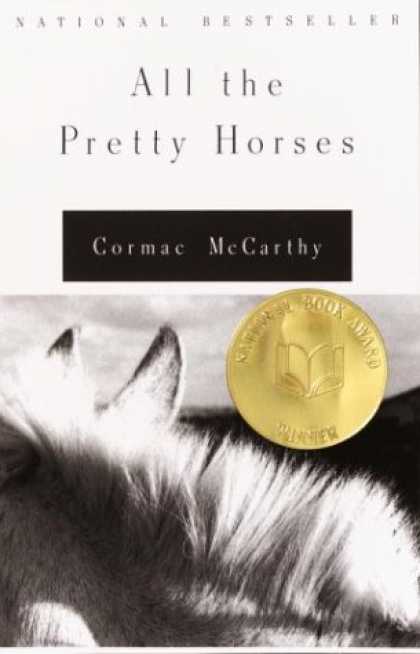
All the Pretty Horses by Cormac McCarthy

All the Pretty Horses is a beautifully written story set at the beginning of the end of two ages – the decline of the cowboy and the end of youth. It is 1949 and John Grady Cole is sixteen, ready to become a man and to put his love of horses to work. To do so, he and his seventeen-year-old friend, Lacey Rawlins, saddle-up and leave their Texas homes behind them in search of ranch work in Mexico. Of course, things aren’t always as simple as we think they should be. It isn’t for these boys either.

Reading the description, I thought this novel was as a bildungsroman, or coming-of-age story, in which the protagonist goes through a tough time to learn valuable lessons which enable him to become an adult. Such stories often include a romantic relationship which helps to achieve this end. But while reading, I felt John Grady was already an adult. This kid knows his mind and how to handle himself. He is already equipped with a trade (braking horses) and is darn good at it. I’m thinking of Dickens’ Great Expectations, often considered a bildungsroman. Pip goes through much to grow up and I don’t think the pattern is the same for John Grady. John is perhaps reckless but not immature. He falls in love but is not a hopeless romantic like Pip. Having finished reading, I will concede this as a coming-of-age story because John undergoes a shift in the way he understands the world. He acquires a more “grown up” perspective. He always tries to do what he thinks is right but still struggles with his conscience. Finally, John recognizes that not everything in life can be explained and rationalized, that all events in life can’t be nicely wrapped up as we would like. More than the physical events that John experiences, it is this mental growth that signals adulthood. For me, watching how John processed his actions was as motivating to turn pages as reading for the plot.

I am a huge fan of McCarthy’s unconventional writing style. I’m amazed at his command of language and find his writing beautiful and inspiring. This is a text to take your time with, to enjoy the language and visualize what is being described. The descriptions are out of this world if you will allow yourself to sink into the text and not worry about finishing and finding out what happens. This is an “enjoy the journey” book and is not about getting to the end but appreciating the steps that lead to it. I realized on page one that I would have to slow down. I’m glad I did. Here’s an example of a description:

Shrouded in the black thunderheads the distant lightning glowed mutely like welding seen through foundry smoke. As if repairs were under way at some flawed place in the iron dark of the world. (McCarthy 67)

Wow, I just love that. I had to read it four times, once out loud to my husband, and we gushed about it (much like I’m doing now). It just so happens to be storming outside right now, too, and that’s just how the lightning is. On another note, I enjoyed the Spanish mingled throughout the text and was surprised at how much I remembered from class. But if you don’t know Spanish don’t worry as the text is 98% English.


Every time I opened this novel, I felt completely transported to the West. It was like I was hanging in the clouds watching John Grady ride his horse. I think that’s why I enjoyed this book so much. This is book one of the “Border Trilogy” but All the Pretty Horses stands well on its own. If I didn’t know there were more books I would have thought it was a standalone novel. Book two will be in my reading list for the future.
Publisher: Vintage, 1993     Source: IC Public Library
Rating: 4 Stars                       Pages: 301

Wednesday, March 31, 2010

The Book Thief by Markus Zusak

At my library, The Book Thief is constantly checked out. Now I know why. This text is worth a reread someday. If you think you’ve read every version of WWII there is to be told, I ask: have you seen it from Death’s perspective? Have you seen from a German’s point of view? Zusak takes on the challenge to present Nazi Germany from within and to show the challenges for those opposed to the Fuhrer. The story is narrated by Death, who tells us about Liesel, a young German girl with a passion for books, her family and friends. As the story unfolds, Liesel understands the power of words and how the Third Reich uses them to break apart her family and everything she loves.

Zusak’s writing style is enjoyable. He gives Death a unique voice and personality. Death is constantly breaking the narrative with short facts and asides about characters, events or his personal observations. These interruptions are a fun part of the narrative and keep the story interesting. I enjoyed how many chapters begin with a teaser, a fact or future event yet to unfold, that Death uses to get us interested in how the story will play out. Here’s an example of what I’m talking about:

Of course, I’m being rude. I’m spoiling the ending, not only of the entire book, but of this particular piece of it. I have given you two events in advance, because I don’t have much interest in building mystery. It’s the machinations that wheel us there that aggravate, perplex, interest, and astound me. (Zusak 243)

What an interesting commentary on story-telling – from Death. Normally, I do not like narrators that directly address the reader. It is often tacky and takes me out of the story. But Zusak caries it off beautifully because, I think, Death has such a real presence in the plot and his voice is so real. And moments as the one quoted remind us that this story is already over and he is telling us this in retrospect, which allows him some authority to talk to us about it. Zusak uses nonstandard English, meaning incomplete sentences and “sporadic” punctuation. I don’t count myself among the “grammar police” (notice my many “mistakes”) but I think it is hard to pull nonstandard English off and make the book strong and the reading experience fluid (thinking of Cormac McCarthy who is brilliant at doing this). Zusak does a fine job but some incompletes did throw me off a couple times. Overall though, it worked, especially as Death’s voice. No one talks in complete sentences all the time and it made him seem real. I also enjoyed the spatial aspect of the text – how some lines stand alone and other pieces are centered. It made for an interesting reading experience.

This book is dehydrating. Literally. I cried practically nonstop through the last fifty pages. Prior to that, I didn’t cry at all. It just all happened so fast, the ending that is. I couldn’t put the book down. This is a thick novel, with plenty of time to develop the characters, yet it never became stagnate. The Book Thief is definitely one worth reading.
Publisher: Knopf, 2006     Recommended Age: 14 and up (the reading and content is pretty heavy for younger readers)
Rating: 5 Stars                   Pages: 552               Source: IC Public Library

Monday, March 22, 2010

The Good Thief by Hannah Tinti

For this text I will begin with the negative and move into the positive. That’s the simplest way, I think, to do a review for it.

This novel has been on my bookshelf for several months and, after a previous attempt to read it, I finally made a point to finish it. So, as you can imagine the text was not an attention grabber. Although I liked Ren, the twelve-year-old orphaned protagonist, I had a difficult time connecting with him and caring about what happened to him (or the rest of the characters). Tinti does a good job at capturing childhood in poverty. Ren is naive, likes to collect rocks and gets into fist fights with his friends – a pretty normal boy for the most part save his missing hand. The elements for character development are all there but maybe I’m too old (and perhaps being a girl doesn’t help me) to really connect with Ren. The story was a bit unbelievable but I could suspend my beliefs enough to enjoy the plot; however, the plot was predictable. When the answers behind Ren’s missing hand were revealed I felt disappointed. I don’t like being able to see every twist coming and I saw too many beforehand. And the ending is very happily ever after. Now, I do like happy endings, and not everything is perfect for Ren, but the ending seemed too good to be true (even with suspended beliefs). I did like Dolly, the good-hearted murderer (yes, the murderer was my favorite character). Otherwise the players in the plot didn’t do much to enhance the story for me. The real villains needed to be much darker and menacing. As to the prose, it is good in the sense that it is grammatically correct. But it stinks in the sense of enjoyable reading. Tinti can write very well but the prose was too standard and well, boring. I fell asleep reading more than once. There were some high moments when action started happening in which I became excited to read on. I kept thinking, ok, it’s going to get better now, but then those moments passed and it was a long time before another came along.

On to the positive. The Good Thief is a recipient of the Alex Award which, in a nut shell, is given to adult books which appeal to young adult readers (age 12-18). I can see this novel appealing to teachers who are tired of reading/teaching Oliver Twist. There are many similarities between the two novels: orphans, con-men, poverty. The depth of Dickens is hard to achieve and his work is definitely better. But I think many a ninth-grader would rather read Tinti than Dickens. I remember reading Oliver Twist as an adult and it was hard to get through. What I appreciate about YA in general (70% of the time, perhaps) and the Alex recipients (I’ve read two so far) is that the stories are fast passed, the foul language is toned down or non-existent and there are few if any “sex scenes.” These are not hard and fast guarantees but definitely factors that draw me to the genre. On top of these qualities, the Alex recipients I’ve read manage to retain an edginess – sometimes scary or unexpected moments – which I enjoy. I plan to read more in the future. I enjoyed the historical info on American dentistry and medicine during the 19th century which adds that edginess I mentioned (think cadavers). The story shows the resiliency of the human spirit and how one good deed can open the door to many positive outcomes. So, wrapping up, I liked this book for its potential to offer young adults different reading. But personally I wasn’t that into The Good Thief. I hope Tinti digs deeper into her writing well and comes back with something better.
Publisher: Dial Press Trade, 2008     Source: Barnes and Noble            Pages: 327
Rating: 3 Stars                                 Recommended Age: 14 and up