Wednesday, May 30, 2012

Review: Toning the Sweep by Angela Johnson

I am surprised I liked this book. Toning the Sweep is a non-plot driven story. Not a whole lot happens. It focuses more on character development and relationships than the rising action/climax/ resolution of a traditional story arch. Yet, I loved the characters. They felt real. Johnson presents common ground between reader and character which made it easy to empathize which, in my opinion, is one of the most important reasons to read -- to learn about people and see ourselves in their shoes for a moment.

Emmie has always enjoyed visiting her grandmother Ola in the California desert. But, when Emmie and her mother visit Ola now, they know it is for the last time. Ola has cancer and they have come to pack Ola's things and say goodbye. It is a soul-searching experience for Emmie (14) who strives to understand her care-free grandmother and her care-worn mother.

What could have been a sad and depressing story turned out to be an uplifting read. Reading Toning the Sweep felt like watching an incredibly pivotal moment in a family's life on T.V. -- like I was given an insightful snapshot. Emmie documents her grandma's life with a video camera and so the reader sees much of the story through Emmie's camera lens -- a perspective that I enjoyed and worked well in revealing Emmie's concerns.

Ola is a great character. Her eccentric behavior is a testament to her independent spirit but also her flawed character. Has Ola run away to the desert to hide from the past? Her strength carved out a great life there but at a cost to her daughter's well being. Emmie pieces these things together, uncovering more about her mother and grandmother's relationship, as she helps pack Ola's household, sorting the "keep", "donate" and "throw aways" of a lifetime.

David is Emmie's friend who she sees when visiting Ola. One of the few males in the story, David's character is important. He is exploring his Native American past, embracing it as a part of who he is, and helps Emmie think about her African American heritage.

No character in this story is superfluous. Each character adds something important in showing Emmie who her family is and who she is. For a little book, Toning the Sweep packs a big punch. It is a touching story about how life's tragedies effect people so deeply and how people can touch others deeply as well. It is about family and about inter-generational relationships between women. Johnson's writing blended metaphor and symbolism seamlessly, enhancing but never detracting from the story. This book counts towards the POC Reading Challenge!

Publisher: Scholastic, 1994     Pages: 112
Rating: 4 Stars     Source: borrowed from my teacher     

Thursday, May 24, 2012

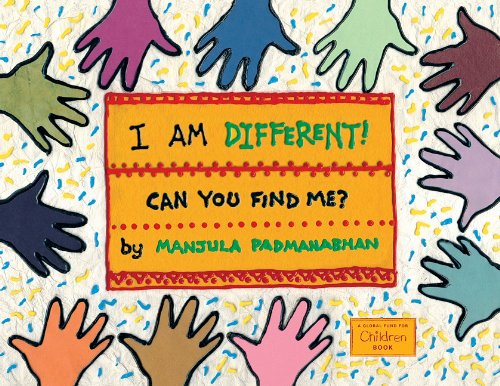
Review: I Am Different: Can You Find Me? by Manjula Padmanabhan

I Am Different explores sixteen languages giving kids a glimpse into the many languages spoken in North America. Each spread features one language, giving a pronunciation guide and examples of familiar words which originated from the language. The book tells in which direction the script is read. There is an accompanying puzzle for each language in which the reader must identify what is different from everything else in the picture.

It was fun to try the different languages according to the pronunciation guide. I read the Mandarin aloud to my Chinese classmates and they had a good chuckle at my effort before correcting me. I can imagine kids enjoying the puzzle aspect. The pictures are colorful and the icons in the puzzles taken from the language's culture. For instance, the puzzle accompanying Hebrew uses the Star of David. A celebration of diversity, I Am Different will likely be enjoyed by elementary students reading with others as they speak the languages aloud and solve the puzzles together. This book counts towards the POC Reading Challenge.

Publisher: Charlesbridge Pub, 2011.     Pages: 36
Rating: 3.5 Stars     Source: Public Library

Monday, May 7, 2012

Blog Hop: Intro to Summer Reading

This week's Book Blogger Hop questions is: " What are the next five books in your TBR (to-be-read) pile?" I like this question a lot since I'm nearly graduated and am looking forward to reading anything and everything I want! I just picked up some books from the library and a used bookshop today. I'm currently reading North and South but have several books lined up for when I finish.


These are my "Into to Summer Reading" books. 
  1. Deadlocked by Charlaine Harris. The newest book in the Sookie Stackhouse mystery series. Put myself on the hold list months ago and just got it today. =)
  2. Game of Thrones by George R.R. Martin. I've already begun this epic fantasy on my Kindle (about 33% through it) but set it aside in favor of N&S. It's good, though, and I'll get back to it.
  3.  Dead End in Norvelt by Jack Gantos. The 2012 Newbery Medal winner! 
  4. Wild: From Lost to Found on the Pacific Crest Trail by Cheryl Strayed. Thought some nonfiction would be a good idea.
  5. No Country for Old Men by Cormac McCarthy. Saw the movie and loved it. Read two other McCarthy books and liked them. I've read the first 20 pages and know this is a keeper. 
Regular readers may notice I've listed several adult titles. I often review children's and YA titles here (especially as I've taken courses on these types of literature recently) and will continue to do so. However, The Prairie Library has always been an eclectic mix and my summer reading will reflect that. My TBR pile is huge. I could keep listing what I hope to read "next." One page at a time, right? 

Thursday, May 3, 2012

Musings of a Grad Student: Degree Completion Near

I attended my last Library and Information Science (LIS) class yesterday and by this time next week I will have submitted my final paper and therefore completed my master’s degree!

Last month I posted only once -- an all time low -- but I was busy doing the following:

Mid April I completed the poster presentation that is required for graduation. Posters are used by professionals (especially librarians) to showcase their work/research to the public. One’s research topic must grow out of a class assignment. My first semester I wrote about video games in libraries and read what practicing librarians had to say on the subject. The third semester I discovered academics like James Gee and Henry Jenkins who’ve written about video games and literacy. Out of these experiences grew my poster project. I continued to research video games on my own.

During the poster defense we were given 2 minutes to make a formal speech about our research while standing with our posters, next to fellow students and in front of the faculty (about 7 if I remember correctly) . After each student in the group spoke (we were in groups of 6), the faculty questioned each of us for 10ish minutes. Afterwards, the session was open to the public for an hour.


Preparing for the poster presentation was nerve-racking. Getting my abstract approved was suspenseful. Preparing my poster (distilling months of research into a small space with bullet points is tricky) and getting it printed was sweat inducing. Crafting my two minute speech was gut twisting. The actual presentation was tons of fun. Sure, I sweat through my three layers of deodorant. But I was READY and talking to the faculty and the public who attended was enjoyable.

Yesterday I gave a presentation/ submitted a project and I’ve already turned in one final paper. So, what’s left? I’m working on analyzing picture books used for storytimes. Albeit, I have a small sample, I’m interested in seeing what types of books are used with preschoolers, toddlers and babies during storytimes. I'm especially looking for multicultural themes but am looking at genre and types of books used (like ABC books or counting books). This project/paper is due next week...and then I’m done!

Now, it’s job hunting time!

Monday, April 2, 2012

Review: Best Shot in the West by Patricia C. McKissack and Fredrick L. McKissack, Jr.

Nat Love, or “Deadwood Dick,” was among the greatest cowboys who ever lived. Daring and dangerous when he needed to be, Nat was a natural at breaking broncs and shooting straight. A freed slave from Tennessee, Nat journeyed west to find work that rewarded his abilities.

A graphic novel, Best Shot in the West, is a dramatized version of Nat’s story mostly adapted from his autobiography. Is this fiction or nonfiction? Nat was a real cowboy. But the author’s note explains they dramatized certain scenes for the sake of the story’s flow. The inside cover describes the book as historical fiction while the Library of Congress subject heading inside says “Biography.” My library has it under Biography as well. It may be that the availability of factual materials on Nat and legends and myths about him make it difficult to create a totally factual story of Nat’s life. Ultimately, I am unsure but still enjoyed the story.

Like comic books, the story and illustrations are broken into panels with speech bubbles and blocks. Illustrator DuBurke’s paintings are muted but dramatically portray cattle stampedes and shootouts. The backgrounds are colorful while people and objects in the foreground are greyish. It’s an interesting technique but sometimes I wanted a clearer picture of people’s faces.

So, we all know that Hollywood tends to skew reality and Wild West films are no exception. But the exact ways that movies skew things may allude us...we know things are inaccurate but we’re not sure how exactly. This is the second book I’ve read about men from the Wild West and they were both African American and had amazing life stories, legends of their time, and  worthy of movies of their own. I would totally watch a movie about Nat Love. While reasons for Indian/Cowboy conflict are alluded to, especially when Nat is captured by an unusual tribe, adults may need to point out the complexities of why Indians conducted raids and why they captured Nat (instead of killing him) as the story is focused only on Nat’s perspective as a loyal cowboy.

Best Shot in the West is a story for kids interested in cowboys, horses, outlaws and crack shots. I recommend this story since it provides an important perspective on what it took to be a cowboy and what type of people cowboys were. This book counts towards the POC Reading Challenge!

Publisher: Chronicle Books, 2012     Pages: 133     
Full Title: Best Shot in the West: The Adventures of Nat Love
Illustrator: Randy DuBurke
Rating: 3.5 Stars     Source: Public Library

Thursday, March 29, 2012

Review: Moon Over Manifest by Clare Vanderpool


Stories. Every day we tell each other stories. We read them, listen to them and share them with others. Stories take many forms: people “catching up,” movies and T.V. shows, music, video games, dirty footprints in the house and, of course, books. Rich in its layers, Moon Over Manifest shows how we are our histories and all our stories are connected.

Can you ever really understand a person or even a place until you know its story?

Abilene and her father, Gideon,  lived the life of hobos, hopping on and off trains until he found work. But now Abilene is too old to be drifting. So, Gideon sends Abilene to stay in Manifest, Kansas with people he knew long ago...

Abilene is looking for stories: a hidden box, with letters and trinkets, reveals a story central to who the townspeople of Manifest are; the story of the Ratler, an unknown townsperson acting as a spy, that Abilene and her friends try to reveal; Miss Sadie the diviner has stories to tell if only someone will listen. Abilene knows these stories are important but the story she most wants to hear is the story of her father who once lived in Manifest. What kind of person is her father? Why did he send her away to live with strangers? Is he coming back for her?

Moon Over Manifest reminds me of the movie Fried Green Tomatos (one of my all-time favorites) in a couple ways. Like the movie, the story is set in the Depression Area. Moon Over Manifest also shifts between the past (in the letters and through Miss Sadie’s stories) and the present as (Abilene narrates her experience in Manifest). The flashbacks take us to the town of Manifest during World War One while Abilene’s story takes place in Manifest during the 1930s. This switching technique worked well and I loved the flashbacks.

Stories are central to the human experience. We can’t always remember raw facts and data. But we can remember stories. They evoke emotion, sympathy and empathy. Stories explain the facts and help us make sense of them. Stories help us remember and help us share memories. Remember when dad did.... Remember when your sister... We’ve all heard stories like these, haven’t we? Stories bind us together and so we tell them over and over.

Stories connect people and I think that’s what Moon Over Manifest shows. No matter how different the townspeople are, no matter their country of origin, their wealth or social class, age or gender, everyone's stories are connected.

While marketed as a children’s book, Moon Over Manifest is nuanced and Vanderpool is an excellent writer. The prose is enjoyable as are the many characters. Adults as well as children will appreciate this work. I highly recommend it!

Publisher: Yearling, 2011 (paperback copy)     Pages: 351
Rating: 5 Stars     Source: purchased copy

Sunday, March 25, 2012

Review: The Firefly Letters by Margarita Engle

Set in Cuba, The Firefly Letters weaves together four voices: Fredrika the foreign traveler, Cecilia the wealthy daughter of the house, Elana the slave girl and Beni, Elana’s husband. It is interesting to watch the dynamics of power between characters and the social structures of Cuba. Those we assume have power are often powerless in certain situations. All the voices represent someone who is or has been enslaved. The idea of freedom is explored. Elana remarks that she is jealous of Elana, a slave, because Elana is free to explore the countryside with Fredrika while she, Cecilia, is not allowed to venture out. Yet, Elana is forced to labor when and where her master commands. The story ends with a struggle wherein the characters work together to find their own freedom.

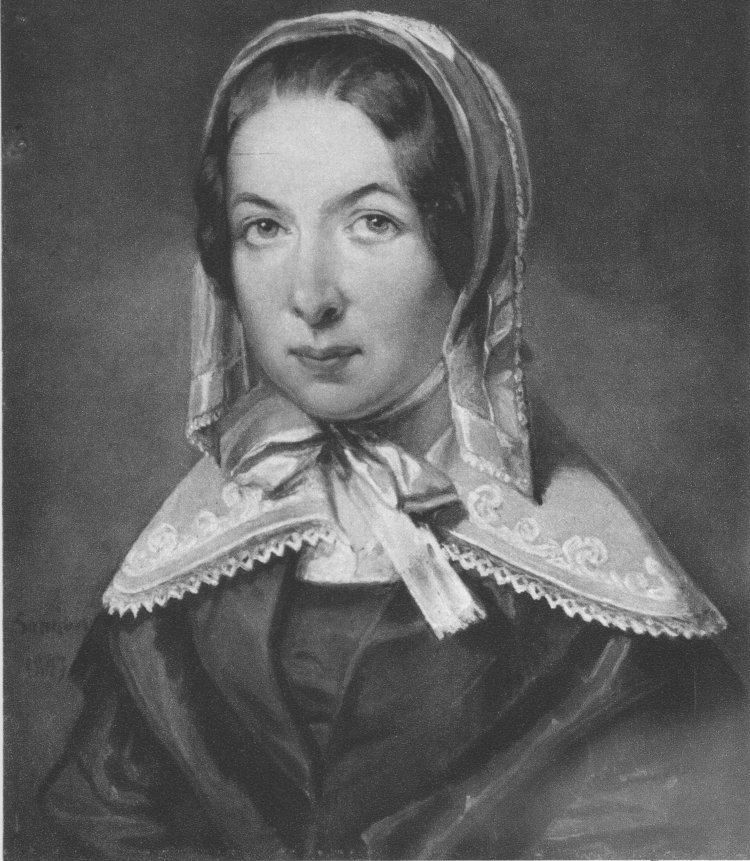
Fredrika Bremer was a Swedish writer and feminist who visited Cuba in 1851. As part of the aristocracy, her position was a privileged one though not necessarily a happy one as she was often forced to stay indoors and deliberately malnourished to have a “feminine” ballerina-like form. Groomed to be a wife for the aristocracy, Bremer never married but filled her life by writing, traveling and working to help the less fortunate.

As a piece of historical fiction, The Firefly Letters shines. But like fireflies, the illumination is brief as this is a short novel in verse. I found the story interesting but would have liked a longer narrative with a chance for deeper character development. I felt Cecilia's transformation was quick and so rather unlikely. However, the four voices offer distinct and insightful perspectives on freedom and Engle captures Cuba’s landscape to great effect. The Firefly Letters won the Pura Belpré Honor in 2011. This book counts towards the POC Reading Challenge!

Publisher: Henry Holt, 2010     Pages: 160     Full Title: The Firefly Letters: A Suffragette's Journey to Cuba     Rating: 3 Stars     Source: Public Library

Saturday, March 10, 2012

Review: Glory Be by Augusta Scattergood

It's the summer of 1964 in Hanging Moss, Mississippi and things are a changin'.

Town Council Man, James Smith, is against desegregation. So, he shuts down the community pool “for repairs.”

Glory’s birthday is the Fourth of July and she’s always had her party at the community pool...until this year. She unknowingly enters the fray as she outspokenly denounces the decision to close the pool.

Laura Lampert’s a Yankee whose mother is starting a freedom clinic in Hanging Moss. Friends are few for a white girl who drinks from the “coloreds only” drinking fountain.

Frankie Smith is caught between his family’s hatred and his friends’ readiness for change. Bullied into doing what’s wrong separates Frankie from his friends all summer.

Miss Bloom, Hanging Moss Librarian, refuses to be bullied and invites the entire town, black and white, to a celebration at the library. 

Emma is more than Glory’s family’s maid. She’s a “freedom fighter” who shelters activists at her home and bravely attends the library’s celebration as one of the few African Americans who do. 

Glory Be has be likened to The Help and I think it’s a good analogy though the two are different in presentation. In The Help, readers see events through many characters’ eyes with each chapter presenting a different character’s point of view. In Glory Be it is Glory’s voice that is the strongest and the book is written from her point of view. The strength in Glory’s point of view is that readers get a distinct feel for what is was like for a white child to participate in the Civil Rights Movement in the South. The other characters are shown how a child would understand them. Adults’ actions are often confusing to Glory and in her innocence she attempts to set them straight. Slowly, Glory begins to understand the implications of what’s going on around her. 

The story goes beyond the Civil Rights Movement and explores a young girl growing up. The relationship between Glory and her teenage sister, Jesslyn, is in flux and I enjoyed watching that relationship change. Their father is a reverend who is somewhat distant as he deals with professional duties. Emma is a stand-in mother to the girls but not there all day. Glory has learned to turn to her sister for support and friendship but now her sister is distancing herself from Glory, desiring more privacy and "grown-up" activities. 

Change is hard -- even good change. Glory Be was an enjoyable story about friendship and family during the Civil Rights Movement. Though I wished Emma’s voice had been louder this is ultimately a story about a white child’s experience and perspective and one well worth reading. This book counts towards the POC Reading Challenge!

Publisher: Scholastic Press, 2012     Pages: 202
Rating: 4 Stars     Source: Free Uncorrected Proof  (paperback)

Tuesday, March 6, 2012

Review: Mockingbird by Kathryn Erskine

I am going to exercise my freedom of speech and declare I did not like this novel. Largely, this is due to personal taste which I will attempt to explain. I feel like this is a book people feel inclined to praise and disinclined to criticize because of it’s subject matter and seal of approval from the National Book Foundation. However, I am at a loss to understand why this book won the National Book Award (2010). I mean no disrespect to the author whose intentions with the book are clearly and admirably stated in the author's note. I just didn't like her book and this is, as always, my honest and subjective opinion.

While looking at the National Book Award’s description page it is incredibly vague as to guidelines for choosing finalists and winners: “They [the judges] may arrive at these choices using whatever criteria they deem appropriate, as long as they do not conflict with the official Award guidelines.” Those guidelines being that the book is by an American author and that the entrance fee was paid. Yet, the award is known for choosing “high” literature which brings into question the criteria for being literature. That may be another discussion but it’s unavoidable for me when thinking about MockingbirdDoes a book's well-timed and admirable theme determine if it's literature? I should hope it is only one factor among many equally important factors. 

For me, the dominant theme was Caitlyn’s Asberger’s Syndrome and it’s sub theme, school violence (a shooting). It was all too much. A school shooting which killed the sibling of young child with Asperger’s who is already motherless with a father lost in grief required too much willful suspension of disbelief for me. This is realistic fiction and I wanted more realism. I felt Erskine wanted to cover too many big and specific subjects and did the sub themes little justice. 

The prose, the first person narrative, was at times plain and at others too forceful. I never felt moved only informed. I want literature to move me. And not just (attempt) to move me to tears. The text felt self-conscious. I felt Erskine’s intense and anxious desire to be respectful and literary (so many motifs beating me over the head) was thrust at me. I felt manipulated as a reader and that made me resistant to the novel. I felt blatantly asked to feel something that the novel could not naturally draw out.

I appreciate what the novel attempts to do especially in regards to raising children’s awareness (and adults’) to the complexities of Asperger’s Syndrome. I feel if Erskine would have kept to this one subject and left the school shooting and motherlessness out of the picture (and saved for other books) this book would have worked better. There needed to be a better balance of theme, plot and prose. I hope the panel that chose this book as the award winner at least had a lengthy debate over it. It’s too bad the public isn't privy to that conversation. I truly feel that the choice of theme is what made this book win the medal. It's a popular medical topic and little addressed in children's literature. I am of the firm opinion, however, that choice of a popular serious subject matter or new subject matter should not carry so much weight when awarding prizes. 

Mockingbird is bold in its scope and gravity of its subjects. It has been well received and praised, loved by many, and I am happy for those who've had a great reading experience. I just did not. Tell me, have you ever found yourself resistant to a novel? A time when you knew a book wanted a certain response from you as a reader that you just couldn't muster?

Publisher: Philomel Books/Penguin, 2010.     Pages: 235
Rating: 2 Stars     Source: Public Library