Saturday, July 24, 2010

Create-A-Cover: Summer Break Reading Challenge Activity #10

I almost forgot to do this challenge! We were supposed to create a random "name" for the author, a random verb for the title and use the first picture in flickr that was a person when we searched with the verb. After assembling the name, title and photo we are to create a summary to go along. I did the picture a few days ago and got stuck on the story. Well real quick, here goes - my create-a-cover!


Eleanor Dowd has lived in her entire life in New York City, feeling safe and secure in her established routines. When she gets a letter in the mail announcing her estranged father's death she is filled with mixed emotions. A Mr. Lumbardi, identifying himself as her father's personal secretary, writes to ask Eleanor to travel to Morocco and accompany her father's remains back to the United States. Eleanor flies to Rabat expecting to leave the same day with her father's remains. But Mr. Lumbardi makes it clear that Eleanor has much to learn about her father and herself before she can return home.

Friday, July 23, 2010

Two Intriguing Reads and The Book Blogger Hop

For the Book Blogger Hop this week Jen says, "TELL US ABOUT THE BOOK YOU ARE CURRENTLY READING!"

Sapphique by Catherine Fisher is the sequel to Incarceron. I loved Incarceron (my review here) and can't wait to see how things will play out in the sequel. I like how Fisher creates legend within a fantasy by starting chapters with "quotes" from a long lost hero. I'm giving away Sapphique to U.S. residents so check out my giveaway!

I'm also reading Northanger Abbey by Jane Austen as part of a readalong. I'm through chapter 9 right now. As usual, Austen is witty and perceptive of her culture. There are several passages that address reading - reading people, reading novels and reading situations. I loved in chapter 7 how Catherine learns to read the obnoxious and exaggerating Mr. Thorpe. She gets confused by his contradictions and realizes that maybe this guy is more than annoying, his word is untrustworthy. Austen is rather bold about her thoughts on the merits of novel reading and about women reading and writing in particular. Her sarcasm is kicked in high gear as she discusses women writers and readers. Austen's crticical and  feminist attitudes towards writing may have attributed to the fact that her "publisher" who bought the manuscript and advertised the book never actually printed the book, much to Austen's dismay, and Jane had to buy the manuscript back several years later so she could have the right to publish it somewhere else. What a fool that publisher was (p.s. he published Udolpho, so conflict of interest?)! Austen never did see Northanger Abbey published. Her brother, Henry, had it published after Jane died. How sad! Stay tuned for more thoughts on this gothic paradoy next week!

If you're stopping by from the Hop leave a comment and I'll visit your blog this weekend! Happy Hopping!

Wednesday, July 21, 2010

Review: The Hundred Thousand Kingdoms by J.K. Jemisin

Looking for a page turner? Look no further. The Hundred Thousand Kingdoms by N.K. Jemisin is a fantasy novel that pulled me in to its strange world and had me returning as often as I could spare a minute to pick up the book.

Summary from Shelfari:
Yeine Darr is an outcast from the barbarian north. But when her mother dies under mysterious circumstances, she is summoned to the majestic city of Sky. There, to her shock, Yeine is named an heiress to the king. But the throne of the Hundred Thousand Kingdoms is not easily won, and Yeine is thrust into a vicious power struggle with a pair of cousins she never knew she had. As she fights for her life, she draws ever closer to the secrets of her mother's death and her family's bloody history. With the fate of the world hanging in the balance, Yeine will learn how perilous it can be when love and hate - and gods and mortals - are bound inseparably together.

The title of the book is somewhat misleading, in my opinion. I thought this story would be an epic, a story that traversed a vast kingdom. But the majority of the action takes place in the castle-city of Sky. So, I was disappointed in this respect.

The beginning was set up well. The politics and intrigues of the royal family are quickly reveled as are the gods trapped in mortal bodies who are at odds with the royalty. I thought that this conflict between the royalty and the gods was the main point to the story. While it is important, the plot actually turned into a romance between Yeine and the dark lord, Nahadoth. I don’t mind political intrigues with a little romance but this story was a romance with a little political intrigue. The romance between Yeine and Nahadoth was interesting with his split personality, but the romance was overdone for my taste, particularly because I wanted more of the original plot and kept waiting for the epic to begin.

The story is told in first person by Yeine and it is Yeine’s personality, strong and inquisitive, along with Jemisin’s writing ability, which kept me turning pages. I wanted to see Yeine solve the mystery about her family and was never sure how things were going to play out. I appreciated the humor which offered the right amount of comic relief.

The relationships between the gods were more than a little weird. Jemisin draws from many myths about gods to bring hers into creation. While most of the gods’ back story was interesting there are some parts about their sexuality that the reader is supposed to accept as normal for the immortals that was just disgusting. This is not a focus of the novel but I don’t understand what purpose mentioning these relationships served. I think mentioning the sexual relationships between family members could have been left out. It certainly didn’t make me want to see Yeine hook up with one of them.

While reading I kept making comparison to Stephanie Meyer’s sci-fi novel The Host. Both novels explore the idea of having two personalities within oneself or being inhabited by another entity or personality. They explore the ideas of one’s conscious and subconscious and what makes a person’s identity. They look at how we go about choosing what kind of person we want to be. I wasn’t a big fan of The Host and think Jemisin’s writing is way better but, if you liked The Host, you may appreciate The Hundred Thousand Kingdoms.

If you’re looking for a fast read, a romance or a new look at mythology this novel might be for you. I enjoyed the pacing that kept things escalating right up to the end. Some of the answers I saw coming, some I didn’t. While this is the first book of a trilogy I felt The Hundred Thousand Kingdoms stands well on its own. Overall, I liked this book but could have done with less romance and more action and adventure.
Publisher: Orbit, 2010     Pages: 228     Source: IC Public Library
Rating: 3 Stars     Recommended Age: adult

Monday, July 19, 2010

A Book in Pictures: Summer Break Reading Activity #9

For this activity we are to select pictures that represent a story we recently read. I chose The Stuff of Legend: Into the Dark which is sort of ironic since it's a graphic novel.

Once upon a time, there was a little boy...


who the Bogeyman snatched from his bed.


His toys were very distraught. But the Colonel marshaled their forces and marched....


into The Dark unknown world of the Bogeyman to rescue the boy.


The toys fought bravely against the The Dark's forces,

playing the Bogeyman's games,


learning to get along and work together.


But where the  boy is... nobody knows.


The Stuff of Legend: Into the Dark is written my Mike Raicht and Brian Smith, Illustrated by Charles and Paul Wilson III. Here's my review.

Sunday, July 18, 2010

Review: A Great and Terrible Beauty by Libba Bray

I fear I'm about to commit Book Blogging suicide. This book gets a lot of attention and praise so I hope that if you loved this book you'll go easy on me here... But I'm getting ahead of myself. A summary:

In 1895, 16-year-old Gemma Doyle leaves India after her mother’s untimely death to attend Spence, a finishing school in England. While mourning her mother, Gemma must also deal with snotty classmates, unnerving visions that come true and the young man who has followed her to England to “watch” her. Things spiral out of control as Gemma experiments with friendships and her new magical ability.

The story is told in first person from Gemma’s point of view and I felt she had a very authentic 16-year-old voice. She quarrels with her mother, pouts about things that are “not fair” and has a spunky sense of sarcasm that helps her get through difficult times.

The characterizations of the main girls were strong in that I felt they had distinct personalities which added to the story-line. However, I didn’t care for Gemma or her friends. They all seemed spoiled, even Ann the “charity case,” constantly whining about their situations. The uppity girls deride their classmates, including each other, and Gemma caves to their peer pressure. She doesn’t always like what her friends say/do but she doesn’t try hard to stop them either. Considering Gemma’s the one with the powers I thought it was rather weak and selfish of her to stand by friends who were so petty. Now, none of these girls’ lives are as great as they seem on the surface – no one’s is – but that’s not an excuse to treat others like dirt. Not connecting well with the main characters was a real drawback to my total experience with the book.

I wanted to know more about the headmistress, Mrs. Nightwing. Her character could have been bolder for me. I kept waiting for her to jump into the action and she didn’t. Also, the mysterious boy, Kartik – what is he doing in this story? He confuses me. If he’s going to threaten Gemma then get rough with her, don’t just leave notes on her pillow. If they’re going to fall in love then they’ll have to interact more for that to happen. It starts to happen, but more or less we’re left with Gemma’s fantasies about him (which are pretty graphic for the 12-year-old recommendation given by my library – eek!). When the book ended I still didn’t know who Kartik was or how he truly felt about Gemma’s magic abilities or her as a person.

A Great and Terrible Beauty
is the first of a series so maybe the next books will address some of the issues I had with the characters. Unfortunately, I’m just not into Gemma Doyle enough to care about what happens to her to bother reading any more. Too many cliches (boarding school kids sneaking out to get drunk... this is so overworked) and obvious endings (selfish people become easy to predict).

This is a well loved novel by many and I think I must be strange for not liking this book. I think Bray’s writing is fine and dandy. She's obviously got talent. There was enough drama that kept me turning pages. But ultimately, this story was not for me.  On an aside, here's a fun interview with the author.
Delacorte, 2003       Pages: 403    Recommended Age: 15 and up
Rating: 2 Stars        Source: U of Iowa Libraries   

Thursday, July 15, 2010

Posts of Note, Books and the Book Blogger Hop

For this week's Book Blogger Hop the question is: what book are you dying to get your hands on right now!
  • I'm looking forward to Mockingjay by Suzanne Collins - who isn't? This trilogy has been awesome and I can't wait to read the last installment!
  • The Scorch Trials by James Dashner is a close runner up. I'll have to read The Maze Runner again to be fresh and ready for the sequel when it comes out this fall.
  • I recently read a review on NPR's website about Frans G. Bengsston's The Long Ships. Vikings, escapes, political intrigue... this sounds like an engrossing read.
What books are you guys eager to get your hands on?

In other news, here's some blogs and online discussions I've found the past couple weeks that have caught my eye:
- A blogger's adventures in the stacks at Yale.
- Shelf Awareness' article "Hashtags Could Save Publishing" offers motivation to be active on Twitter.
- Wastepaper Prose sparked a discussion about avoiding negativism when using said hashtags.
- Bibliophiliac also sparked discussion with her post "On Ratings and Reviews."
- The Broke and the Bookish is written by a group of college students. The varitey of reviewers means a variety of genres and opinions and I'm enjoying their blog!

It seems like there have been a lot of great posts recently. I should have kept better track but these are the ones I remember! How has your week been? Read anything good lately?

Wednesday, July 14, 2010

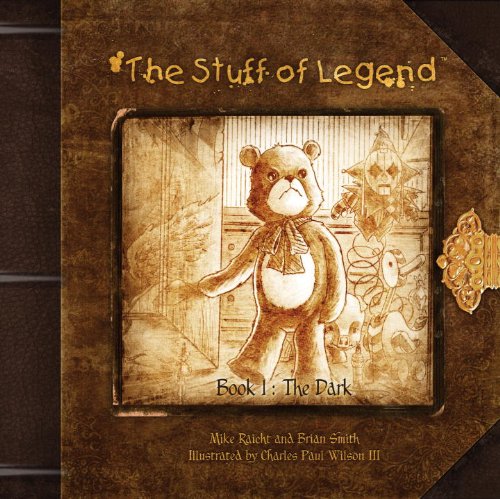
The Stuff of Legend, Book 1: The Dark - A Graphic Novel Review

In many ways The Stuff of Legend, Book One: Into the Dark, written my Mike Raicht and Brian Smith, Illustrated by Charles and Paul Wilson III,  reminds me of a fairy tale. Its pages are dark, dangerous and strangely pleasant. This is a story about a band of toys on a rescue mission to save “the boy,” their friend and master, from the Boogeyman, Lord of The Dark. Where the boy has been taken we do not know. We only know his toys and puppy, led by the Colonel, are desperate to save him.

The Boogeyman is scary. When I was very little I was sure there was something sinister hiding in the shadows beneath my bed. I would get a running start and leap into my bed so that there was no way I could be snatched by an arm from under my box springs. The opening pages perfectly capture that horrifying feeling I had for a split second whilst sailing through the air before hitting my pillow – that terrifying feeling that something was about to drag me under. One of my favorite frames is drawn from the boy’s perspective. We see the boy’s hands stretched out towards Maxwell, the teddy bear lying helpless in his frozen state, watching as the boy is dragged off by the Boogeyman. Can you imagine watching someone you love being abducted while you are unable to move or speak? The boy’s kidnapping is a heavy blow to Maxwell.

The sepia tone leant a serious feel to the book which worked well considering the book’s themes. Each character was vital to the story, adding something important to each other’s characterization. The “natural” representation of each toy was just what I thought they’d be like. I actually enjoyed the way book one dropped off. I don’t want to give much away but I thought it was clever.

There are many themes in this graphic novel: war, friendship and loyalty stand out the strongest. The toys’ resolve is tested as they face foes from within and without their party. Worst of all, they can’t seem to find out anything about the boy. I found this to be the most frustrating part of the story. As much as I enjoyed the toys’ adventures, I wanted to know more about why the boy was taken in the first place. Perhaps unanswered questions are customary with comic books but I felt this first installment, especially as a graphic novel, would have been stronger with more information here. However, I thoroughly enjoyed The Dark and want to read the next book.

What do you think of the cover? Doesn’t Maxwell’s face epitomize determination? I love it.
Publisher: Villard, 2010     Pages: 128     Source: Purchased on Amazon
Rating: 4 Stars     Recommended Age: 12 and up (There's a few pictures very young children might find too scary.)

Monday, July 12, 2010

Review: The Lone Ranger and Tonto Fistfight in Heaven by Sherman Alexie

I’ve been waiting a few days to write my review for this book. It left me with an odd feeling that I’m still not quite sure how to translate into words. Did I like it, how did it make me feel, what did I learn? I’ve been asking myself these questions but Alexie doesn’t make them easy for me to answer. There’s a lot to digest.

The Lone Ranger and Tonto Fistfight in Heaven is a short story collection by Native American author Sherman Alexie. The text revolves around several characters living around the Spokane Indian Reservation but focuses primarily on Victor, Thomas and Norma. There are several themes explored in the text but the main thrust seems to be a quest to present what it means to be Native American in the 20th century (the text was published in 1993).

My first and lingering impression of this text is that it marks Alexie’s early writing career. There’s a lot of angst coming through the words. It seems as if he had much to express, much that he wanted the world to hear and there’s fingers pointing every which way which left me feeling dizzy. And it comes across rather loud and in your face. I think Alexie’s later works reflect similar messages but with a lot more skill. That isn’t to say this work isn’t skillful. No, Alexie’s got skill by the bucket loads. Rather, his later works show a honed skill.

These stories are powerful in their representation of Indian life. There’s a lot of conflict – between father and son, between urban and reservation Indians, between white culture and reservation culture. Alexie confronts the stereotype of alcoholic Indians. I thought it was interesting how Victor is shown before he begins drinking as full of promise and hope and after he begins drinking his hopefulness and positive outlook disappears. Most of the men on the reservation succumb to alcohol. Victor and his friends seem to lose their cultural identity when they become alcoholic, or in other words, they take on a new cultural identity – one that feeds stereotypes and doesn’t reflect Native American traditions. In one story, Victor is involved in a car accident and the white authorities are shocked he isn’t drunk. It is the small victories like these that offer hope.

I’m still not sure how to answer my initial questions. It was a worthwhile read. I recommend it to people interested in or unfamiliar with Native American life, cultural studies or a general interest in anthropology. 
Publisher: Harper, 1994    Pages: 223   
Rating: 3.5 Stars                 Source: used bookstore.

Saturday, July 10, 2010

What Makes a Good Dystopian Society? Read-A-Like List: Activity #8

For this challenge Karin the Librarian asks us to create a list of books we've read with similar themes. From Big Brother (1984) to The Sisterhood (The Forest of Hands and Teeth) I like reading about a protagonist desperately trying to figure out what's wrong the prevailing order. So, some of my favorite dystopias from this year are:


The Maze Runner  - Thomas wakes up in an elevator without any idea where he is or who he is. Turns out he's one of many boys living in a community surrounded by huge walls that open each morning into a labyrinth and close each night to keep out monsters. But when the elevator brings new surprises the boys realize that time is running out to solve the maze and figure out who's behind it all.


The Hunger Games - The Capitol reigns the Districts with an iron grip, each year reminding the citizens of their subjugation by requiring two kids from each district to fight to the death in a televised arena. I love Katniss' story. She faces her fears with stubborn courage becoming the Capitol's worst nightmare.


The Forest of Hands and Teeth - Mary lives in a village surrounded by a fence keeping out the Unconsecrated, also known as the infected or zombies. When the Sisterhood, entrusted with the village’s history and safety, betrays Mary’s trust and a breach occurs she must choose between the home she knows and the unknown world in the forest.


What makes a good dysopian story? For me, the powers that be need to be spooky, deceptive, dangerous, manipulative and wield a lot of unchecked power over the lives of those they govern. And they usually govern through fear. They don't have to be a hated power. Take for instance The Sisterhood who the villagers trust and only through circumstances does Mary find out they withhold information to heighten fear in order to maintain power. In The Maze Runner the boys feel incredibly manipulated which leaves them feeling powerless and resentful of "the man behind the curtain."And Katniss feels manipulated by the Capitol as well as scared of its unbridled use of power to stifle lives in the Districts. A mark of each story's ruling power is deception. The control of information is usually what keeps protagonists jumping through hoops - they never know what's happening, things are not often as they seem and their plans are often laid to waste because they are misinformed.

What makes a good dytpopian society to you? What are some of your favorite messed-up fictional communities?