Showing posts with label memoir. Show all posts

Sunday, July 21, 2013

Review: Wild by Cheryl Strayed

My first attempt to read Wild: From Lost to Found on the Pacific Crest Trail was unsuccessful. I saw it advertised last year as a woman’s memoir about hiking the Pacific Crest Trail (PCT) and quickly put the book on hold at my library. I read a few pages and quit.

A year later, I decided to give Wild another shot. The author, Cheryl Strayed, was coming to speak at my library and I thought I would go. This time, I listened to the audio version read by Bernadette Dunne.

My overall impression of the book is disappointment that the story is not about Strayed hiking the PCT. The memoir jumps fully into Strayed’s grief over her mother’s death and explores its impact on her life. Her marriage disintegrates and she makes one poor choice after another. These chapters lagged for me but I stuck with it.

When Strayed does discuss hiking the PCT the memoir is a fun read. She writes with humor in these sections which offer relief to the heavy overarching themes of loss, grief and self-searching.

I had a difficult time relating to Strayed which made it a struggle for me to get through the book. We were both married and divorced at about the same age. We’re both Midwestern, too. But while I have things in common with Strayed I simply could not relate. Frequently, I found myself thinking “This is moment! She’s finally gonna get some cojones, take charge and stop depending on other people.” But alas, that moment was constantly postponed. Example: The horse scene, which many found disturbing, I found infuriating. I so wanted her to take the gun and do what needed to be done. But she passed the responsibility to another. I found myself frustrated with her attitude and dependency. I didn’t walk in her shoes so I wouldn’t judge her but it became tortuous for me to read about her mistakes as a young woman. She does begin to understand herself better after she hikes the PCT. She learns that while people need other people, there will be times when you need enough inner strength to carry on without them.

Strayed’s writing and her memories evoked strong emotions in me. If I’d had the physical book in hand I’ve no doubt I’d have thrown it several times. And I truly enjoyed the segments about her hiking experience as I recall laughing out loud. I did listen to Strayed speak at my library and she asked for hands of everyone who cried. The room was packed to standing room only, perhaps 250 people, and ¾ of them lifted their hands. I didn’t cry. I was too frustrated with Strayed to cry.

Oddly enough, I still enjoyed the book. For a journey about self-discovery and the search for inner strength, Wild delivers. Strayed is a successful, centered and strong woman so there is a positive resolution. But it was no easy journey to get there. And she certainly has cojones to write honestly about her shortcomings. But for a story about long distance hiking, I would look to other narratives.


Publisher: Random House Audio, 2012     Length: 13 hours, 6 minutes
Rating: 3 Stars     Source: Purchased on Audible

Wednesday, July 27, 2011

Review: In Stitches by Anthony Youn, M.D.

Tony was raised to be a doctor. His parents would except nothing less. Growing up as one of two Asian-American kids in a small town wasn't easy. Neither was medical school. In Stitches is a lighthearted memoir about Tony's progression from awkward child to confident doctor. 

The first of five parts covers Youn's premed years: birth-college. He recounts many failed attempts at gaining a girlfriend. The rejections begin piling up. Like most kids, he struggles with his looks and as his jaw juts out it sabotages his lustful ambitions. The text focuses on his attempts to score and until he finds a steady girlfriend the story is more about chasing skirts than becoming a doctor. About a third of the way through, once Youn finds said girl, the text focused much more on his medical school days which was what kept my attention. For all the emphasis on finding a girlfriend I would have liked a bit more about their relationship. We really don't know anything about her.

Things get dicey and interesting in part 4, "Third Year," where Youn recounts the "highlights" of clinical rotations. He encounters interns from hell, detached cool-as-a-cucumber doctors, horrible trauma and quirky surgeons. Tony is drawn to plastic surgery and ends his last year in school working with plastic surgeons around the country. 

Youn tells the story as one looking back, who's breathed a sigh of relief that those grueling years of med school are behind him. One can only imagine what a current medical student might write -- a whoa-is-me type of journal. But Youn's memoir is light and funny. This text counts towards to the POC Reading Challenge!

Publisher: Gallery Books, 2011     Pages: 271     Written with Alan Eisenstock
Rating: 3.5 Stars     Source: Won from Crazy-for-Books. Thanks, Jen!

Thursday, September 30, 2010

Review: The Impostor's Daughter: A True Memoir by Laurie Sandell

The graphic novel is a format I’ve discovered in the past year. The complexity and skill which graphic novelists posses ranges from simple and flat to extraordinarily moving. If you haven’t read a graphic novel before I urge you to give them a try.

“Laurie Sandell grew up in awe – and sometimes in terror – of her larger-than-life father. A former Green Beret with a law degree, a Ph.D, and fluency in several languages… Beguiled and repelled by his outrageous behavior, she grew into a young woman as restless as her father, roaming the globe, trying on her outsized personalities – Tokyo striper, seducers of Yeshiva girls, yogi, Ambien addict.”

This first part of The Impostor's Daughter was jaw-dropping. It was hard to believe the mind games going on in her family. Sandell’s father sounds like a fictional character which is probably why she inserted “true” into the title, just to emphasize that these events actually happened to her.

At times, I didn’t know who I disliked more – Laurie, her father or her mother. I don’t mean to sound harsh. I think Sandell means for the reader to see how selfishly everyone, including herself, behaves. She is honest about her incredible need to be loved by her father which leads her to attempt to be someone just as crazy sounding as her dad is. It’s a roller coaster ride.

“Laurie finally lucked into the perfect job: interviewing celebrities for a top women’s magazine. Growing up with her extraordinary father gave her a knack for relating to the stars… Yet even after meeting so many of entertainment’s most intriguing people, it was her father she still desperately wanted to understand. Her Investigation uncovered a staggering secret: her father wasn’t the man he had always claimed to be, not even close.”

So, you may be thinking, how could anyone ever believe her father was telling the truth? Those are some big claims he makes, after all. There are lots of red flags that make Laurie question him, but within this family dynamic, the truth is buried so deep that it takes all the strength she can muster to uncover it.

While she tries to figure out who her father really is, Laurie must face her own demons as well. She checks herself intro rehab (a place which Ashley Judd recommended to her) and realizes that obsessing over her father has lead her down a path she doesn’t want to follow anymore. It takes a lot of guts, but she confronts her father, her mother and her own addictions.

It may seem a little cheesy, the whole rehab bit, but hey, this is a real person’s life and I’m glad she found a way to deal with the craziness around her.

And this was the good part – she finds a way to forgive and let go of her anger even when it’s totally justified. This is what made the book stand out for me.

I’m not an artist so take this with a grain of salt: I wasn’t too impressed with the drawings. The story flowed really well and I didn’t have trouble following the story-board. But the artwork was flat. It did not add to the story in the way I’ve come to expect from graphic novels. However, I did appreciate the bright colors and style. So, while the art may leave graphic novel connoisseurs unimpressed the story was still worthwhile.
Publisher: Little, Brown and Company, 2009 – All quotes are from the dust jacket cover.
Source: I won this book from Zia!
Parent alert: there are several nude scenes so it may not be appropriate for young children
Rating: 3.5 Stars      Pages: 247

Thursday, September 23, 2010

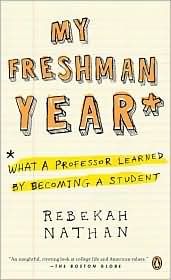
Review: What a Professor Learned By Becoming a Student by Rebekah Nathan

As someone who’s had a wide range of experiences with different educational institutions (see my about me page), I find this memoir/study to be perceptive and reflective of my undergraduate experience. My non-traditional background left me feeling like an “outsider” to mainstream American college culture and I could identify with several of Nathan’s findings of how “outsiders” are perceived and treated. Many of Nathan’s perceptions are, incidentally, not flattering. And I think this is why I’ve read so many upset and negative reviews by college students for this book (which I find unwarranted).


But before I get carried away, here's an abbreviated summary from Shelfari: "After fifteen years of teaching anthropology at a large university, Rebekah Nathan had become baffled by her own students. Their strange behavior—eating meals at their desks, not completing reading assignments, remaining silent through class discussions—made her feel as if she were dealing with a completely foreign culture. So Nathan decided to do what anthropologists do when confused by a different culture: Go live with them. She enrolled as a freshman, moved into the dorm, ate in the dining hall, and took a full load of courses".


First of all, Nathan does not submit this book as “proof” or as a sound study. She recognizes upfront the limitations of her investigations and realizes that in the end, her freshman year was a personal experience that may or may not be indicative of college life across the board. This point is reiterated several times. However, this does not mean Nathan doesn’t make good observations. She shares the view of an outsider looking in. So, if your college prof. assigned this book and you don’t think its “academic” enough, that’s not Nathan’s fault. It’s your prof.’s for assigning it. Something to keep in mind.

So, why should you read this book and who should read it? Anyone interested in educational institutions like college-bound high schoolers, professors (especially those who find themselves dismayed with their students), students, and those interested in cultural studies should read this book because it holds a mirror up to our faces. And sometimes that’s what we need.

This isn’t investigative journalism. Nathan isn’t out to get “the scoop,” nasty secrets or expose outlandish behaviors. We’re all aware of the antics that go on around campus. Rather, it’s a sincere investigation to understand the berth between college students and their professors. It attempts to find out why students act the way they do, how they manage academic demands with cultural and social demands. Nathan has attempted to get inside the freshman mindset. She was often surprised to find herself engaging in behaviors she saw her own students do and wondered why they did. Her freshman experience gave her an appreciation for her students and informed her teaching strategies when she returned to professorhood.

I don’t know how much longer this book will be relevant before it turns into historical data. But for now, it’s still an engaging and worthwhile read.
Publisher: Penguin, 2005    Source: Purchased at a used bookstore
Rating: 4 Stars

Saturday, July 31, 2010

Review and Confession: Extra Lives: Why Video Games Matter by Tom Bissell

My name is Chelle, and I’m a gamer. I’ve been known to scream out loud in panic and jam my fingers on all available buttons when caught off guard. Those of you who know what I’m talking about will sympathize (or laugh), those of you who do not… you’re missing out!

If you want to get to the review and skip my nostalgia, scroll down to the asterisks.

There is a secret I’ve kept hidden from you, my book blogging friends. I play video games. It all started at an early age with the Atari – with Frogger, River Raid and the most primitive version of Donkey Kong I’ve ever seen. I progressed to PC games and grew fond of Wolfenstein (it was years before I realized those were swastikas on the walls and that I was killing Nazis!), Duke Nukem, Keen and a little known game called Colonize. Doom I and II scared me to death but I still loved it. Myst was very difficult for me but I enjoyed spending hours each evening with my Dad trying to solve the puzzles in its beautiful yet creepy world. I’ve built skyscrapers and entire cities as well as managed huge farms all brought to me by SIM. I’ve wandered fantastic worlds wielding huge weapons in Fantasy Star on my Dream Cast as well as mastered the bow and arrow and “sneak” in Oblivion for my PS3. I’ve eaten numerous eggs as Yoshi. I’m working on my kill-death ration in Call of Duty: Modern Warfare 2. My Donkey Kong Country skills on the Super Nintendo are off the charts. My favorite game ever is Grandia II. I even own the soundtrack. I’m in love with Sackboy from Little Big Planet, enjoy creating my own levels (5 I’ve published), and will be first among those who buys LBP2.

**************************************
In Extra Lives: Why Video Games Matter, Tom Bissell explores how video game narrative structure differs from that of movies and literature. He broaches the subject of video games as art and discusses the obstacles they face in the artistic community (i.e. most game developers are NOT writers so their stories are often on the lame side). All throughout, Bissell discusses what video games mean to him and why he spends hours of his life playing them.

Ultimately, this book left me unsatisfied. It started out well but the bigger concepts were not followed up on. For instance, I wanted to know more about this “shock of the new” and why new things are so attractive in video games (nay, addictive when you first buy a game) (Bissell 26). Also, there were way too many spoilers! He mentions several times how these games takes 40 hours or more to finish the story-line but several times he reveals how certain scenes go down at critical game play moments! A spoiler alert would have been nice.

The beginning was intriguing, the middle boring and the end felt way off course as Bissell describes his addiction to cocaine. I suspect that he fell victim to this addiction after he began writing and needed to simply end the book so he could deal with real life. He has my sympathy and best wishes towards staying clean… but his personal addiction to drugs had little to do with this book’s initial subject: why video games matter.

I’m going to leave you with my favorite quotes from the text. Despite its many detractors, this book makes some interesting arguments that any gamer will appreciate. Non-gamers? I fear you’ll get lost in long game descriptions.

“…video games favor a form of storytelling that is, in many ways, completely unprecedented” (13).

“More than any other form of entertainment, video games tend to divide rooms into Us and Them. We are, in effect, admitting that we like to spend our time shooting monsters, and They are, not unreasonably, failing to find the value in that” (35).

“…no one is sure what purpose 'story' actually servers in video games” (36).

Unlike books or movies which largely control you, in video games… “You get control and are controlled” (39). I think this is a huge part of video games’ appeal.

“…modern game design is too complex and collaborative for any individual to feel propriety about his or her own ideas” (62). How different from writers who are highly territorial about their work!

“…the industry, which began as an engineering culture, transformed into a business, and now, like a bright millionaire turning to poetry, had confident but uncertain aspirations toward art” (87).

“So what have games given me? Experiences. Not surrogate experiences, but actual experiences, many of which are as important to me as any real memories” (182). I don’t doubt that he’s had a certain type of experience. But there is no replacement for real life adventures spent with real life, ever unpredictable, people. How can memories in real life be equal to those made with make-believe characters? This is a question for book fiends as well.

I love video games. I’ve clocked what might seem like an outrageous amount of time playing them – up to 12 hours a day on Christmas break when I got Oblivion. But while the world of Oblivion is incredible with its colors and people (truly it’s remarkable), there’s no replacement for the real Sun and Moon outside my window. We gamers (and book lovers!) must make time for people and the real world lest we lose touch with things that are important. Now, I can’t wait to get home to play some Call of Duty.
Publisher: Pantheon, 2010     Pages: 218 (183 to additional information)
Rating: 2.5 Stars     Source: U of Iowa Libraries

Sunday, July 4, 2010

Review of Summer at Tiffany by Marjorie Hart: A Memoir

There are many reasons why I liked this memoir. First of all, I must confess that I do enjoy perusing Tiffany’s online catalog. I’ve been in a couple Tiffany stores before with my mom in Chicago and Kansas City (My mom and I have taken some fun trips just to go window shopping in the big towns and keep our eyes peeled for a bargain or a little treasure to take home). It’s such fun to look at all the sparklies. And the salespeople always treated us with respect even when we were just looking.

But Marjorie Hart’s memoir, Summer at Tiffany, is about more than just expensive jewelry and timeless heirlooms. It’s about war and loss. It’s about growing up. It’s about friends. About taking risks. And probably my favorite theme, it’s about women forging their way into the work world.

During World War Two, the United States began recruiting women to fill what were traditionally men’s roles as much of the male population had enlisted. One such role was a page at Tiffany, responsible for relaying packages within the Tiffany building to repair shops or the shipping department. Marjorie Hart and her friend Marty were the first women to work as pages at Tiffany let alone work on the show floor. The friends saw actors, actresses and many other famous people which totally tripped their triggers.

Another reason I enjoyed this read was because Marjorie and Marty are from my home state and attended my University. It was fun to see how New Yorkers responded to these small-town Iowan girls. Many still have the same responses today – we must be quaint, naïve and very cute in our small-town ways. And maybe we are, but no more than most young women I dare say. Here’s another reaction Marjorie encountered when helping a well-to-do shopper:
‘I’m from Iowa.’ I said, flustered by the attention.
‘Oh, dear!’ She shook her head, her feather bobbing. ‘Here on the East Coast – we pronounce it O-hi-o!”
I bit my lip… (Hart 185)
Ha! That’s actually happened to me and when I try to tell people it’s IOWA they don’t get it! There were lots of moments like this that had me laughing.

The text is written in a present tense style akin to journal writing. I think it helps the book feel immersed in the 1940s as Marjorie worries about sugar rationing, painting pretend stocking lines on the backs of her legs and getting her hair pinned up for the perfect curls. I remember my grandma talking about painting that line on her legs because pantyhose production was cut for the war effort. Until this past year she always put her hair up in pin curls, too! Marjorie shares many humorous stories that had me chuckling. I enjoyed Summer at Tiffany and recommend it for someone looking for a fun read or for those who like memoirs.

Publisher: Harper Collins, 2007    Pages: 266
Rating: 4 Stars        Source: Purchased at a library sale for 10₵! Can you say bargain!?!

Monday, May 31, 2010

Smile by Raina Telgemeier: Another Great Graphic Novel

I am usually a read-one-book-at-a-time type of reader. But I could not resist that cover. It begs to be picked up. I ended up reading the book straight through.

When twelve year old Raina loses her two front teeth – her permanent teeth – it seems like the end of the world. Through years of braces, headgear, retainers, middle school and high school Raina learns who her true friends are and how to be happy with herself.
I’ve yet to read a graphic novel I haven’t liked. And Smile by Raina Telgemeier is no exception. It has such an uplifting message for young girls and is an enjoyable read. Telgemeier is not only a great writer but a great artist. The pictures are all in color and do a nice job of capturing the emotion of each moment. There were some funny moments when I chuckled and some tender ones when I teared up. From experiencing your first crush to worrying about pimples, there’s something in this book for every girl. In a time of life when girls feel pressured to mature quickly, I appreciated how Smile portrays an innocent who’s happy to be that way. Raina realizes she doesn’t have to follow her friends into makeup and kissing if she’s not ready. As you likely noticed, the character and author’s name are the same. That’s because this is a true story which makes it even better!
Publisher: Scholastic, 2010     Pages: 218
Rating: 5 Stars     Recommended Age: 10 and up     Source: IC Public Library

Monday, April 19, 2010

American On Purpose by Craig Ferguson

American On Purpose is an uplifting and fun read. This is not to say it is an entirely funny read. There is plenty of humor interspersed, as would be expected of the host of The Late Late Show, but this memoir is a reflection on the harrowing journey Ferguson took through drugs, alcohol and failed relationships before landing a successful show-biz career in the land of the free and home of the brave.

Growing up in Scotland, Ferguson felt an affinity for the United States as a young child, and after a visit to NYC he swore he would return to pursue a career in Hollywood. It was a long time before his dream was realized. There are a lot of dark moments as Ferguson hits several lows but eventually the light dawns, he reaches out for help and begins a slow but successful climb to sobriety and success. Eventually, Ferguson decides that the U.S. of A. is a people he identifies with and has a Constitution he believes in. He truly is a patriot who thought carefully before becoming a U.S. citizen.

Ferguson is a captivating writer who is able to recount events in his life without boring his reader to death. And surprisingly he handles the darker moments of acid trips and wild brawls in such a way that made me neither disgusted nor overly sympathetic. He maintains an endearing honesty throughout and an uplifting message of hope for anyone who has ever experienced or known someone who is consumed by an addiction. I strongly suggest viewing a few of his shows before reading because a) Ferguson is hilarious and b) it was so much fun to hear his Scottish accent in my head while I read. I enjoyed this book. It’s nice to know some people truly love this country. I am reminded of a professor of mine from Uganda who received his citizenship while I was taking his class. We were all so excited for him and he was thrilled. Encountering stories such as these remind me how precious our freedoms are and that the U.S. is still the land of opportunity!
Publisher: Harper, 2009          Source: Purchased at a Local Bookstore
Rating: 4 Stars                          

Friday, March 5, 2010

Persepolis II: The Story of a Return by Marjane Satrapi

In Persepolis II, Marjane’s parents send her to Vienna where she lives by herself and grows up quickly. It is an extremely difficult time for Marjane. After four years, she returns to Iran at age 18 with emotional baggage and conflicted feelings. In this poignant sequel, Marjane is a woman of two worlds, feeling western and Iranian but not fully accepted by either culture.

Persepolis II highlights the subjugation and chauvinism exuded by the state that makes it hard for free thinkers to live in Iran. Although the war with Iraq is over, fear is ever prevalent as Marjane and her friends dodge the “guardians of the Islamic revolution.” Marjane struggles to find companions with similar ideologies and often feels alone. This text shows how precious our freedom of speech is as we watch Marjane become paranoid about how she speaks, dresses and draws advertisements for work.

Book two is much more serious as Marjane deals with the burdens of adulthood. She turns to radical friends, smoking, drinking and relationships in an attempt to find a place and purpose for herself. It is her strong will that keeps her going, but even her will wavers when she experiences a severe depression leading to an attempted suicide. As she realizes the extent of the state’s control over her life, Marjane’s perception of and hope in her country changes. I found Marjane’s story to be captivating. She has lead a challenging life to say the least. Her memoir allows readers a peek into a very conservative and foreign culture and how many people there continue to hope for change and peace.
Publisher: Pantheon, 2004     Recommended Age: 15 and up
Source: IC Public Library       Pages: 187
Rating: 4 Stars

Thursday, March 4, 2010

Persepolis: The Story of a Childhood by Marjane Satrapi

Marjane Satrapi chronicles her life when growing up during the Islamic revolution. When the Shah is overthrown Marjane and her family are overjoyed but soon realize that their hopes for liberty are being thwarted by a new and powerful regime. While she and her family hold onto their freedom (with clandestine card parties and music bought from the black market) the war with Iraq breaks out, increasing tensions among Iranians as they fight over religion and food supplies. From the innocent and often naïve perspective of childhood, Satrapi presents a dissident voice during a troubling time.

Can one be patriotic and dissident at the same time? The Satrapi family loves their country so much they do not want to leave despite the increasing violence and subjugation. They love their culture, friends and family and feel their life in Iran is better than what it could be anywhere else, including the United States. They want to make their home a better place by staying rather than leaving. It is the people that define a nation and Marjane’s parents want to be a part of that definition. Despite the context she grows up in, Marjane is a typical teenager who wants to go to parties and listen to popular music. Marjane is resilient after all she sees and experiences during protests and war. Seeing Marjane as a typical kid should make it easier for U.S. kids to identify with her and put themselves in her shoes and to ask how they would have felt if they were Marjane’s maid, neighbor or if they were Marjane herself.

I read this book in one sitting and enjoyed it a lot. The text offered an inside perspective of a third-world country that I would likely have never seen otherwise. It shows us what it was/is like for women who are forced to wear the veil. Marjane’s spunky attitude kept me hooked. It was amazing that she never asked the reader for sympathy or pity but to simply listen to her story. She just wants her side of the story, the unheard part of the truth, to be told.
Publisher: Pantheon Books, 2004     Source: IC Public Library                  Pages: 160
Rating: 5 Stars                                  Recommended Age: 13 and up