Showing posts with label National Book Award. Show all posts

Tuesday, March 6, 2012

Review: Mockingbird by Kathryn Erskine

I am going to exercise my freedom of speech and declare I did not like this novel. Largely, this is due to personal taste which I will attempt to explain. I feel like this is a book people feel inclined to praise and disinclined to criticize because of it’s subject matter and seal of approval from the National Book Foundation. However, I am at a loss to understand why this book won the National Book Award (2010). I mean no disrespect to the author whose intentions with the book are clearly and admirably stated in the author's note. I just didn't like her book and this is, as always, my honest and subjective opinion.

While looking at the National Book Award’s description page it is incredibly vague as to guidelines for choosing finalists and winners: “They [the judges] may arrive at these choices using whatever criteria they deem appropriate, as long as they do not conflict with the official Award guidelines.” Those guidelines being that the book is by an American author and that the entrance fee was paid. Yet, the award is known for choosing “high” literature which brings into question the criteria for being literature. That may be another discussion but it’s unavoidable for me when thinking about MockingbirdDoes a book's well-timed and admirable theme determine if it's literature? I should hope it is only one factor among many equally important factors. 

For me, the dominant theme was Caitlyn’s Asberger’s Syndrome and it’s sub theme, school violence (a shooting). It was all too much. A school shooting which killed the sibling of young child with Asperger’s who is already motherless with a father lost in grief required too much willful suspension of disbelief for me. This is realistic fiction and I wanted more realism. I felt Erskine wanted to cover too many big and specific subjects and did the sub themes little justice. 

The prose, the first person narrative, was at times plain and at others too forceful. I never felt moved only informed. I want literature to move me. And not just (attempt) to move me to tears. The text felt self-conscious. I felt Erskine’s intense and anxious desire to be respectful and literary (so many motifs beating me over the head) was thrust at me. I felt manipulated as a reader and that made me resistant to the novel. I felt blatantly asked to feel something that the novel could not naturally draw out.

I appreciate what the novel attempts to do especially in regards to raising children’s awareness (and adults’) to the complexities of Asperger’s Syndrome. I feel if Erskine would have kept to this one subject and left the school shooting and motherlessness out of the picture (and saved for other books) this book would have worked better. There needed to be a better balance of theme, plot and prose. I hope the panel that chose this book as the award winner at least had a lengthy debate over it. It’s too bad the public isn't privy to that conversation. I truly feel that the choice of theme is what made this book win the medal. It's a popular medical topic and little addressed in children's literature. I am of the firm opinion, however, that choice of a popular serious subject matter or new subject matter should not carry so much weight when awarding prizes. 

Mockingbird is bold in its scope and gravity of its subjects. It has been well received and praised, loved by many, and I am happy for those who've had a great reading experience. I just did not. Tell me, have you ever found yourself resistant to a novel? A time when you knew a book wanted a certain response from you as a reader that you just couldn't muster?

Publisher: Philomel Books/Penguin, 2010.     Pages: 235
Rating: 2 Stars     Source: Public Library

Thursday, February 9, 2012

Review: Inside Out and Back Again by Thanhha Lai

Ha is ten when war comes to her home. She and her family leave Saigon on the last ship fleeing the city. Even after they land in the U.S. Ha, her  mother and brothers still feel adrift in a new and often hostile culture.

Inside Out and Back Again addresses war (in Vietnam), immigration, racism, bullying and family with simple verse. In each poem, Ha tells about her day, what went wrong and what went right. She talks about what it's like to learn a new language and what it's like to leave one's home not by choice but by necessity.

One feature that stood out for me was how simple cultural misunderstandings were dealt with by various characters. Some were willing to laugh and learn together while other characters let prejudice fuel cruel actions and prevent learning. Another interesting character interaction (or lack thereof) was between Ha and her teacher who seemed completely unequipped and uninterested in learning about Ha's situation and how best to help her feel comfortable and to learn.

Lai's book of free verse is told narratively, like a story, from Ha's perspective. So, don't let the poetry factor get in your way of reading this significant story which, Lai tells us at the end, is partially based off her personal experience. I tend to be critical of issue-oriented fiction and Inside and Back Again certainly is such a book; yet, I enjoyed it for it's rich description of setting and emotion and for the plain fact that it had a good story to tell. This book counts towards the POC Reading Challenge!


The above video is Lai reading her book. My favorite poem begins at 2:53!

Publisher: Scholastic, 2012     Pages: approximately 200
Rating: 4 Stars     Source: borrowed from my teacher =)

Sunday, June 26, 2011

Review: The House of the Scorpion by Nancy Farmer

On the bottom of Matt’s foot a tattoo states: “Property of the Alacrán Estate.” He is a clone, an exact replica of a powerful drug lord, El Patrón, who rules Opium, a small country between the U.S. and what was once Mexico. While El Patrón dotes on Matt, the rest of the Alacrán family is openly hostile save for one girl, Maria. Everyone seems to know something Matt does not. Who can he trust when everyone seems to be hiding something?

The story is constantly changing direction. As Matt grows up, and his understanding of his situation becomes less fuzzy, his circumstances change – sometimes for better and sometimes for worse. Farmer takes her time developing Matt’s character. The chapters are grouped into sections which divide Matt’s life into ages: 0-6, 7-11 and so on. I found Matt’s story gripping, especially the last half. I was reading while riding the bus and I didn’t notice the bus come to stop. I didn’t see everyone get off. Nor did I hear the driver twice tell me the bus was out of service and I needed to get off. (Yeah, I felt a little silly.) That’s how engrossing the story was.

It was exciting and bit scary watching Matt figure out answers to his questions and unearth the dark secrets of El Patrón. Each new chapter of his life required Matt to adapt in order to survive in Farmer’s world. It is an intriguing world with a bizarre political structure, a dangerous drug lord, a psycho family and a resilient protagonist. If you know a middle school or high school reader who enjoys thoughtful science fiction then make sure to recommend The House of the Scorpion.

Publisher: Simon Pulse, 2004     Pages: 380
Rating: 4 Stars     Source: Public Library

Saturday, May 7, 2011

Review: Claudette Colvin: Twice Toward Justice by Phillip M. Hoose

The Montgomery Bus Boycott of 1955 protested racial segregation. You probably remember Rosa Parks who refused to give up her seat on the bus, BUT did know it was a 15-year-old girl who started it all? A year before Rosa took her now famous seat, Claudette Colvin, acting entirely on her own and fed up with racial segregation, refused to move for a white passenger. Claudette was drug off the bus while shouting "It's my constitutional right!" She was jailed that night and eventually testified "as a key plaintiff in Browder v. Gayle, the landmark case that struck down the segregation laws of Montgomery and swept away the legal underpinnings of the Jim Crow South.

The structure of this book is amazing and to take full advantage of it I highly recommend reading the hardback. The photographs are in black and white and several take up full pages. They give readers a glimpse into how racial segregation affected lives in the South. There are several photos of Claudette and her family, too. Separated from the main text are black boxes offering extra information that the reader can choose to skip over, continuing with the story, or stop to read to learn more about issues and people introduced in the text.

Claudette's bravery, her struggle for justice, once on the bus and again in court, as a teenager no less, is inspiring as much as it is informational. Claudette's story is an excellent choice for middle schoolers, or anyone, looking to learn about the Civil Rights Movement and how one person really can make a difference.

Publisher: Farrar, Strause and Giroux, 2009     Pages: 144
Rating: 4.5 Stars     Source: Purchased Copy

Monday, April 5, 2010

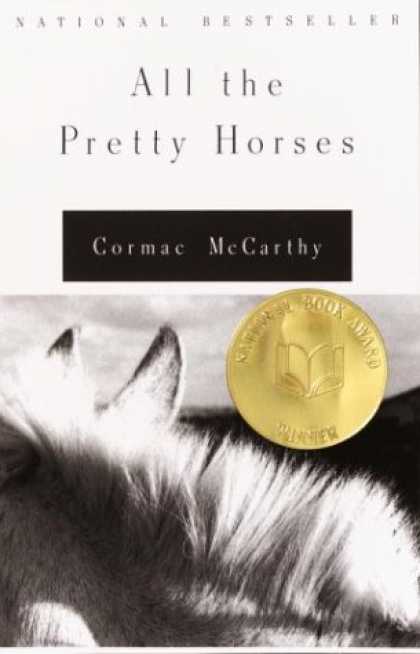
All the Pretty Horses by Cormac McCarthy

All the Pretty Horses is a beautifully written story set at the beginning of the end of two ages – the decline of the cowboy and the end of youth. It is 1949 and John Grady Cole is sixteen, ready to become a man and to put his love of horses to work. To do so, he and his seventeen-year-old friend, Lacey Rawlins, saddle-up and leave their Texas homes behind them in search of ranch work in Mexico. Of course, things aren’t always as simple as we think they should be. It isn’t for these boys either.

Reading the description, I thought this novel was as a bildungsroman, or coming-of-age story, in which the protagonist goes through a tough time to learn valuable lessons which enable him to become an adult. Such stories often include a romantic relationship which helps to achieve this end. But while reading, I felt John Grady was already an adult. This kid knows his mind and how to handle himself. He is already equipped with a trade (braking horses) and is darn good at it. I’m thinking of Dickens’ Great Expectations, often considered a bildungsroman. Pip goes through much to grow up and I don’t think the pattern is the same for John Grady. John is perhaps reckless but not immature. He falls in love but is not a hopeless romantic like Pip. Having finished reading, I will concede this as a coming-of-age story because John undergoes a shift in the way he understands the world. He acquires a more “grown up” perspective. He always tries to do what he thinks is right but still struggles with his conscience. Finally, John recognizes that not everything in life can be explained and rationalized, that all events in life can’t be nicely wrapped up as we would like. More than the physical events that John experiences, it is this mental growth that signals adulthood. For me, watching how John processed his actions was as motivating to turn pages as reading for the plot.

I am a huge fan of McCarthy’s unconventional writing style. I’m amazed at his command of language and find his writing beautiful and inspiring. This is a text to take your time with, to enjoy the language and visualize what is being described. The descriptions are out of this world if you will allow yourself to sink into the text and not worry about finishing and finding out what happens. This is an “enjoy the journey” book and is not about getting to the end but appreciating the steps that lead to it. I realized on page one that I would have to slow down. I’m glad I did. Here’s an example of a description:

Shrouded in the black thunderheads the distant lightning glowed mutely like welding seen through foundry smoke. As if repairs were under way at some flawed place in the iron dark of the world. (McCarthy 67)

Wow, I just love that. I had to read it four times, once out loud to my husband, and we gushed about it (much like I’m doing now). It just so happens to be storming outside right now, too, and that’s just how the lightning is. On another note, I enjoyed the Spanish mingled throughout the text and was surprised at how much I remembered from class. But if you don’t know Spanish don’t worry as the text is 98% English.


Every time I opened this novel, I felt completely transported to the West. It was like I was hanging in the clouds watching John Grady ride his horse. I think that’s why I enjoyed this book so much. This is book one of the “Border Trilogy” but All the Pretty Horses stands well on its own. If I didn’t know there were more books I would have thought it was a standalone novel. Book two will be in my reading list for the future.
Publisher: Vintage, 1993     Source: IC Public Library
Rating: 4 Stars                       Pages: 301