Showing posts with label Children's fiction. Show all posts

Monday, December 30, 2013

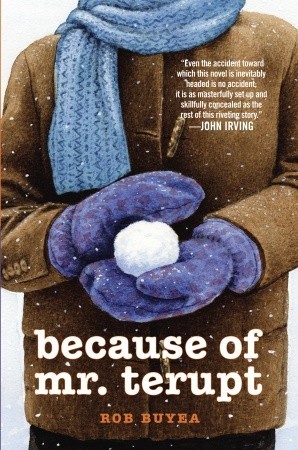
Review: Becuase of Mr. Terupt by Rob Buyea

Mr. Terupt is the teacher we all wish we had. For some, he’s that teacher who touched the lives of students and changed them forever. The narrative alternates between Mr. Terupt’s seven 5th grade students. Each voice adds a unique perspective on what it means to be a student, on making and keepings friends, and how to forgive.

When disaster strikes midway through the year, the students are pushed to the emotional edge. They are hard pressed to put all of Mr. Terupt’s teachings into action when life crashes down on them.

Buyea’s writing captures the student’s voices exceptionally well. Tweens will no doubt identify with one or more of the characters. Readers are given the chance to see one disastrous event through the eyes of many. Empathy is evoked as we see how one person’s perception of events can be vastly different from another’s but they are all affected. Though the story became a bit slow, there is a lot worth discussing with a group of tweens. From grief and guilt to isolation and hope, Buyea offers a lot of thinking matter in this thoughtful novel.

Publisher: Delacorte, 2010     Pages: 288  
Rating: 3 Stars     Source: Public Library

Friday, December 27, 2013

Review: The Mouse with the Question Mark Tail by Richard Peck

Mice make such endearing characters. Jack and Gus from Cinderella, Mickey Mouse, Despereaux from DiCamillo’s book. And now, enter “Mouse Minor,” a mouse with unknown origins and an affection for alliteration.

Set during Queen Victoria’s reign, Mouse Minor (lineage: unclear; stature: decidedly small) sets off on an adventure spanning the the grounds, outbuildings and buildings proper of Buckingham Palace to seek his place in life. He overcomes fears and perseveres when answers are not quickly revealed. A large cast of delightful animals helps Mouse Minor find his way. If you know a child who enjoys adventure stories with more daring than danger, more thrills and less chills, this tender-hearted read may be what you need.

Richard Peck is an established children’s author with awards under his belt. He does not disappoint with The Mouse with the Question Mark Tail. I picked this story up on a whim, looking for something a little different to read, and was not disappointed. I may have even teared up once or twice… those mice. Small characters with big things to prove! They get to me every time!

Publisher: Dial, 2013     Pages: 224
Rating: 4 Stars     Source: Public Library

Friday, July 13, 2012

Owly: The Way Home and the Bittersweet Return by Andy Runton

Owly is a popular graphic novel at my library. I had to place a hold on it and I took that as a good sign, that kids must really like this book. I was not disappointed.

An unlikely friendship forms between an owl and a worm. Together, they search for Wormy's home and parents. In the second adventure, they befriend a pair of hummingbirds. Both stories focus on friendship as they help each other out of tough situations. Owly is particularly sensitive to his friends' needs. It's impossible not to love him.

Owly is nearly wordless but I was impressed with how Runton conveyed conversations and emotions. I "heard" their conversations in my head even though there weren't any words on the page. Instead of text, the speech bubbles hold pictures and other symbols. The artwork is skillful in conveying meaning. The simplest strokes, like the arch of an eyebrow, tell readers if Owly is thinking, scared, happy, etc. So, while there isn't much traditional text, I found I was scrutinizing the pictures and reading everything -- expressions, gestures, background and the "speech" bubbles. I'm not used to paying so much attention to the pictures but I really enjoyed doing so with Owly.

Owly is a great book to read with a young child to ask him/her "What's going on in this picture?" or "What are they saying now?" to help encourage a child's narration skills and to draw on their vocabulary to describe what's happening on the page. 

The artwork is as cute as the story. Runton's cartoon-like style and the brief use of text will appeal to reluctant readers and graphic novel readers. An innocent tale of friendship, I thoroughly enjoyed Owly.

Publisher: Top Shelf Productions, 2004.     Pages: 160
Rating: 4 Stars     Source: Public Library

Friday, June 8, 2012

Review: Dead End in Norvelt by Jack Gantos

For a book about a kid being grounded all summer, Dead End in Norvelt by Jack Gantos, is surprisingly touching and funny. Jack Gantos’ character in the book (yes, he writes about himself), while mischievous, maintained an honest voice throughout the novel, enduring him to me, making me laugh.

Jack helps his elderly neighbor, Miss Volker, write obituaries as she is physically incapable of doing so. An unlikely relationship forms between them. Having an older person in a child’s life is such a gift. Though Jack is skeptical of Miss Volker at first, he comes to realize his great fortune at having her for a mentor. Miss Volker shows Jack what he’s truly capable of and what it means to be a friend.  

Somewhat tedious are the history lessons that accompany the obits Jack and Miss Volker write. It wasn’t that the histories weren’t interesting but I wanted to get back to the story and having so many obits written so closely together...it got slow. The history lessons felt like just that -- history lessons. As a kid, I probably wouldn’t have finished the book because of these history bits.

As an adult, I forged through the histories and was rewarded with a satisfying if somewhat far-fetched ending. I enjoyed the caught-in-the-middle relationship Jack has with his parents. He can’t please one without getting in serious trouble with the other. One sympathizes. The town's citizens were colorful and Jack's interactions with them humorous. I laughed out loud several times and recommend this book be read aloud (as it was to me to my great enjoyment).

Publisher: Farrar, Straus and Giroux, 2011     Pages: 352
Rating: 4 Stars     Source: Public Library

Wednesday, May 30, 2012

Review: Toning the Sweep by Angela Johnson

I am surprised I liked this book. Toning the Sweep is a non-plot driven story. Not a whole lot happens. It focuses more on character development and relationships than the rising action/climax/ resolution of a traditional story arch. Yet, I loved the characters. They felt real. Johnson presents common ground between reader and character which made it easy to empathize which, in my opinion, is one of the most important reasons to read -- to learn about people and see ourselves in their shoes for a moment.

Emmie has always enjoyed visiting her grandmother Ola in the California desert. But, when Emmie and her mother visit Ola now, they know it is for the last time. Ola has cancer and they have come to pack Ola's things and say goodbye. It is a soul-searching experience for Emmie (14) who strives to understand her care-free grandmother and her care-worn mother.

What could have been a sad and depressing story turned out to be an uplifting read. Reading Toning the Sweep felt like watching an incredibly pivotal moment in a family's life on T.V. -- like I was given an insightful snapshot. Emmie documents her grandma's life with a video camera and so the reader sees much of the story through Emmie's camera lens -- a perspective that I enjoyed and worked well in revealing Emmie's concerns.

Ola is a great character. Her eccentric behavior is a testament to her independent spirit but also her flawed character. Has Ola run away to the desert to hide from the past? Her strength carved out a great life there but at a cost to her daughter's well being. Emmie pieces these things together, uncovering more about her mother and grandmother's relationship, as she helps pack Ola's household, sorting the "keep", "donate" and "throw aways" of a lifetime.

David is Emmie's friend who she sees when visiting Ola. One of the few males in the story, David's character is important. He is exploring his Native American past, embracing it as a part of who he is, and helps Emmie think about her African American heritage.

No character in this story is superfluous. Each character adds something important in showing Emmie who her family is and who she is. For a little book, Toning the Sweep packs a big punch. It is a touching story about how life's tragedies effect people so deeply and how people can touch others deeply as well. It is about family and about inter-generational relationships between women. Johnson's writing blended metaphor and symbolism seamlessly, enhancing but never detracting from the story. This book counts towards the POC Reading Challenge!

Publisher: Scholastic, 1994     Pages: 112
Rating: 4 Stars     Source: borrowed from my teacher     

Thursday, March 29, 2012

Review: Moon Over Manifest by Clare Vanderpool


Stories. Every day we tell each other stories. We read them, listen to them and share them with others. Stories take many forms: people “catching up,” movies and T.V. shows, music, video games, dirty footprints in the house and, of course, books. Rich in its layers, Moon Over Manifest shows how we are our histories and all our stories are connected.

Can you ever really understand a person or even a place until you know its story?

Abilene and her father, Gideon,  lived the life of hobos, hopping on and off trains until he found work. But now Abilene is too old to be drifting. So, Gideon sends Abilene to stay in Manifest, Kansas with people he knew long ago...

Abilene is looking for stories: a hidden box, with letters and trinkets, reveals a story central to who the townspeople of Manifest are; the story of the Ratler, an unknown townsperson acting as a spy, that Abilene and her friends try to reveal; Miss Sadie the diviner has stories to tell if only someone will listen. Abilene knows these stories are important but the story she most wants to hear is the story of her father who once lived in Manifest. What kind of person is her father? Why did he send her away to live with strangers? Is he coming back for her?

Moon Over Manifest reminds me of the movie Fried Green Tomatos (one of my all-time favorites) in a couple ways. Like the movie, the story is set in the Depression Area. Moon Over Manifest also shifts between the past (in the letters and through Miss Sadie’s stories) and the present as (Abilene narrates her experience in Manifest). The flashbacks take us to the town of Manifest during World War One while Abilene’s story takes place in Manifest during the 1930s. This switching technique worked well and I loved the flashbacks.

Stories are central to the human experience. We can’t always remember raw facts and data. But we can remember stories. They evoke emotion, sympathy and empathy. Stories explain the facts and help us make sense of them. Stories help us remember and help us share memories. Remember when dad did.... Remember when your sister... We’ve all heard stories like these, haven’t we? Stories bind us together and so we tell them over and over.

Stories connect people and I think that’s what Moon Over Manifest shows. No matter how different the townspeople are, no matter their country of origin, their wealth or social class, age or gender, everyone's stories are connected.

While marketed as a children’s book, Moon Over Manifest is nuanced and Vanderpool is an excellent writer. The prose is enjoyable as are the many characters. Adults as well as children will appreciate this work. I highly recommend it!

Publisher: Yearling, 2011 (paperback copy)     Pages: 351
Rating: 5 Stars     Source: purchased copy
Sunday, March 25, 2012

Review: The Firefly Letters by Margarita Engle

Set in Cuba, The Firefly Letters weaves together four voices: Fredrika the foreign traveler, Cecilia the wealthy daughter of the house, Elana the slave girl and Beni, Elana’s husband. It is interesting to watch the dynamics of power between characters and the social structures of Cuba. Those we assume have power are often powerless in certain situations. All the voices represent someone who is or has been enslaved. The idea of freedom is explored. Elana remarks that she is jealous of Elana, a slave, because Elana is free to explore the countryside with Fredrika while she, Cecilia, is not allowed to venture out. Yet, Elana is forced to labor when and where her master commands. The story ends with a struggle wherein the characters work together to find their own freedom.

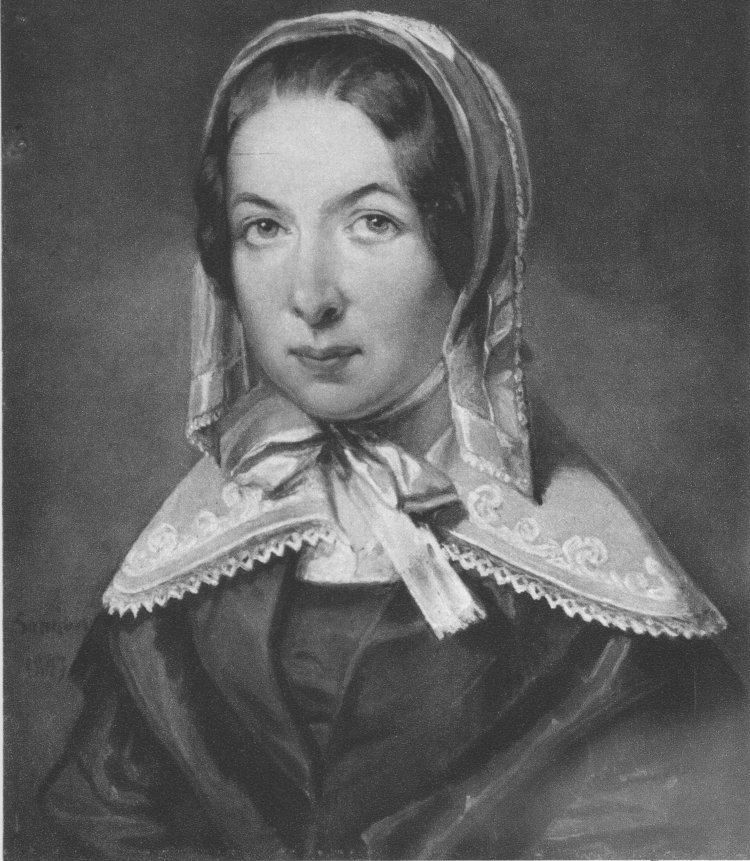
Fredrika Bremer was a Swedish writer and feminist who visited Cuba in 1851. As part of the aristocracy, her position was a privileged one though not necessarily a happy one as she was often forced to stay indoors and deliberately malnourished to have a “feminine” ballerina-like form. Groomed to be a wife for the aristocracy, Bremer never married but filled her life by writing, traveling and working to help the less fortunate.

As a piece of historical fiction, The Firefly Letters shines. But like fireflies, the illumination is brief as this is a short novel in verse. I found the story interesting but would have liked a longer narrative with a chance for deeper character development. I felt Cecilia's transformation was quick and so rather unlikely. However, the four voices offer distinct and insightful perspectives on freedom and Engle captures Cuba’s landscape to great effect. The Firefly Letters won the Pura Belpré Honor in 2011. This book counts towards the POC Reading Challenge!

Publisher: Henry Holt, 2010     Pages: 160     Full Title: The Firefly Letters: A Suffragette's Journey to Cuba     Rating: 3 Stars     Source: Public Library

Saturday, March 10, 2012

Review: Glory Be by Augusta Scattergood

It's the summer of 1964 in Hanging Moss, Mississippi and things are a changin'.

Town Council Man, James Smith, is against desegregation. So, he shuts down the community pool “for repairs.”

Glory’s birthday is the Fourth of July and she’s always had her party at the community pool...until this year. She unknowingly enters the fray as she outspokenly denounces the decision to close the pool.

Laura Lampert’s a Yankee whose mother is starting a freedom clinic in Hanging Moss. Friends are few for a white girl who drinks from the “coloreds only” drinking fountain.

Frankie Smith is caught between his family’s hatred and his friends’ readiness for change. Bullied into doing what’s wrong separates Frankie from his friends all summer.

Miss Bloom, Hanging Moss Librarian, refuses to be bullied and invites the entire town, black and white, to a celebration at the library. 

Emma is more than Glory’s family’s maid. She’s a “freedom fighter” who shelters activists at her home and bravely attends the library’s celebration as one of the few African Americans who do. 

Glory Be has be likened to The Help and I think it’s a good analogy though the two are different in presentation. In The Help, readers see events through many characters’ eyes with each chapter presenting a different character’s point of view. In Glory Be it is Glory’s voice that is the strongest and the book is written from her point of view. The strength in Glory’s point of view is that readers get a distinct feel for what is was like for a white child to participate in the Civil Rights Movement in the South. The other characters are shown how a child would understand them. Adults’ actions are often confusing to Glory and in her innocence she attempts to set them straight. Slowly, Glory begins to understand the implications of what’s going on around her. 

The story goes beyond the Civil Rights Movement and explores a young girl growing up. The relationship between Glory and her teenage sister, Jesslyn, is in flux and I enjoyed watching that relationship change. Their father is a reverend who is somewhat distant as he deals with professional duties. Emma is a stand-in mother to the girls but not there all day. Glory has learned to turn to her sister for support and friendship but now her sister is distancing herself from Glory, desiring more privacy and "grown-up" activities. 

Change is hard -- even good change. Glory Be was an enjoyable story about friendship and family during the Civil Rights Movement. Though I wished Emma’s voice had been louder this is ultimately a story about a white child’s experience and perspective and one well worth reading. This book counts towards the POC Reading Challenge!

Publisher: Scholastic Press, 2012     Pages: 202
Rating: 4 Stars     Source: Free Uncorrected Proof  (paperback)

Tuesday, March 6, 2012

Review: Mockingbird by Kathryn Erskine

I am going to exercise my freedom of speech and declare I did not like this novel. Largely, this is due to personal taste which I will attempt to explain. I feel like this is a book people feel inclined to praise and disinclined to criticize because of it’s subject matter and seal of approval from the National Book Foundation. However, I am at a loss to understand why this book won the National Book Award (2010). I mean no disrespect to the author whose intentions with the book are clearly and admirably stated in the author's note. I just didn't like her book and this is, as always, my honest and subjective opinion.

While looking at the National Book Award’s description page it is incredibly vague as to guidelines for choosing finalists and winners: “They [the judges] may arrive at these choices using whatever criteria they deem appropriate, as long as they do not conflict with the official Award guidelines.” Those guidelines being that the book is by an American author and that the entrance fee was paid. Yet, the award is known for choosing “high” literature which brings into question the criteria for being literature. That may be another discussion but it’s unavoidable for me when thinking about MockingbirdDoes a book's well-timed and admirable theme determine if it's literature? I should hope it is only one factor among many equally important factors. 

For me, the dominant theme was Caitlyn’s Asberger’s Syndrome and it’s sub theme, school violence (a shooting). It was all too much. A school shooting which killed the sibling of young child with Asperger’s who is already motherless with a father lost in grief required too much willful suspension of disbelief for me. This is realistic fiction and I wanted more realism. I felt Erskine wanted to cover too many big and specific subjects and did the sub themes little justice. 

The prose, the first person narrative, was at times plain and at others too forceful. I never felt moved only informed. I want literature to move me. And not just (attempt) to move me to tears. The text felt self-conscious. I felt Erskine’s intense and anxious desire to be respectful and literary (so many motifs beating me over the head) was thrust at me. I felt manipulated as a reader and that made me resistant to the novel. I felt blatantly asked to feel something that the novel could not naturally draw out.

I appreciate what the novel attempts to do especially in regards to raising children’s awareness (and adults’) to the complexities of Asperger’s Syndrome. I feel if Erskine would have kept to this one subject and left the school shooting and motherlessness out of the picture (and saved for other books) this book would have worked better. There needed to be a better balance of theme, plot and prose. I hope the panel that chose this book as the award winner at least had a lengthy debate over it. It’s too bad the public isn't privy to that conversation. I truly feel that the choice of theme is what made this book win the medal. It's a popular medical topic and little addressed in children's literature. I am of the firm opinion, however, that choice of a popular serious subject matter or new subject matter should not carry so much weight when awarding prizes. 

Mockingbird is bold in its scope and gravity of its subjects. It has been well received and praised, loved by many, and I am happy for those who've had a great reading experience. I just did not. Tell me, have you ever found yourself resistant to a novel? A time when you knew a book wanted a certain response from you as a reader that you just couldn't muster?

Publisher: Philomel Books/Penguin, 2010.     Pages: 235
Rating: 2 Stars     Source: Public Library

Thursday, February 9, 2012

Review: Inside Out and Back Again by Thanhha Lai

Ha is ten when war comes to her home. She and her family leave Saigon on the last ship fleeing the city. Even after they land in the U.S. Ha, her  mother and brothers still feel adrift in a new and often hostile culture.

Inside Out and Back Again addresses war (in Vietnam), immigration, racism, bullying and family with simple verse. In each poem, Ha tells about her day, what went wrong and what went right. She talks about what it's like to learn a new language and what it's like to leave one's home not by choice but by necessity.

One feature that stood out for me was how simple cultural misunderstandings were dealt with by various characters. Some were willing to laugh and learn together while other characters let prejudice fuel cruel actions and prevent learning. Another interesting character interaction (or lack thereof) was between Ha and her teacher who seemed completely unequipped and uninterested in learning about Ha's situation and how best to help her feel comfortable and to learn.

Lai's book of free verse is told narratively, like a story, from Ha's perspective. So, don't let the poetry factor get in your way of reading this significant story which, Lai tells us at the end, is partially based off her personal experience. I tend to be critical of issue-oriented fiction and Inside and Back Again certainly is such a book; yet, I enjoyed it for it's rich description of setting and emotion and for the plain fact that it had a good story to tell. This book counts towards the POC Reading Challenge!


The above video is Lai reading her book. My favorite poem begins at 2:53!

Publisher: Scholastic, 2012     Pages: approximately 200
Rating: 4 Stars     Source: borrowed from my teacher =)

Sunday, February 5, 2012

Review: Just Juice by Karen Hesse


Juice is nine, the middle child in a family with five girls. Times are tough. Pa is out of work. Ma is pregnant. And Juice struggles to hide the fact that she can’t read. When Pa receives a letter announcing their home has been sold for back taxes Juice devises a plan to pay the taxes and keep their home.

This is a story about learning to read. Neither Pa nor Juice can read and it affects the entire family. Juice tries to hide her inability by keeping away from school and “pretend” reading to her younger siblings. Juice is a smart girl, resourceful, proactive and hardworking; yet, this one thing, her struggle with reading, dominates her life.

Little cues tell the reader that Juice is dyslexic which may need to be pointed out and discussed with young readers. When Juice’s sisters make flashcards with letters made of string Juice is able to touch the letters, to feel them, and a breakthrough is made.

This is a story about poverty. Pa and Juice work hard in their shop but sometimes there isn’t any work to be done. A social worker comes to the house to check on Ma and the baby and to bring food.

There is a lot going on in this story. Mini-spoiler alert: Juice even delivers a baby. Juice is lovable and her iron will to succeed kept my interest. But I could have done with more comic relief, fewer issues (for such a short book), and a more complicated ending than the one we’re given.

Published: Scholastic, 1998     Pages: 138
Rating: 3 Stars     Source: purchased copy

Thursday, January 26, 2012

Review: The Mostly True Story of Jack by Kelly Barnhill


“When Jack is sent to Hazelwood, Iowa, to live with his strange aunt and uncle, he expects a summer of boredom. Little does he know that the people of Hazelwood have been waiting for him for a long time...” - from inside the jacket.

Jack is invisible. At least he feels that way. His parents sometimes act like they can’t remember he even exists and then they dump his at his aunt’s. What’s a twelve-year-old to do?

Jack does not believe in fairy tales. But strange happenings force him to reconsider who he is and what he’s capable of.

I loved Barnhill’s writing for two reasons. First, as a native Iowan I know she’s spent time here, listening to the corn grow and cicadas chirping at night, because it’s reflected in her writing. Iowa isn’t flashy -- there aren’t any mountains or big cities -- but it has a quiet beauty which Jack discovers as he investigates the mysteries written in The Secret History of Hazelwood, written by his uncle. Secondly, Barnhill captures the essence of otherness in her writing which makes for good fantasy. I love writing that creates a mysterious atmosphere by leaving room for the imagination.  It makes you go, whoa, what in the world?

There is resolution in the ending but not a “happy ending” in a traditional sense. I found it very satisfying and think children readers will, too. Jack must make a difficult choice and any decision will have its consequences for him and those he cares about. This book shows how the world is not black and white, that good and evil are more complicated concepts than we wish they were. It’s unusual to find a children’s book that is willing to show this. I felt Barnhill’s representation of the ideas of good and evil, sacrifice, bullying and true friendship were masterful. The characters were great though there may have been one too many. That’s my only “complaint.” I loved the bodyguard cats, Gog and Magog. Hysterical! I can’t wait to see what Barnhill writes next!

Publisher: Little Brown, 2011 Pages: 323
Rating: 4.5 Stars Source: Public Library

Tuesday, January 10, 2012

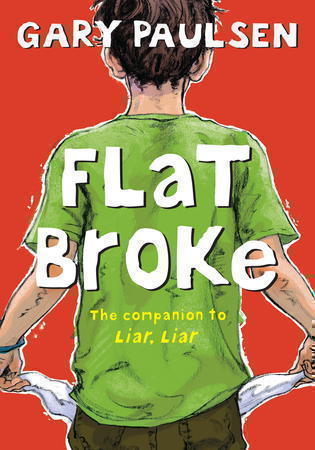
Review: Flat Broke by Gary Paulsen


Kevin is becoming one of my favorite characters. He’s such a …. character! Always scheming someway to get things done, he’s a path-of-least-resistance kind of teen who acts before thinking things through.

In Flat Broke, Kevin needs to make quick cash to take his crush to a dance. Due to his previous shenanigans (in Liar, Liar), Kevin’s allowance has been taken away, his aunt won’t hire him anymore and his babysitting gig isn’t paying like it used to. Kevin, crafty and undaunted, finds creative ways to make a fast buck. But like most get rich quick schemes, Kevin’s plans don’t work out as he hoped.

I laughed a lot while reading. Below are some quotes to demonstrate the humor that any attempt by me to analyze will surely ruin. I’ve added who is speaking for clarification. 

Kevin: I don’t want a ride.
Sister: What do you want?
Kevin: Money
Sister: How much? And Why? And you know I don’t just give money away for nothing. There’s a vig.
     I raised my eyebrows, glad that one of the books I’d read had been written by a guy in the witness protection program, explaining his former career as a loan shark. I knew that a vig was the interest due on money borrowed. My sister is a dark and mysterious person. More likely, she read the same book in our basement. I was starting to like her more and more. (Paulsen 20).

Kevin: Auntie Buzz.
     She looked up from her desk, started to smile, remembered she was still mad about the way I’d lied to her, and scowled.
Kevin: I’m here to make you an offer, I said 
Aunt: I have an MBA, I’m wired on too much caffeine and I have a grudge against you. You think you have what it takes to do business with me?
Kevin: Yup.
Aunt: I’m a sucker for self-confidence. State your case. (Paulsen 22)

Despite the fact that all my ideas turned into poo on a stick, everyone around me farts gold dust these days. (Paulsen 115)


I hope Paulsen writes more about Kevin! If you're looking for a good middle grade book that's funny look no further!

Publisher: Wendy Lamb Books (Random House), 2011     Pages: 118
Rating: 5 Stars     Source: Public Library

Tuesday, October 25, 2011

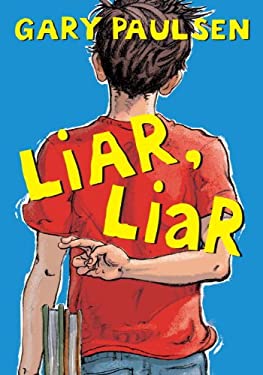
Review: Liar, Liar by Gary Paulsen


A while back I was perusing the children’s new shelf at my library and looking for slim books that might catch my eye. With its catchy title and fun cover, Liar, Liar looked promising. I read the blurb and it sounded amusing. So, I was shocked, just shocked, when I saw who the author was – Gary Paulsen. Gary Paulsen? He does humor? Ok, so, my only other experience with Gary Paulsen was the Newbery Honor book Hatchet which I found a tad dull and boring (how a survival tale can be dull and boring is beyond me). And while some say that Hatchet was a favorite when they were young I simply don’t see it…

Anyways, so I was amazed by how much I liked Liar, Liar. I mean, I read it straight through (which, despite its being a short book is still a big deal for me). And I laughed frequently and uproariously.

It’s about this eighth grader, Kevin, who attempts to get in good with a crush by telling a massive amount of lies. Of course, the lies come back to bite him in the butt. Kevin’s first person point of view, with his rationales for lying, are hilarious, and while obviously these rationales are flawed on many levels they are oddly a little truth revealing, too. I enjoyed the sibling rivalry between Kevin and his older brother and sister and Kevin’s devious ways of getting back at them. It sounded real to me. Really scary and really funny and true.

For fans of the Diary of a Wimpy Kid books who have grown a bit and are ready for something new (without pictures and daily entries) Liar, Liar is a good choice. There’s a sequel, Flat Broke, and I’m definitely going to read it! Gary Paulsen – who knew? I'm still stunned.

Publisher: Wendy Lamb Books (Random House), 2011     Pages: 120
Full Title: Liar, liar : the theory, practice, and destructive properties of deception
Rating: 4.5 Stars     Source: Public Library     

Friday, August 5, 2011

Review: Latasha and the Little Red Tornado by Michael Scotto

When I opened the package that Latasha came in I was surprised. The cover was so cute, the colors vibrant! This is a good sign, I thought. When I accept a book for review by an unknown author and press it creates a bit of suspense and anxiety. I never know what to expect.

I began reading. Eight year old Latasha has a crazy dog and she believes that if she can train her dog it will prove she's mature and grown up. Her mom gets a great new job as a nurse's assistant but it means Latasha has less time to spend training her dog and she must be babysat by a strange old neighbor lady, Mrs. Okocho -- the horror! I wavered in the first short chapter. I don't about this. Is this going to be a cliche ridden story?

As the story began to flow I was sucked into Latasha's world. Her cares and concerns were so real. The text made me remember both the easy delights and frustrations of being eight. Latasha is an endearing character who learns about the weight of responsibility and how to make and keep friends. I appreciated that the neighbor lady was a well-rounded character who was not just a "prop" but a real character with depth. Ella, the dog, offered comic relief as she tested Latasha's resolve to train her.

While the text may have special appeal for city kids (Latasha lives in Pittsburgh) or dog lovers I think this is a good book for late elementary and early middle school readers. Latasha and the Little Red Tornado was a delight. I read it in one sitting. When I closed the book, with a few tears in my eyes, I thought, What a good story. This text counts towards to the POC Reading Challenge!

Publisher: Midlandia, 2011 (Book released November 15th, 2011)     Pages: 141     Illustrator: Evette Gabriel
Rating: 4 Stars     Source: Received for free for review from the author. Thanks, Mr. Scotto!

Tuesday, August 2, 2011

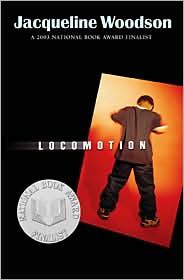
Review: Locomotion by Jacqueline Woodson

After Lonnie's parents died he and his sister live in separate foster homes. Lonnie uses writing assignments in school to cope. The result is a short novel in verse -- a book of poems that tells a story. Lonnie deals with some heavy stuff for an eleven year old. Grief, loss, separation, loneliness and uncertainty are a few of the themes. But Lonnie also talks of hope and his affection for his sister.

The poems are short, ranging from three lines to a little over a page. From free verse to Haiku there is a variety of poetry Lonnie experiments with to express what he sees, feels and remembers. Locomotion would make great teaching material to use as examples of poetry. The book may also appeal to elementary kids who are ready to move beyond strictly rhyming and silly poems (not that there anything wrong with silly rhyming poems!).

From my perspective, Locomotion was a little sad and ended abruptly. There is a follow up novel called Peace Locomotion in which Lonnie writes letters to his sister. For such a short book it took me a long time to read. The text was often introspective. I don't think I was in the mood for it. Yet, I would recommend this text to kids interested in poetry or for someone looking for a book about grieving. This text counts towards to the POC Reading Challenge

Publisher: Speak, 2003     Pages: 100
Rating: 3 Stars     Source: Public Library

Tuesday, June 28, 2011

Review: Zan-Gah by Allan Richard Shickman

Zan-Gah is eager to become a man but his journey towards adulthood is perilous. The story opens with an exciting lion hunt which captured my attention right away. Later we learn that Zan’s twin brother, Dael, is missing and Zan-Gah is determined to find and bring Dael home. Like most quest stories the object sought is less important than journey. Zan’s travels test his strength and wisdom as he crosses the borders of hostile clans and landscapes.

The novel left me wanting more. I enjoyed the descriptions of the landscape and liked watching Zan survive harsh environments. Yet I wanted even more description. Sometimes I felt the plot moved too quickly, skimming over things I wanted to know more about, like Zan’s time with the Wasp people where he spends a year which is briefly mentioned in one sentence. Shickman’s writing was clear and never confused me. The tenor of the prose gave me the feeling that the story is very old which is fitting since the subtitle is A Prehistoric Adventure. Yet the simplicity of the prose, and its many well-used figures of speech, again left me wanting more.

The story has a lot of action and brief but strong violence which kept my attention. It also has some great themes like learning to forgive and asking for help. I was a little surprised at the ending. Shickman chose to end the novel talking about Dael, and not the hero Zan-Gah. I found this a bit anti-climactic. Though he fit into the storyline, Dael was a bit of a downer character and since it’s not a story about Dael I was confused why it ended talking about him. There is a sequel, Zan-Gah and The Beautiful Country which I suspect will fill in some of the blanks and looks like it will continue the twins’ story.

While reading, I kept thinking about Gary Paulsen’s Hatchet. Personally, I enjoyed Zan-Gah more than Hatchet but they are very similar in that a boy is on his own surviving in the wilderness for a good part of the story. I would recommend Zan-Gah to middle school boys who enjoy survival stories. This text counts towards the PoC Reading Challenge!

Publisher: Earthshaker Books, 2007     Pages: 148
Rating: 3 Stars     Source: Received for free from the publisher. Thanks, Earthshaker!

Sunday, June 26, 2011

Review: The House of the Scorpion by Nancy Farmer

On the bottom of Matt’s foot a tattoo states: “Property of the Alacrán Estate.” He is a clone, an exact replica of a powerful drug lord, El Patrón, who rules Opium, a small country between the U.S. and what was once Mexico. While El Patrón dotes on Matt, the rest of the Alacrán family is openly hostile save for one girl, Maria. Everyone seems to know something Matt does not. Who can he trust when everyone seems to be hiding something?

The story is constantly changing direction. As Matt grows up, and his understanding of his situation becomes less fuzzy, his circumstances change – sometimes for better and sometimes for worse. Farmer takes her time developing Matt’s character. The chapters are grouped into sections which divide Matt’s life into ages: 0-6, 7-11 and so on. I found Matt’s story gripping, especially the last half. I was reading while riding the bus and I didn’t notice the bus come to stop. I didn’t see everyone get off. Nor did I hear the driver twice tell me the bus was out of service and I needed to get off. (Yeah, I felt a little silly.) That’s how engrossing the story was.

It was exciting and bit scary watching Matt figure out answers to his questions and unearth the dark secrets of El Patrón. Each new chapter of his life required Matt to adapt in order to survive in Farmer’s world. It is an intriguing world with a bizarre political structure, a dangerous drug lord, a psycho family and a resilient protagonist. If you know a middle school or high school reader who enjoys thoughtful science fiction then make sure to recommend The House of the Scorpion.

Publisher: Simon Pulse, 2004     Pages: 380
Rating: 4 Stars     Source: Public Library

Wednesday, June 22, 2011

Review: Princess Academy by Shannon Hale


Hale's writing is heavy with simple but lovely metaphors. She transports the reader to Miri's village where the mountain dominates their lives until the Princess Academy alters them forever. It wasn't until about half way through the book that I really got into it. I was reading on the bus and had a hard time keeping back tears. Miri's fear of being useless because of her small size was so sad and sweet. I enjoyed watching Miri overcome her fears and develop the self-confidence she needed to help the village and other girls at the academy. If you're looking for a sweet, gentle read with a bit of suspense then Princess Academy may be what you're looking for. This is definitely a girly read great for elementary and early middle school readers.

Publisher: Bloomsbury, 2007     Pages: 336
Rating: 4 Stars     Source: Public Library

Summary: "Miri lives on a mountain where, for generations, her ancestors have quarried stone and lived a simple life. Then word comes that the king's priests have divined her small village the home of the future princess. In a year's time, the prince himself will come and choose his bride from among the girls of the village. The king's ministers set up an academy on the mountain, and every teenage girl must attend and learn how to become a princess. Miri soon finds herself confronted with a harsh academy mistress, bitter competition among the girls, and her own conflicting desires to be chosen and win the heart of her childhood best friend. But when bandits seek out the academy to kidnap the future princess, Miri must rally the girls together and use a power unique to the mountain dwellers to save herself and her classmates."

Monday, June 13, 2011

Review: Harry Potter and the Sorcerer's Stone by J. K. Rowling

Finally, I've read Harry Potter! Wow, what great characters! I loved Hagrid, the giant "gamekeeper," who befriends Harry and sees him through his first year at the wizards' school, Hogwarts. Harry's story as "the boy who lived" is so endearing yet sometimes I found him dry... that is, until he meets Ron and Hermione and they get into some close calls while tracking mysterious happenings at the school. Need a plot summery? Click here.

The interactions between characters felt so real and there was some great dialogue. Despite the fact that they have magical abilities, it felt like I was reading about otherwise normal kids who worry about wearing hand-me-downs and meeting expectations. The professors were equally as interesting. I liked never knowing what to think about professor Snape - is he good, bad? Don't tell me! I want to read the books without spoilers!

The Hogwarts world is very creative with it's own candy, newspaper and sport, quidditch. Reading about the quidditch tournaments was a little boring for me but they worked into the plot of the story so well that I was soon happily reading again. I enjoyed the academic environment of Hogwarts and got a chuckle out of the library scenes with magical books and a very old-fashioned librarian guarding them.

There were a few dark moments (that unicorn scene, ick!) but that's the nature of fantasy. In order to have an epic tale of good vs. evil there must be dark moments. I didn't find the dark parts too overwhelming for young readers.

I'm glad I made time for Harry Potter. I'll slowly make my way through the series. Has anyone listened to them on CD? Are they any good?

Publisher: Scholastic, 2008     Pages: 330
Stars: 4                                          Source: Public Library