Tony was raised to be a doctor. His parents would except nothing less. Growing up as one of two Asian-American kids in a small town wasn't easy. Neither was medical school. In Stitches is a lighthearted memoir about Tony's progression from awkward child to confident doctor.
The first of five parts covers Youn's premed years: birth-college. He recounts many failed attempts at gaining a girlfriend. The rejections begin piling up. Like most kids, he struggles with his looks and as his jaw juts out it sabotages his lustful ambitions. The text focuses on his attempts to score and until he finds a steady girlfriend the story is more about chasing skirts than becoming a doctor. About a third of the way through, once Youn finds said girl, the text focused much more on his medical school days which was what kept my attention. For all the emphasis on finding a girlfriend I would have liked a bit more about their relationship. We really don't know anything about her.
Things get dicey and interesting in part 4, "Third Year," where Youn recounts the "highlights" of clinical rotations. He encounters interns from hell, detached cool-as-a-cucumber doctors, horrible trauma and quirky surgeons. Tony is drawn to plastic surgery and ends his last year in school working with plastic surgeons around the country.
Youn tells the story as one looking back, who's breathed a sigh of relief that those grueling years of med school are behind him. One can only imagine what a current medical student might write -- a whoa-is-me type of journal. But Youn's memoir is light and funny. This text counts towards to the POC Reading Challenge!
Publisher: Gallery Books, 2011 Pages: 271 Written with Alan Eisenstock
Rating: 3.5 Stars Source: Won from Crazy-for-Books. Thanks, Jen!
Showing posts with label College. Show all posts
Wednesday, July 27, 2011
Thursday, September 23, 2010
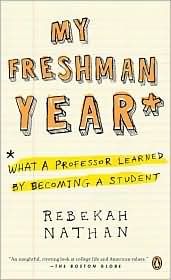
Review: What a Professor Learned By Becoming a Student by Rebekah Nathan
As someone who’s had a wide range of experiences with different educational institutions (see my about me page), I find this memoir/study to be perceptive and reflective of my undergraduate experience. My non-traditional background left me feeling like an “outsider” to mainstream American college culture and I could identify with several of Nathan’s findings of how “outsiders” are perceived and treated. Many of Nathan’s perceptions are, incidentally, not flattering. And I think this is why I’ve read so many upset and negative reviews by college students for this book (which I find unwarranted).
But before I get carried away, here's an abbreviated summary from Shelfari: "After fifteen years of teaching anthropology at a large university, Rebekah Nathan had become baffled by her own students. Their strange behavior—eating meals at their desks, not completing reading assignments, remaining silent through class discussions—made her feel as if she were dealing with a completely foreign culture. So Nathan decided to do what anthropologists do when confused by a different culture: Go live with them. She enrolled as a freshman, moved into the dorm, ate in the dining hall, and took a full load of courses".
First of all, Nathan does not submit this book as “proof” or as a sound study. She recognizes upfront the limitations of her investigations and realizes that in the end, her freshman year was a personal experience that may or may not be indicative of college life across the board. This point is reiterated several times. However, this does not mean Nathan doesn’t make good observations. She shares the view of an outsider looking in. So, if your college prof. assigned this book and you don’t think its “academic” enough, that’s not Nathan’s fault. It’s your prof.’s for assigning it. Something to keep in mind.
So, why should you read this book and who should read it? Anyone interested in educational institutions like college-bound high schoolers, professors (especially those who find themselves dismayed with their students), students, and those interested in cultural studies should read this book because it holds a mirror up to our faces. And sometimes that’s what we need.
This isn’t investigative journalism. Nathan isn’t out to get “the scoop,” nasty secrets or expose outlandish behaviors. We’re all aware of the antics that go on around campus. Rather, it’s a sincere investigation to understand the berth between college students and their professors. It attempts to find out why students act the way they do, how they manage academic demands with cultural and social demands. Nathan has attempted to get inside the freshman mindset. She was often surprised to find herself engaging in behaviors she saw her own students do and wondered why they did. Her freshman experience gave her an appreciation for her students and informed her teaching strategies when she returned to professorhood.
I don’t know how much longer this book will be relevant before it turns into historical data. But for now, it’s still an engaging and worthwhile read.
Publisher: Penguin, 2005 Source: Purchased at a used bookstore
Rating: 4 Stars
But before I get carried away, here's an abbreviated summary from Shelfari: "After fifteen years of teaching anthropology at a large university, Rebekah Nathan had become baffled by her own students. Their strange behavior—eating meals at their desks, not completing reading assignments, remaining silent through class discussions—made her feel as if she were dealing with a completely foreign culture. So Nathan decided to do what anthropologists do when confused by a different culture: Go live with them. She enrolled as a freshman, moved into the dorm, ate in the dining hall, and took a full load of courses".
First of all, Nathan does not submit this book as “proof” or as a sound study. She recognizes upfront the limitations of her investigations and realizes that in the end, her freshman year was a personal experience that may or may not be indicative of college life across the board. This point is reiterated several times. However, this does not mean Nathan doesn’t make good observations. She shares the view of an outsider looking in. So, if your college prof. assigned this book and you don’t think its “academic” enough, that’s not Nathan’s fault. It’s your prof.’s for assigning it. Something to keep in mind.
So, why should you read this book and who should read it? Anyone interested in educational institutions like college-bound high schoolers, professors (especially those who find themselves dismayed with their students), students, and those interested in cultural studies should read this book because it holds a mirror up to our faces. And sometimes that’s what we need.
This isn’t investigative journalism. Nathan isn’t out to get “the scoop,” nasty secrets or expose outlandish behaviors. We’re all aware of the antics that go on around campus. Rather, it’s a sincere investigation to understand the berth between college students and their professors. It attempts to find out why students act the way they do, how they manage academic demands with cultural and social demands. Nathan has attempted to get inside the freshman mindset. She was often surprised to find herself engaging in behaviors she saw her own students do and wondered why they did. Her freshman experience gave her an appreciation for her students and informed her teaching strategies when she returned to professorhood.
I don’t know how much longer this book will be relevant before it turns into historical data. But for now, it’s still an engaging and worthwhile read.
Publisher: Penguin, 2005 Source: Purchased at a used bookstore
Rating: 4 Stars
Subscribe to:
Posts (Atom)